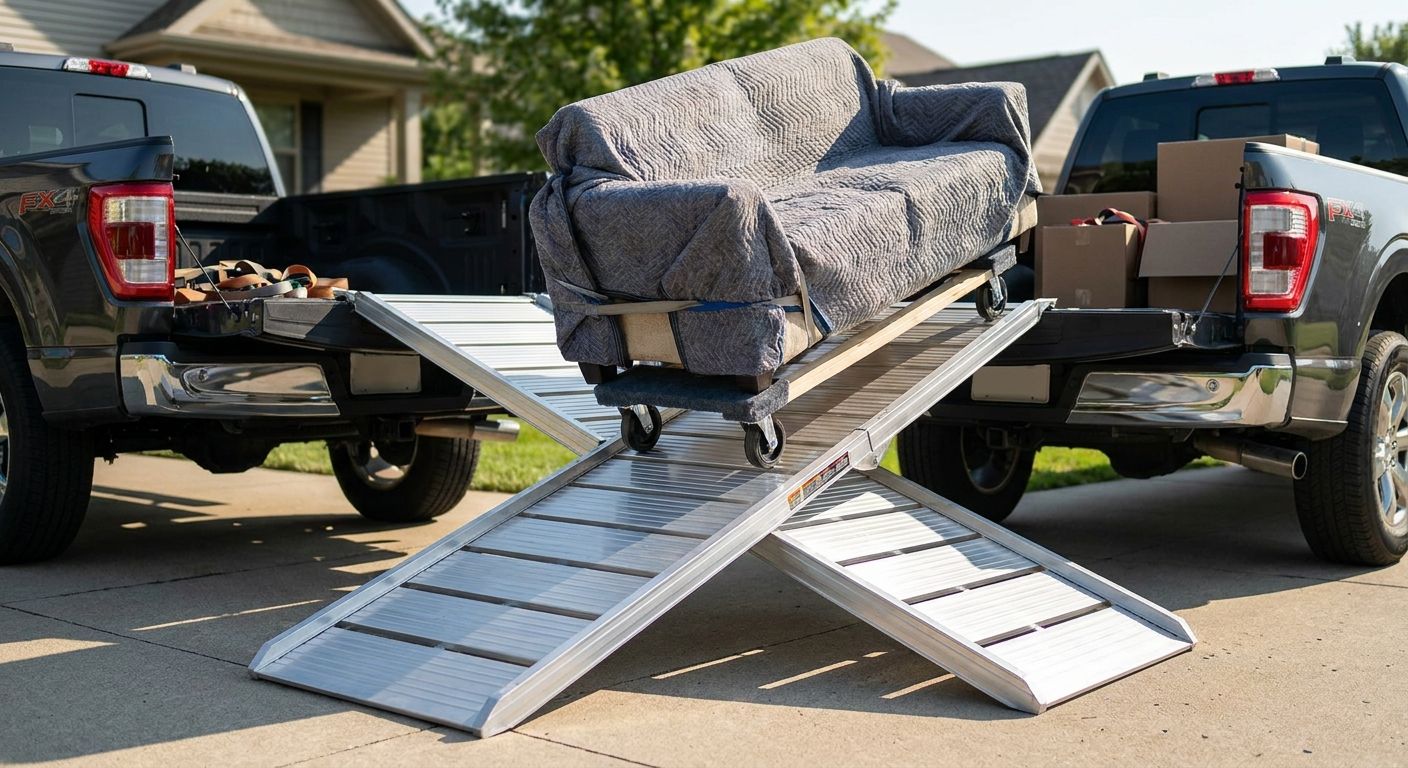
A loading ramp turns a two-person mattress pickup into a one-person job, and picking the wrong one turns a $15 sofa flip into a trip to urgent care. This guide ranks ramp types by weight capacity, incline safety, and how well they hold up under daily furniture-hauling use in 2026.
TL;DR
Independent Sharetown reps picking up returned mattresses, dressers, and treadmills from retailers do this loading-and-unloading motion dozens of times a month, not once. A ramp that's undersized or too steep isn't a minor inconvenience on route ten — it's the reason a 220 lb recliner gets away from you on a 25-degree incline.
The math is simple and it's published, not guesswork: a ramp should run about four times the height it's climbing to keep the incline under roughly 15 degrees. Most full-size pickup tailgates sit 32 to 36 inches off the ground, which means a safe ramp for furniture work starts around 10 to 12 feet, not the 5-foot ramp sold for lawn tractors.
Each ramp type below is scored on weight capacity relative to real furniture loads (dressers, sectional pieces, treadmills, mattresses), incline safety at standard tailgate height, and durability under repeated daily loading rather than occasional weekend use. Capacity figures reflect standard published tiers used across the ramp industry in 2026 — 600 lb, 1,000 lb, 1,500 lb, 3,000 lb, and 5,000 lb classes.
Bi-fold aluminum ramps typically carry a 1,500 to 3,000 lb combined rating and fold in half for storage behind a truck seat or in a cargo van. That capacity covers dressers, china cabinets, and even a loaded two-wheel dolly with an appliance strapped to it.
The aluminum build keeps a single ramp light enough for one person to unfold and set against a tailgate without a second set of hands. Pair one with a solid furniture dolly built for one-person resale routes and most retailer-return furniture moves alone.
Verdict: Buy.
Arched ramps use a flat center bridge instead of a straight incline, which keeps ground clearance low enough that small dolly wheels don't bottom out mid-climb. That detail matters more than it sounds — a stalled dolly wheel halfway up a straight ramp is how a mattress ends up back on the pavement.
These work best when the load is already on wheels rather than being carried flat. Reps running high dolly volume on flipping routes see fewer stalled climbs with this design.
Verdict: Buy for dolly-heavy routes.
Tri-fold ramps run longer, often 8 to 10 feet, which flattens the incline for bulky single pieces like sectional sofas or armoires that can't be broken down. Combined capacity across a pair typically tops out near 3,000 lb.
The extra length means more storage space needed in the truck bed or van, which is the trade-off for the gentler climb. For anyone hauling oversized furniture pieces regularly, the shallower angle reduces strain compared to a shorter ramp forcing a steeper push.
Verdict: Consider if your loads run oversized and you have the storage space.
Sold individually rather than as a matched pair, these ramps commonly carry a 600 to 1,000 lb rating and cost less upfront. They work for occasional light loads — a bike, a small side table, a box of housewares.
Under daily furniture-hauling use, the lighter-gauge construction flexes and fatigues faster than a rated bi-fold pair. Reps running routes several times a week outgrow this option inside a season.
Verdict: Consider for occasional use, Skip if ramps are a daily tool.
Built for reps running a trailer rather than a truck bed, modular ramp systems combine for a rated capacity near 5,000 lb and bolt or pin directly to a trailer gate. That capacity handles a fully loaded appliance dolly, a stacked mattress load, or multiple furniture pieces in one trip.
If a route has scaled to the point of running a trailer setup for hauling furniture and mattresses, this is the ramp class built for that volume rather than retrofitted from truck-bed use.
Verdict: Buy if running a trailer route in 2026.
Rubber threshold ramps are built for wheelchairs and light foot traffic, not furniture. Their capacity and length are designed around a person's weight crossing a doorway lip, not a dresser or a treadmill deck.
They show up in ramp searches because they're cheap and widely stocked, which is exactly why they get misapplied to furniture hauling. They aren't rated for the job and the flex under a heavy single-point load is a real hazard.
Verdict: Skip.
Turn furniture pickups into paid routes
Sharetown connects reps with retailer returns to pick up, resell, and recycle locally.
Bi-fold aluminum
Arched walk ramp
Tri-fold ramp
Single extendable ramp
Modular full-length system
Rubber threshold ramp
What's the best loading ramp for pickup trucks hauling furniture in 2026?
Bi-fold aluminum ramps rated 1,500 to 3,000 lb per pair are the best loading ramps for pickup trucks hauling furniture in 2026. They fold for one-person storage and cover most dresser, cabinet, and dolly-loaded weights.
How much weight can a bi-fold aluminum ramp hold?
A bi-fold aluminum ramp pair typically holds 1,500 to 3,000 lb combined. That covers most single furniture pieces plus a loaded dolly.
Is a tri-fold ramp better than a bi-fold ramp for furniture?
A tri-fold ramp is better for oversized single pieces because its extra length (8-10 ft) flattens the incline. A bi-fold ramp is more compact and easier to store for daily use.
How long should a loading ramp be for a pickup truck?
A safe loading ramp runs about four times the tailgate height, so a 32-36 inch tailgate needs a ramp around 10-12 feet for the safest incline. Shorter ramps work for lighter, lower loads.
Can you use loading ramps with a furniture dolly?
Yes, arched walk ramps and bi-fold aluminum ramps both work with a furniture dolly. Arched designs keep small dolly wheels from bottoming out mid-climb.
What incline angle is safe for loading heavy furniture?
A 4:1 length-to-height ratio keeps the incline under roughly 15 degrees, which is the generally accepted safe range for pushing heavy furniture up a ramp. Steeper angles increase the risk of a load rolling back.
Do rubber threshold ramps work for furniture?
No, rubber threshold ramps are rated for foot traffic and wheelchairs, not furniture. Their capacity and construction aren't built for a dresser or treadmill's concentrated weight.
Do I need two ramps or one for a pickup truck?
Use a matched pair for anything over 150 lb on wheels, since one ramp under a dolly load shifts weight unevenly. A single ramp is fine only for light, hand-carried items.
The ramp isn't the part that fails first — the hinge is. Most bi-fold ramp complaints trace back to loading dead center on the fold line instead of walking the dolly along one rail, and that single habit change adds real years to a ramp used daily on a resale route.