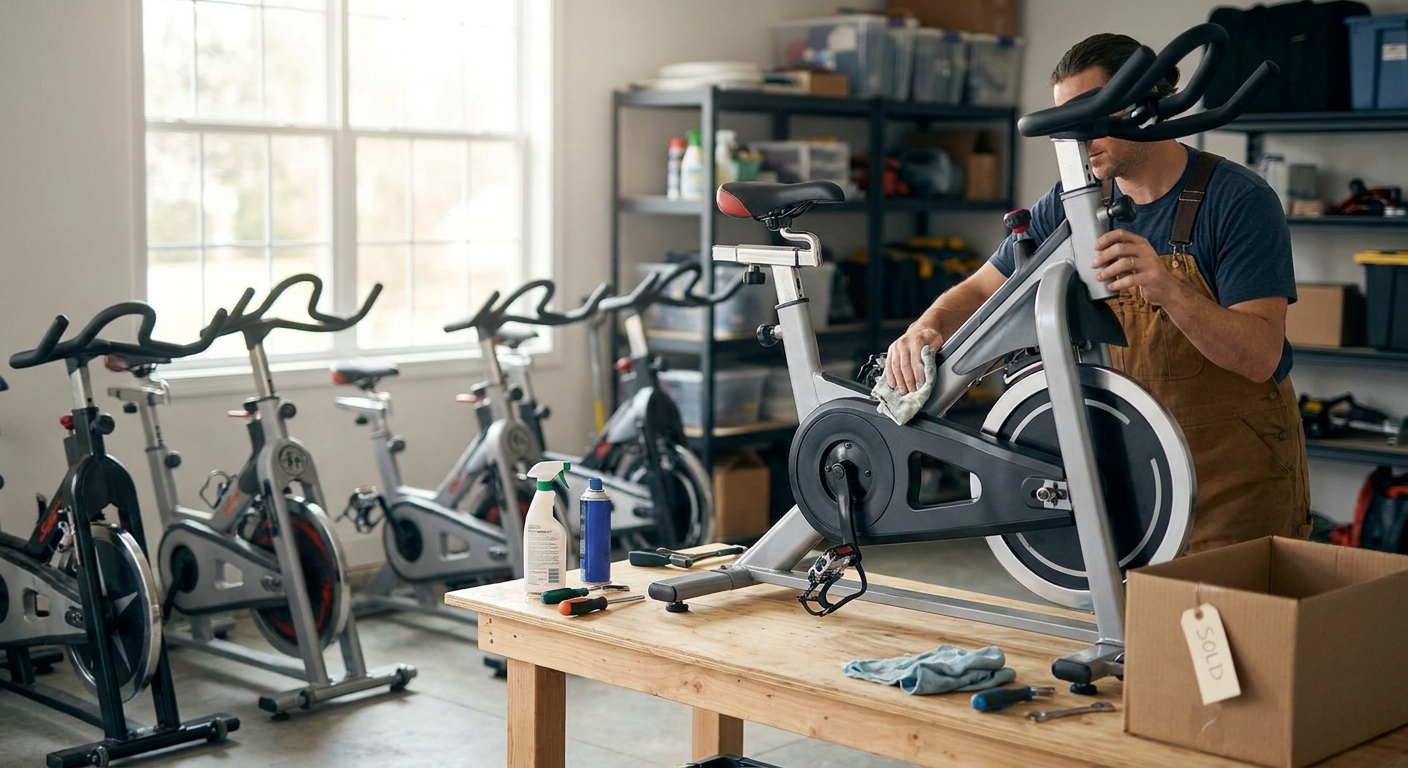
Exercise bikes sit in that sweet spot of resale: heavy enough that most buyers won't drive across town for a cheap one, valuable enough that a single flip can clear $150 to $400 profit, and abundant enough that retailers process thousands of returns on them every month. Flipping exercise bikes for profit in 2026 rewards people who know which models hold value and which ones are dead weight in a garage.
TL;DR
Gym equipment returns pile up at premium retailers year-round, mattress-season style, but exercise bikes carry a specific problem: most look fine in a photo and hide their real condition in the belt, the flywheel bearing, or a subscription-locked touchscreen. Buyers who don't know what they're looking at overpay for junk or underprice a bike that's actually worth $600.
The margin in this category comes from knowing brand-specific quirks — a Peloton with a cracked screen is still worth hundreds because the frame and flywheel are fine, while a no-name folding bike with a dead resistance motor is scrap. The best places to sell used gym equipment matter less than knowing what you're buying in the first place.
This guide is built for people already flipping furniture, appliances, or other bulky items who want to add exercise bikes to their rotation — reps with a truck or cargo van, garage-based resellers, and anyone running a part-time flipping operation who needs a category with steady, year-round demand instead of a January-only spike.
Buyers search by name — Peloton, NordicTrack, Echelon, Schwinn — and a listing with a recognizable brand in the title sells in days instead of weeks. Off-brand bikes from big-box liquidation lots can still be profitable, but they sit longer and need a lower asking price to move.
A scuffed frame doesn't matter; a slipping belt, a seized flywheel bearing, or a dead resistance motor does. Spin the pedals by hand before you buy — grinding, clicking, or resistance that won't adjust are the three failures that kill resale value fastest.
Most exercise bikes run 100 to 140 pounds, which means a two-person lift and a full-size vehicle for most pickups. Folding models cut delivery time in half because buyers can collapse them into a hatchback, which matters if you're pricing your time against the profit on a $200 flip.
Connected bikes with locked touchscreens (Peloton, some Echelon models) still hold most of their frame-and-flywheel value even when the subscription-tied screen is dead, because buyers can bypass it with third-party apps. Know this before you write off a bike with a black screen as worthless — it usually isn't.
A bike missing pedals, a resistance knob, or a flywheel cover isn't a $20 fix — replacement parts for discontinued models can run $40 to $80 and take weeks to source. Check for all major parts before you commit to a price.
Exercise bikes are a poor shipping category because of weight and box size, so your resale price is set entirely by what local buyers will pay — not by national averages you see in a Facebook group from three states away.
Peloton Bike and Bike+ — the premium pick. These sell used for $700 to $1,400 in 2026 even with a cracked or dead touchscreen, because the frame, flywheel, and resistance system carry the value on their own. One spec that matters: check the flywheel spins freely with zero grinding — that alone justifies the higher price tag. Verdict: Buy whenever you can source one under $500.
NordicTrack and ProForm foldables — the volume mover. These list fast at $250 to $500 because they're common, familiar, and easy for buyers to transport folded. The number that matters here: incline motors fail often, so test the auto-incline function before you buy, not after. Verdict: Consider — solid margin if the incline and console both work.
Echelon connected bikes — the wildcard. Echelon's app-based resistance system means the bike is nearly worthless if the Bluetooth module is dead, but fully functional units move at $300 to $600. Test the app connection on-site before you commit any money. Verdict: Consider, but only after confirming connectivity.
Schwinn and Marcy recumbent bikes — the safe pick. Recumbents have fewer moving parts and no subscription lock-in, which keeps resale predictable at $120 to $220. The one number that matters: seat weight capacity, since recumbents attract a wider buyer age range and heavier buyers who check that spec first. Verdict: Buy — lowest mechanical risk in the category.
No-name basic spin bikes — the one to skip. These flood liquidation pallets and rarely clear $80 to $100 resale, which barely covers a pickup trip once gas and time are factored in. Verdict: Skip unless you're getting one free with a bundle of higher-value items.
The fastest way to protect your margin is inspecting before you pay, not after. A buying used equipment checklist applies the same logic used for secondhand electric bikes to exercise bikes: test every moving and electronic part on-site, because a seller who won't let you test it is telling you something.
Turn returns into resale profit
Pick up bulky retailer returns and resell them locally for profit.
Peloton Bike/Bike+
NordicTrack/ProForm foldable
Echelon connected
Schwinn/Marcy recumbent
No-name spin bike
Flipping exercise bikes for profit works the same way as flipping recliners for profit or any bulky-item category: your margin lives in inspection quality, not luck. If you're new to sourcing, how to negotiate prices when buying secondhand items to resell covers the exact scripts to use when a seller quotes a price that doesn't match the bike's actual condition.
Is flipping exercise bikes for profit worth it in 2026?
Yes, exercise bikes flip for $150 to $400 profit on average when sourced under retail value, and demand stays steady year-round rather than spiking seasonally like most fitness gear.
What's the best exercise bike brand to flip?
Peloton holds the highest resale value at $700-$1,400 used even with a dead touchscreen, because the frame and flywheel carry most of the value on their own.
How much does a used Peloton sell for in 2026?
A used Peloton Bike or Bike+ sells for $700 to $1,400 depending on screen condition and accessories included, with fully functional units at the top of that range.
How do you tell if an exercise bike's flywheel is bad?
Spin the pedals by hand and listen for grinding or clicking; a healthy flywheel spins freely and slows down gradually with no resistance catching.
Are folding exercise bikes easier to flip than full-size ones?
Yes, folding models from NordicTrack and ProForm move faster because buyers can transport them in a standard car, cutting your time-to-sale compared to full-size frames.
What parts commonly break on used exercise bikes?
Resistance motors, incline motors, and Bluetooth connectivity modules fail most often, and each one significantly cuts the bike's resale value if untested before purchase.
Should you buy an exercise bike with a broken screen?
Yes for connected bikes like Peloton, since the frame and flywheel hold most of the value; no for budget bikes where the screen is the main selling point.
How much can you realistically make flipping fitness equipment part-time?
Part-time flippers working a handful of pickups a month typically clear a few hundred dollars in profit per bike after accounting for gas, cleaning supplies, and listing time.
The detail most new flippers miss: a Peloton with a completely dead screen still sells because third-party apps like the ones built for spin bikes let buyers bypass the locked interface entirely — don't pass on a $150 Peloton just because the screen won't turn on.