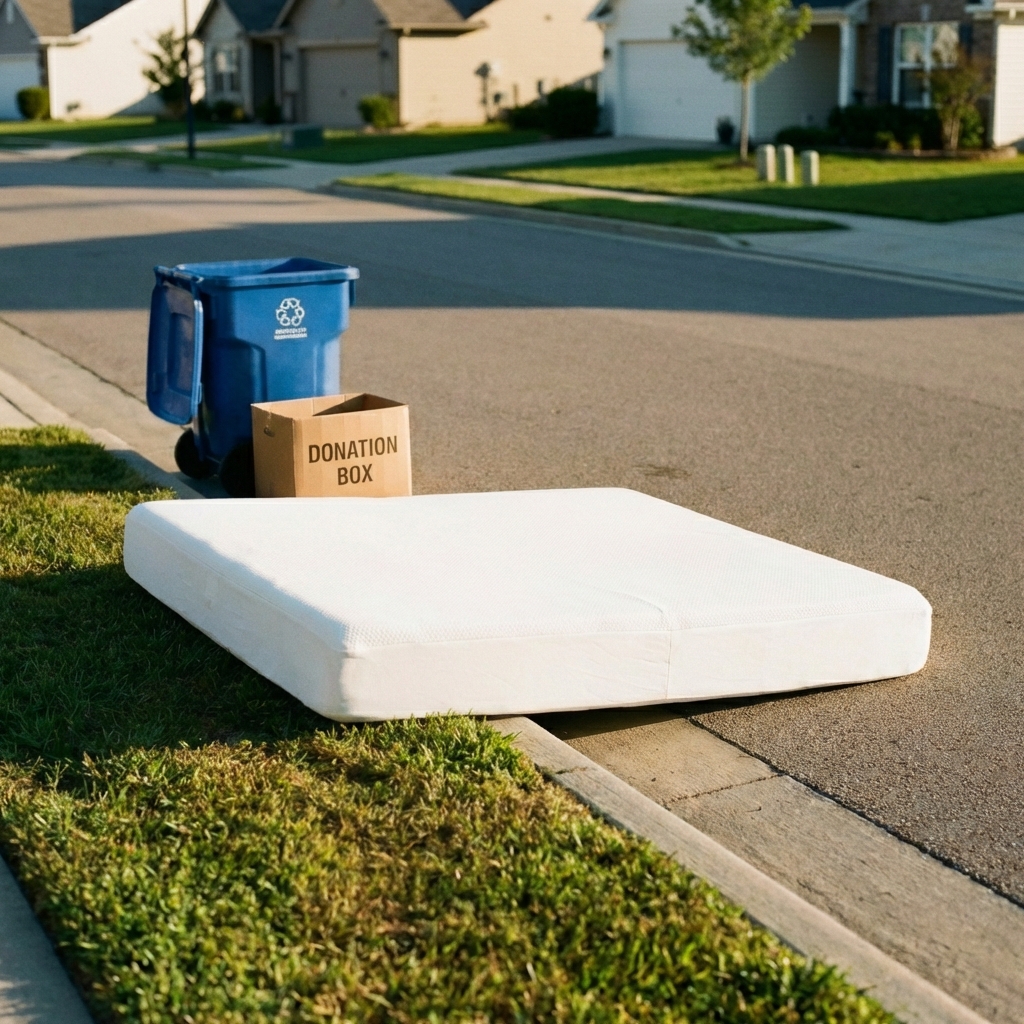
Getting rid of an old mattress is one of those tasks that seems simple until you actually try to do it. You can't just toss it in the garbage bin. Most waste haulers won't take it with regular trash. And leaving it on the curb can earn you a fine in many cities.
Every year, roughly 20 million mattresses end up in American landfills — that's about 55,000 per day. Each one takes up to 40 cubic feet of landfill space and can take decades to decompose. The good news? You have more options than you think.
Whether you're upgrading your sleep setup, dealing with a return, or clearing out a spare room, this guide walks you through every practical way to get rid of a mattress — ranked by cost, convenience, and environmental impact.
Before diving into solutions, it's worth understanding why mattress disposal is so tricky in the first place.
Size and bulk. A standard queen mattress weighs between 60 and 150 pounds and measures roughly 60 × 80 inches. That makes it too large for standard waste bins and too heavy for most people to move solo.
Municipal restrictions. Many cities and counties have specific rules about oversized waste. In places like California, Connecticut, and Rhode Island, mattresses are actually banned from landfills altogether under extended producer responsibility (EPR) laws.
Pickup schedules. Even where bulk pickup exists, it often runs on a limited schedule — monthly, quarterly, or by appointment only. If you need a mattress gone this week, you'll need a different approach.
Environmental concerns. Mattresses are made from steel springs, polyurethane foam, cotton, and wood — all of which are recyclable. Throwing one in a landfill wastes recoverable materials and takes up significant space that could be avoided.
Here are your seven options, ranked from most convenient to most effort-intensive.
Cost: Free | Effort: Minimal | Eco Impact: ★★★★★
This is the option most people don't know about — and it's the best one.
Companies like Sharetown specialize in picking up used and returned mattresses, refurbishing them, and giving them a second life through local resale. Here's how it works: a local independent contractor (called a "rep") comes to your home, picks up the mattress, professionally cleans and sanitizes it, and then resells it to someone in your community.
The beauty of this model is that it's hyper-local — the average distance from pickup to the new owner is just 13 miles. That means minimal transportation emissions and maximum community impact.
Why this ranks #1:
Best for: Mattresses in fair to good condition, mattress returns, and anyone who wants the easiest and most sustainable option.
Cost: Free–$50 | Effort: Low | Eco Impact: ★★★☆☆
If you're buying a new mattress, many retailers will haul away your old one as part of the delivery. Major brands and stores that offer this include:
The catch? Not every retailer actually recycles or resells the old mattress. Some end up contracting with services like Sharetown to handle the logistics responsibly — but others simply send them to a landfill. Always ask what happens to the mattress after pickup.
Best for: People who are buying a new mattress and want a one-trip solution.
Cost: Free–$30 | Effort: Medium | Eco Impact: ★★☆☆☆
Most cities offer some form of bulk trash pickup that accepts mattresses. Here's what to expect in a few major metros:
The downsides: You'll need to get the mattress to the curb yourself (which can be a challenge from a second-floor apartment). Pickup windows are often vague ("sometime this week"), and in most cases, the mattress goes straight to a landfill.
Best for: Budget-conscious disposal when condition is poor and the mattress can't be reused.
Cost: Free | Effort: Medium | Eco Impact: ★★★★☆
If your mattress is in good condition — no stains, no sagging, no structural damage — donation is a solid option. Organizations that commonly accept mattresses include:
Important: Most charities have strict cleanliness requirements. If there are visible stains, odors, or damage, they'll decline the donation. Always call before making a trip.
Best for: Mattresses in good condition when you have transportation available.
Cost: $0–$40 | Effort: High | Eco Impact: ★★★★★
Mattress recycling facilities break down each mattress into its components — steel springs are melted down, foam is repurposed, cotton is shredded for industrial use, and wood frames are chipped. Up to 90% of a mattress can be recycled this way.
States with mandatory mattress recycling programs:
In these states, you can drop off mattresses at designated collection sites for free. In other states, private recycling facilities may charge $20–$40 per mattress.
The challenge: Recycling centers aren't everywhere, and you'll need to transport the mattress yourself — which usually requires a truck or trailer.
Best for: Environmentally conscious consumers in states with recycling programs.
Cost: $75–$200 | Effort: Minimal | Eco Impact: ★★☆☆☆
Companies like 1-800-GOT-JUNK, LoadUp, and College Hunks Hauling Junk will come to your home and remove a mattress, usually within a few days. Pricing typically runs:
While this is convenient, it's the most expensive option and the environmental outcome is mixed. Some junk haulers recycle or donate qualifying items, but many simply take everything to the dump.
Best for: People who need fast removal and don't mind the cost.
Cost: Free | Effort: High | Eco Impact: ★★★★☆
If your mattress still has life in it, you can list it on:
Pro tip: Price it to move. A mattress listed at $50 will sell 10x faster than one at $200. If you just want it gone, list it for free and you'll usually have takers within hours.
Best for: Mattresses in good condition when you have time and don't mind coordinating with buyers.
Traditional mattress disposal has a dirty secret: the overwhelming majority of removed mattresses end up in landfills, regardless of condition. Even "eco-friendly" junk removal services often dump more than they recycle.
Sharetown takes a fundamentally different approach. Instead of collecting mattresses into warehouses or shipping them across the country, Sharetown uses a network of local independent reps who live in your community. When a mattress needs to be picked up — whether it's a return from a brand like Casper or Purple, or a consumer disposal — a nearby rep handles the entire process:
1. Pickup — The rep comes to your door at a scheduled time
2. Assessment — They evaluate condition and determine the best path forward
3. Refurbishment — Mattresses in good condition are professionally cleaned, sanitized, and restored
4. Local resale — The mattress is resold to a new owner nearby, keeping it hyper-local
5. Responsible disposal — Items that can't be resold are donated to organizations like Habitat for Humanity or recycled
The result? A 97% reduction in waste and emissions compared to traditional reverse logistics. And because the average distance from the first customer to the second is just 13 miles, the carbon footprint is a fraction of what centralized processing requires.
Interested in being part of the solution? Sharetown is actively growing its rep network. If you have a truck and want to earn money picking up and reselling mattresses in your area, learn more about becoming a Sharetown rep.
Mattress disposal laws vary significantly by state. Here's what you should know about the major ones:
California — The Bye Bye Mattress program (funded by a $10.50 recycling fee on new mattress purchases) provides free drop-off at hundreds of collection sites statewide. Retailers are also required to offer take-back services.
Connecticut — Free drop-off at transfer stations and participating retailers. Funded by a recycling surcharge on new mattresses. The state recycles over 250,000 mattresses annually.
Rhode Island — Mattresses are banned from landfills. Free recycling is available through the state's mattress stewardship program at municipal transfer stations.
Oregon — Expanded mattress recycling legislation is in various stages of implementation. Check with your county waste management office for current programs.
New York — Mattresses must be sealed in a plastic bag before curbside pickup (bed bug prevention ordinance). The city offers free bulk pickup scheduling online.
Massachusetts — Mattresses are banned from regular trash collection. Residents must arrange separate bulky waste pickup or drop-off.
Vermont — The Universal Recycling Law encourages diversion of bulky items from landfills, including mattresses. Many transfer stations accept them for a fee.
It ranges from free to about $200. Free options include curbside bulk pickup (where available), donation, and pickup services like Sharetown. Junk removal services are the most expensive at $75–$200 per mattress.
Yes. Up to 90% of a mattress is recyclable — steel springs, foam, cotton, and wood can all be recovered. Four states (California, Connecticut, Rhode Island, and Oregon) have formal mattress recycling programs with free drop-off locations.
Your best free options are: (1) a sustainable pickup service like Sharetown, (2) curbside bulk pickup through your municipality, (3) donation to Habitat for Humanity or a local shelter, or (4) listing it for free on Facebook Marketplace or a Buy Nothing group.
It depends on your city. Many municipalities allow it during scheduled bulk pickup days, but leaving it outside that window can result in fines ($50–$500 in some areas). New York requires mattresses to be sealed in plastic bags before curbside placement.
The most eco-friendly option is giving the mattress a second life through refurbishment and local resale — which is exactly what Sharetown does. This keeps the entire mattress out of the landfill and reduces emissions by 97% compared to traditional disposal. Recycling is the next best option, where available.
This is where pickup services really shine. Companies like Sharetown and junk removal services will come into your home and carry the mattress out for you. If going the DIY route, fold the mattress in half (memory foam and hybrid mattresses can usually be folded) and secure it with ratchet straps to make it easier to navigate through hallways and stairways.
Getting rid of a mattress doesn't have to mean sending it to a landfill. With the right approach, your old mattress can find a new home, get recycled into raw materials, or support someone in your community who needs one. Choose the option that fits your situation — and when in doubt, go with the one that keeps it out of the ground.