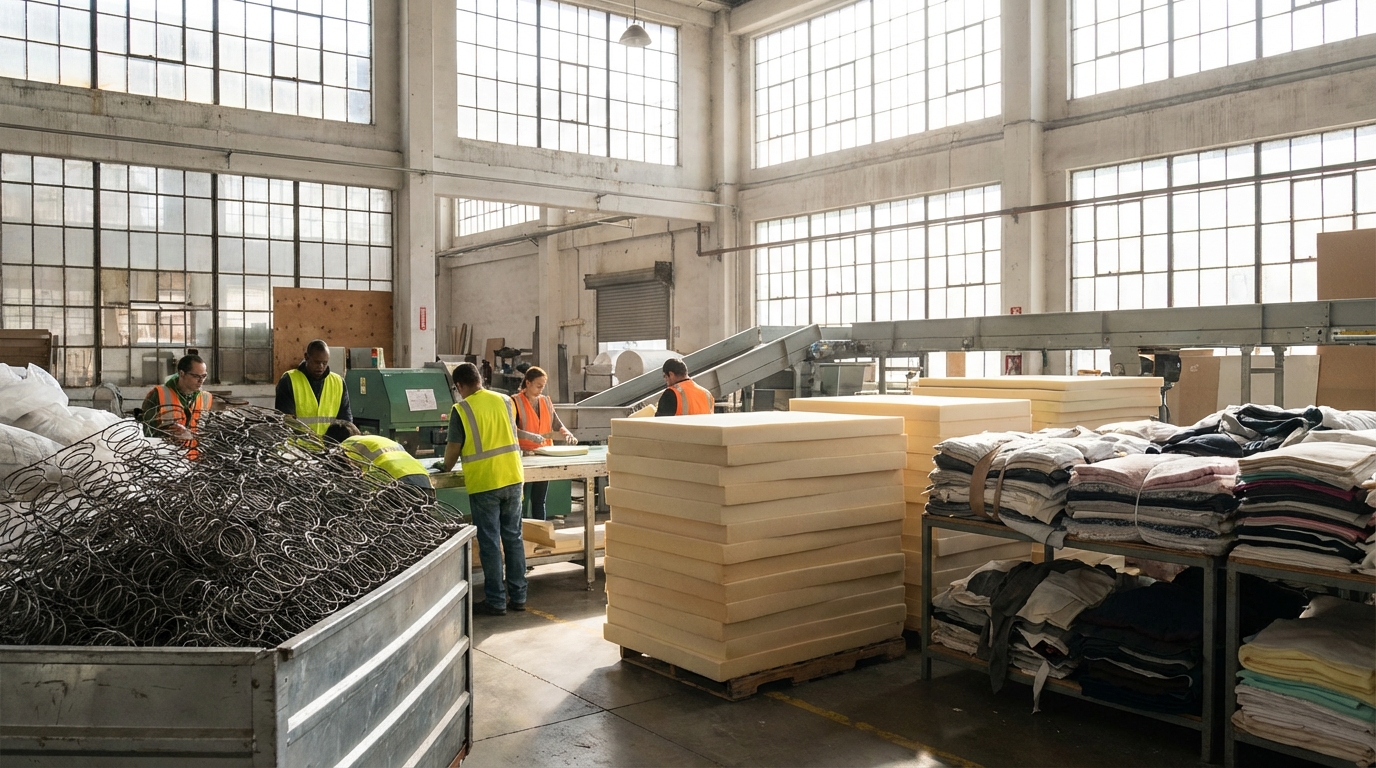
You've decided to do the right thing — recycle your old mattress instead of tossing it in a landfill. But finding a mattress recycling facility near you isn't always straightforward. Programs vary wildly by state, many facilities don't advertise well, and the rules around drop-off can be confusing.
Here's the reality: about 80% of a mattress can be recycled. The steel in the springs, the polyurethane foam, the cotton batting, and even the wood in the box spring all have value. Yet fewer than 5% of discarded mattresses in the U.S. actually get recycled. The rest — around 20 million per year — end up taking up space in landfills, where each one occupies up to 40 cubic feet and takes decades to break down.
This guide will help you find mattress recycling options near you, understand your state's specific laws and programs, and discover alternatives when recycling facilities aren't conveniently located.
Before we talk about where to recycle, let's look at what you're actually recycling. A typical mattress contains:
Steel coils and springs (25-30% of weight)
The innerspring unit is the most valuable recyclable component. Steel is infinitely recyclable and can be melted down and reformed into new products. A single queen mattress yields about 25 pounds of steel.
Polyurethane foam (30-40% of weight)
Memory foam, comfort layers, and support foam can be shredded and repurposed into carpet padding, pet beds, gym mats, and industrial insulation. Some facilities also process it into fuel through waste-to-energy conversion.
Cotton and fiber (10-15% of weight)
The quilted top layer, batting, and fire-retardant barriers contain cotton and synthetic fibers. These are typically shredded and used in industrial applications — automobile sound insulation, filtration material, or new textile products.
Wood (5-10% of weight)
Box springs and some mattress foundations contain wood frames that can be chipped for mulch, biomass fuel, or particleboard manufacturing.
Fabric covering (5-10% of weight)
The outer ticking fabric is usually a cotton-polyester blend. This is the hardest component to recycle and is sometimes the only part that goes to waste.
When a mattress goes through a proper recycling facility, workers (or increasingly, machines) disassemble it layer by layer. The process takes about 10-15 minutes per mattress and diverts up to 90% of the material from landfills.
Mattress recycling availability depends heavily on where you live. Four states have enacted mattress recycling legislation, making it significantly easier for residents. Other states have private options or municipal programs.
California leads the nation in mattress recycling. The Bye Bye Mattress program, funded by a $10.50 recycling fee added to every new mattress sold in the state, has created a vast network of free drop-off locations.
Major metro coverage:
Connecticut was the first state in the nation to pass a mattress stewardship law (2013). The program operates similarly to California's.
Rhode Island banned mattresses from landfills and funds recycling through a product stewardship program.
Oregon has been expanding its mattress recycling infrastructure through legislation modeled after California and Connecticut's programs.
Even without formal legislation, several states have robust private mattress recycling options:
Texas
New York
Florida
Washington State
Illinois
Massachusetts
If your state isn't listed above, here's how to find mattress recycling options:
1. Search "mattress recycling + [your city]" — Private facilities often don't rank well in directories but show up in local search
2. Call your municipal waste management office — Ask specifically about mattress disposal. Many have programs that aren't well-publicized
3. Check Earth911.org — Enter your zip code and search for "mattress" to find nearby recycling options
4. Contact Habitat for Humanity ReStores — Many locations accept mattresses in good condition and either resell or recycle them
5. Ask about collection events — Some counties hold periodic bulky waste recycling events (often in spring and fall)
Ever wondered what the actual recycling process looks like? Here's a step-by-step breakdown of what happens after you drop off a mattress:
Step 1: Intake and inspection (1-2 minutes)
Each mattress is checked for contamination — primarily bed bugs, excessive moisture, or hazardous materials. Contaminated units are separated for proper disposal.
Step 2: Deconstructing the layers (5-10 minutes)
Workers use cutting tools to separate the mattress into its component layers. The outer fabric is cut away first, followed by the foam layers, cotton batting, and finally the spring unit.
Step 3: Steel extraction
Innerspring units are compressed using industrial balers and sent to steel recycling facilities where they're melted down. The steel retains its quality through unlimited recycling cycles.
Step 4: Foam processing
Polyurethane foam is shredded into small pieces using industrial shredders. The shredded foam is then baled and shipped to manufacturers who use it for carpet padding, pet beds, gym flooring, and insulation.
Step 5: Fiber and cotton sorting
Cotton and fiber materials are sorted, shredded, and baled for use in industrial applications — primarily automotive insulation and filtration products.
Step 6: Wood chipping
Any wood from box springs or foundations is processed through a chipper. The resulting material becomes mulch, biomass fuel, or raw material for composite wood products.
The entire process diverts up to 90% of the mattress from the landfill. Some advanced facilities claim even higher diversion rates, with only the outer fabric covering occasionally going to waste.
Let's be honest — if you don't live in California, Connecticut, Rhode Island, or a major metro, finding a mattress recycling facility can be genuinely difficult. Here are your best alternatives:
If recycling isn't available near you, the next best thing is keeping the mattress in use. Sharetown operates a nationwide network of local reps who pick up mattresses, professionally refurbish them, and resell them to new owners in the same community.
This approach is arguably better than recycling for several reasons:
Sharetown works with major mattress brands to handle returns, but they also serve consumers who simply need a mattress picked up. If your mattress is in fair to good condition, this is the most environmentally responsible choice available.
Organizations that accept mattresses in good condition:
If you're handy and motivated, you can partially recycle a mattress yourself:
1. Cut away the fabric using a utility knife
2. Remove the foam layers — these can be repurposed as cushioning, pet beds, or donated to upholstery shops
3. Extract the springs — take the spring unit to a scrap metal recycler (you might even get a few dollars for the steel)
4. Chip or bundle the wood from box springs for firewood or mulch
This approach takes 30-60 minutes and requires a box cutter, wire cutters, and work gloves. It's not for everyone, but it can divert most of the mattress from the landfill.
The mattress recycling landscape is changing rapidly. Here are the trends that will affect your options in the coming years:
More states adopting EPR laws. Extended Producer Responsibility legislation — which puts the cost of recycling on manufacturers rather than consumers — is being considered in several states including New York, Massachusetts, and Washington. These laws create the funding infrastructure that makes free consumer recycling possible.
Brand-led sustainability initiatives. Major mattress companies are increasingly investing in end-of-life solutions. Brands are partnering with reverse logistics companies like Sharetown to ensure returned mattresses get refurbished and resold rather than landfilled. This trend is accelerating as consumers demand more sustainable practices.
Technology improvements. Automated mattress deconstruction machines are getting faster and more cost-effective, making recycling economically viable in more markets. Some newer facilities can process a mattress in under 5 minutes, compared to the 10-15 minutes manual disassembly requires.
Circular economy models. The most exciting development is the shift toward keeping mattresses in use longer through refurbishment and local resale. This "reduce and reuse" approach sits higher on the waste hierarchy than recycling and has a lower overall environmental impact.
Free mattress recycling is available in California (Bye Bye Mattress program — 200+ locations), Connecticut (all municipalities), and Rhode Island (municipal transfer stations). Outside these states, some municipal recycling events and Habitat for Humanity ReStores accept mattresses at no charge.
In states with recycling programs, it's free for consumers (funded by a surcharge on new mattresses). Private recyclers typically charge $20–$40 per mattress. Junk removal services that recycle charge $75–$200 but include pickup from your home.
Yes. Memory foam (polyurethane foam) is one of the most recyclable mattress components. It's shredded and repurposed into carpet padding, pet beds, gym mats, and insulation. Memory foam mattresses are actually easier to recycle than innerspring mattresses in some ways because they don't require steel extraction.
Both are excellent choices. Donation keeps a mattress in use as a complete product, which is the highest-value environmental outcome. Recycling breaks it into raw materials, which requires more energy but is the right choice for mattresses that can't be reused. If your mattress is in usable condition, services like Sharetown that refurbish and resell locally are the best option.
If recycling facilities aren't available locally, your best alternatives are: (1) a sustainable pickup and resale service like Sharetown, (2) donation to Habitat for Humanity or a local shelter, (3) DIY disassembly and component recycling (take springs to a scrap metal yard, repurpose foam), or (4) checking for periodic bulky waste recycling events in your county.
Some do, especially when paired with a new purchase. Retailers like Casper, Purple, and IKEA offer take-back programs. However, what happens after take-back varies. Some retailers partner with companies like Sharetown to ensure responsible handling, while others may simply use standard waste disposal. Always ask the retailer specifically what happens to the old mattress.
Recycling a mattress takes a bit more effort than throwing it away — but the impact is significant. Each recycled mattress keeps up to 40 cubic feet of material out of a landfill and recovers valuable resources. Whether you use a state program, a private recycler, or a refurbishment service, you're making a choice that matters.