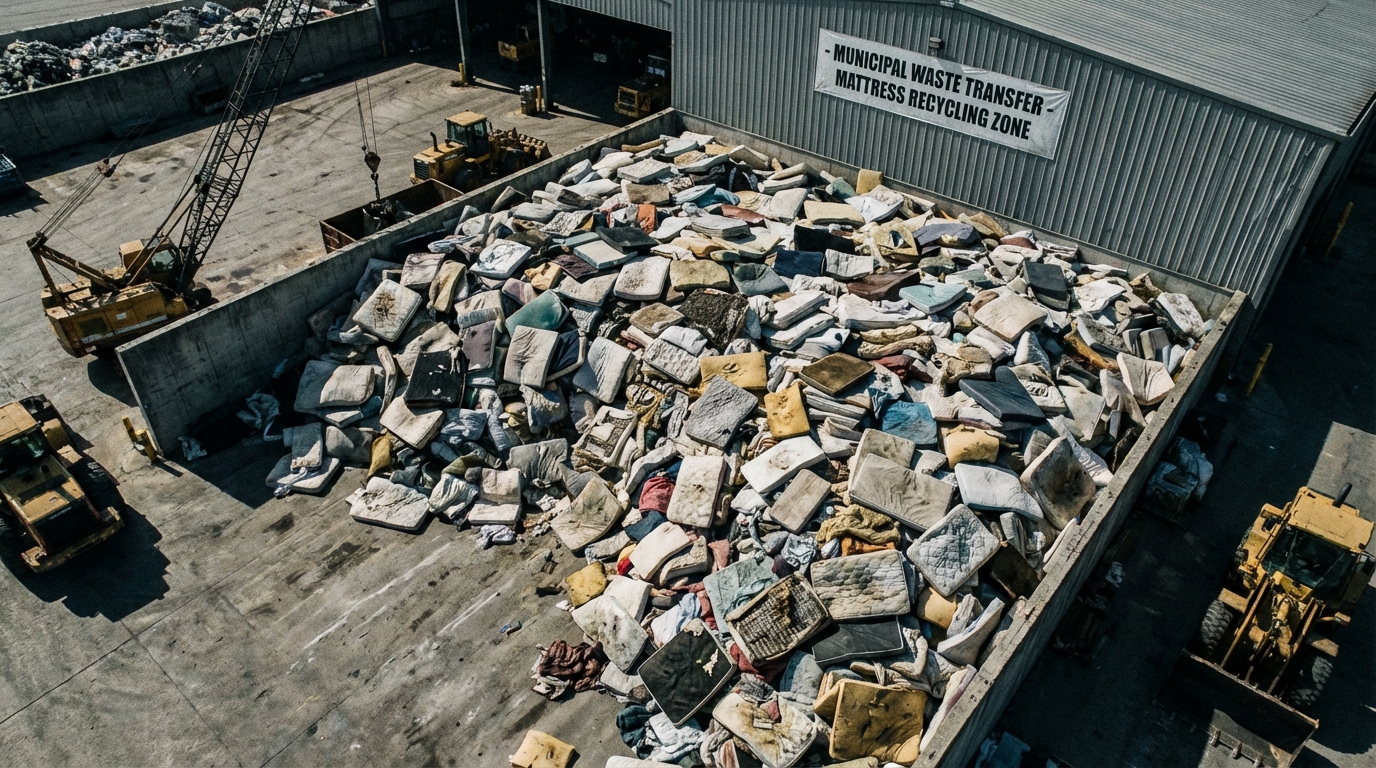
Every day in America, roughly 50,000 mattresses are thrown away. That's about 2,000 an hour. Thirty-three every minute. By the time you finish reading this sentence, another mattress has been dumped somewhere it doesn't belong.
That adds up to approximately 18–20 million mattresses hitting U.S. landfills every single year — a number that's been climbing steadily as the bed-in-a-box boom, shortened replacement cycles, and surging e-commerce return rates combine into a disposal crisis that most people never think about.
Because here's the thing about mattresses: they're among the worst items to landfill. They're massive, non-compactable, and engineered to last decades in your bedroom — which means they last even longer in a landfill. Once buried, the steel springs, polyurethane foam, and synthetic fabrics inside a single mattress can take 80 to 120 years to decompose.
This article pulls together the most important mattress waste statistics in America, examines why the problem is accelerating, and shows what's being done to fix it — from state-level recycling legislation to private-sector models like Sharetown that are quietly diverting millions of mattresses from landfills every year.
The numbers are staggering:
To put the volume in perspective: if you lined up one year's worth of discarded American mattresses end-to-end, they'd stretch over 56,000 miles — enough to circle the Earth more than twice.
The majority of discarded mattresses follow one of these paths:
Mattresses aren't just bulky — they're environmentally destructive at every stage of their disposal:
Moving mattresses to disposal sites generates significant carbon emissions:
The environmental cost doesn't start at disposal. Manufacturing a new mattress requires:
When a perfectly functional mattress is discarded and replaced with a new one, both the disposal impact and the manufacturing footprint are wasted.
Several converging trends are accelerating mattress waste:
The direct-to-consumer mattress revolution that began around 2014 has fundamentally changed how Americans buy — and discard — mattresses.
Companies like Casper, Purple, Tuft & Needle, and dozens of others popularized compressed, vacuum-sealed mattresses shipped directly to consumers. This convenience came with a game-changing sales feature: generous trial periods of 90–365 nights, during which customers could return the mattress for a full refund.
The return rates tell the story:
And here's the critical problem: most brands don't want these mattresses back. The logistics of receiving, inspecting, cleaning, and restocking a decompressed foam mattress typically cost more than the mattress is worth. So what happens to them?
Many are simply abandoned. Brands pay local services to "pick up" the return, and the mattress ends up in a landfill — often a mattress that was slept on for a few weeks and is in near-perfect condition.
Americans used to keep mattresses for 10–15 years. That number has dropped significantly:
Shorter cycles mean more mattresses flowing through the system faster.
Mattresses are part of a broader oversized-goods returns crisis. Online return rates for furniture and large goods average 12–20%, compared to 8–10% for in-store purchases. Every returned oversized item requires pickup, transportation, and disposition — and for items like mattresses, the default answer has historically been "throw it away."
The policy response to mattress waste has been slow but is accelerating:
EPR laws shift the cost of end-of-life disposal from municipalities to the companies that produce and sell mattresses. Currently, three states have enacted mattress EPR legislation:
California (enacted 2014)
Connecticut (enacted 2014)
Rhode Island (enacted 2015)
Oregon (enacted 2023, effective 2025)
Several other states — including New York, Illinois, Massachusetts, and Washington — have considered similar legislation, though none have enacted laws as of early 2026.
When a mattress does reach a recycling facility, it's surprisingly recyclable:
A properly processed mattress can be up to 90% recyclable by weight. The problem isn't recyclability — it's infrastructure. There are fewer than 60 dedicated mattress recycling facilities in the entire United States.
Many cities have launched mattress-specific collection programs:
The gap between what's available in EPR states versus the rest of the country is enormous.
Recycling is important, but it's a downstream solution. By the time a mattress reaches a recycling facility, it's already been manufactured, shipped, used, and transported again for disposal. The energy, materials, and emissions embedded in that lifecycle aren't recovered through recycling — they're lost.
The far more impactful approach is keeping functional mattresses in use — extending their life through refurbishment and resale rather than breaking them down for raw materials.
This is exactly what Sharetown does.
Sharetown has built a reverse logistics network specifically for oversized product returns — mattresses, furniture, fitness equipment — that redirects items away from landfills and back into the economy.
Here's the process:
The result: 97% of items processed through Sharetown's network are diverted from landfills. That's not a recycling number (breaking things down) — it's a reuse number (keeping things whole and functional).
Why this matters more than recycling:
Sharetown's model proves that the mattress waste problem isn't just a disposal problem — it's a logistics problem. When the right system connects returned products with local buyers, the "waste" disappears.
Learn how Sharetown partners with brands to manage returns sustainably →
Sharetown is actively building its network of local reps who pick up, refurbish, and resell returned products. It's a way to earn flexible income while directly preventing mattress waste in your community.
Apply to become a Sharetown rep →
Approximately 18–20 million mattresses are discarded annually in the United States, or about 50,000 per day. The majority (75–80%) end up in landfills, with only 5–10% being recycled nationwide.
Mattresses are actually highly recyclable — up to 90% by weight. The challenge is infrastructure, not technology. There are fewer than 60 dedicated mattress recycling facilities in the U.S., and the labor cost of manually disassembling mattresses makes processing expensive. EPR programs in states like California are funding the expansion of recycling capacity.
A conventional innerspring mattress takes approximately 80–120 years to decompose in a landfill. Memory foam and hybrid mattresses may take even longer due to their synthetic materials. During decomposition, mattresses can leach chemicals into groundwater and produce methane.
As of 2026, four states have enacted Extended Producer Responsibility (EPR) laws for mattresses: California (2014), Connecticut (2014), Rhode Island (2015), and Oregon (2023). Several other states, including New York and Illinois, have considered similar legislation.
The most sustainable option is reuse — selling or donating a mattress that's still functional. This preserves 95% of the product's embodied energy. The next best option is recycling, where components are separated and repurposed. Landfilling should be the last resort. Services like Sharetown specialize in keeping returned mattresses in use through local refurbishment and resale.
Sharetown partners with brands to manage their product returns through a network of local reps. Instead of sending returned mattresses to landfills, reps pick them up, clean and refurbish them, and resell them locally. This process diverts 97% of items from landfills while creating income opportunities for reps and reducing costs for brands.
---
Mattress waste is a massive and growing problem — but it's solvable. Sharetown is proving that returned mattresses don't have to be trash. They can be income, opportunity, and a step toward a circular economy. Learn how →