If you're like most side hustlers, DoorDash was probably one of the first delivery jobs you considered. And for good reason — it's easy to sign up, the app is intuitive, and you can start earning the same day. But here's the truth most delivery drivers learn the hard way: after gas, vehicle maintenance, and self-employment taxes, the average DoorDash driver takes home around $12–$17 per hour.
That's not bad for zero-commitment flexible work. But it's not great either — especially when there are side hustle delivery jobs that pay significantly more per trip, require only slightly more effort, and are far less saturated.
In this guide, we'll show you the delivery side hustles that most people don't know about — the ones that pay $25, $50, even $100+ per delivery. If you've been grinding through food delivery apps and wondering if there's something better, keep reading.
Let's be clear: food delivery apps like DoorDash, Uber Eats, and Grubhub aren't going away. They serve a real need and offer genuine flexibility. But several trends are working against food delivery drivers in 2026:
Market saturation. There are now millions of active drivers on every major food delivery platform. More drivers = fewer deliveries per person = lower effective hourly pay.
Shrinking base pay. Platforms have steadily reduced base pay per delivery over the past few years. Many orders now pay just $2–$4 before tips, making you almost entirely dependent on customer generosity.
Rising vehicle costs. Gas prices fluctuate, but vehicle maintenance costs consistently go up. The average food delivery driver puts 20,000–30,000 extra miles per year on their car, which translates to $3,000–$6,000 in depreciation, maintenance, and fuel.
Algorithm dependency. Your earnings are at the mercy of the app's algorithm. Get a few bad ratings, decline too many low-paying orders, or work during an off-peak time, and your earnings can drop dramatically.
The tip problem. A significant portion of food delivery income depends on tips, which are unpredictable. One customer tips $10; the next tips nothing. This inconsistency makes it hard to plan your income.
All of this adds up to a simple conclusion: food delivery works, but it's not the best delivery side hustle if your goal is to maximize earnings per hour.
Here's where it gets interesting. Beyond the world of food and grocery delivery, there's an entire ecosystem of delivery-adjacent side hustles that pay dramatically more per job.
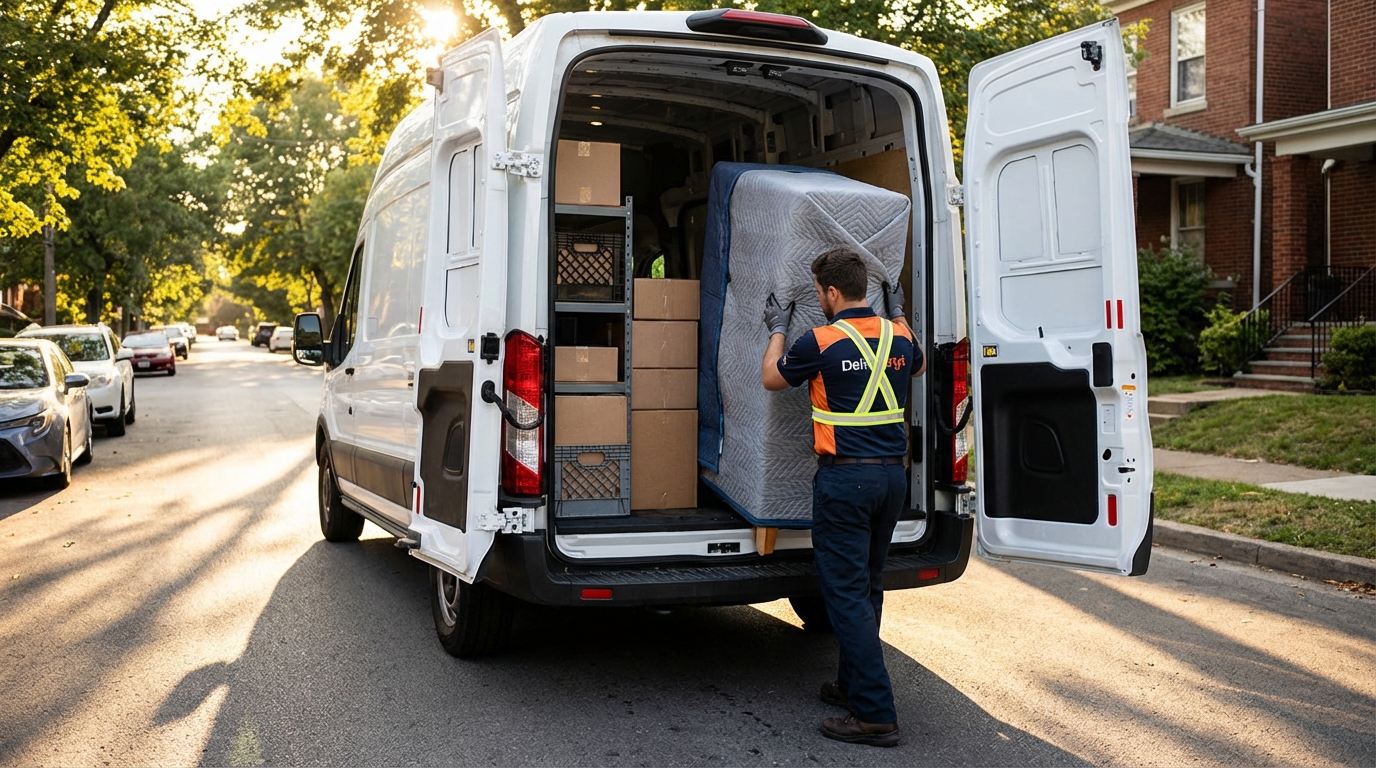
What it is: As a Sharetown independent contractor, you pick up returned mattresses, furniture, and fitness equipment from customers' homes — then clean, refurbish, and resell them locally.
Average earnings per pickup: $50–$150+ (pickup fee + resale profit)
Vehicle needed: Pickup truck, SUV, or cargo van
Average distance per job: 13 miles
Schedule: Flexible — accept jobs that fit your calendar
Why it pays more: You're not just delivering — you're picking up valuable items and reselling them. A returned queen-size mattress that you pick up for free and resell on Facebook Marketplace for $300–$600 represents a massive per-job earning that no food delivery order can match.
The sustainability angle: Sharetown diverts 97% of returned items from landfills. You're earning great money while doing something genuinely good for the environment. That's a rare combination in the gig economy.
What it is: Help customers move large items — furniture from stores, appliances, large online purchases — using your truck or van.
Average earnings per job: $30–$75+
Vehicle needed: Pickup truck, cargo van, or box truck
Schedule: On-demand — claim available jobs
Why it pays more: Moving a couch from a furniture store to someone's apartment is a 1–2 hour job that pays $50–$100. Compare that to spending the same time completing 3–4 DoorDash deliveries for $20–$30.
The catch: Jobs can be inconsistent, and the physical labor is significant. You'll need at least one helper for heavy items, which means splitting the pay or bringing a friend.
What it is: Deliver medical supplies to patients' homes, transport lab specimens between facilities, or courier medications from pharmacies.
Average earnings per route: $150–$300/day (often contracted routes)
Vehicle needed: Reliable car (some companies provide vehicles)
Schedule: Usually set routes with fixed schedules
Why it pays more: Medical delivery is specialized, time-sensitive, and requires reliability. Companies pay a premium for dependable drivers who pass background checks and can handle sensitive materials.
How to find these jobs: Search for "medical courier" or "lab specimen courier" on Indeed, and check companies like MedSpeed, Dispatch Health, and local hospital courier services.
What it is: Deliver auto parts from local parts stores and warehouses to mechanic shops and dealerships.
Average earnings: $15–$25/hour (often as an employee, not 1099)
Vehicle needed: Company typically provides
Schedule: Part-time shifts available
Why it pays more: While the hourly rate isn't dramatically higher than food delivery, auto parts delivery is usually W-2 employment — meaning the company covers gas, vehicle costs, and your share of employment taxes. Your effective take-home is significantly higher than a 1099 gig at the same rate.
How to get started: Check with AutoZone, O'Reilly Auto Parts, NAPA, and local parts stores. Many hire part-time delivery drivers.
What it is: Deliver large catering orders from restaurants and catering companies to offices, events, and venues.
Average earnings per delivery: $30–$80 (including tips)
Vehicle needed: Car with large trunk or SUV
Schedule: Mostly weekday lunch hours and weekend events
Why it pays more: Catering orders are large (often $200–$1,000+), which means higher base pay and significantly bigger tips than individual food orders. One corporate lunch delivery can pay what 4–5 regular DoorDash orders would.
How to find these gigs: Sign up for DeliverThat, Relay, and EzCater's delivery network. You can also approach local catering companies directly.
What it is: Drive delivery routes for Amazon through a Delivery Service Partner (DSP) — an independent company that contracts with Amazon to deliver packages.
Average earnings: $18–$22/hour (W-2 employee of the DSP)
Vehicle needed: Company provides (branded vans)
Schedule: Set routes, typically 10-hour shifts, 4 days/week
Why it pays more: Compared to Amazon Flex (1099), DSP routes are W-2 positions that often include benefits — health insurance, paid time off, and 401(k) after a qualifying period. The effective hourly rate is higher because the company covers vehicle costs and employment taxes.
What it is: Deliver prescriptions from local pharmacies to patients' homes.
Average earnings: $14–$20/hour (often W-2)
Vehicle needed: Your own car (mileage reimbursed)
Schedule: Part-time, flexible hours
Why it pays more: Similar to auto parts delivery, many pharmacy delivery positions are W-2 employment with mileage reimbursement, making the effective pay higher than it appears. Plus, routes tend to be short and predictable.
Where to apply: CVS, Walgreens, local independent pharmacies, and companies like ScriptDrop.
Let's break down the numbers for a typical 5-hour side hustle shift:
| Metric | Amount |
|---|---|
| Deliveries completed | 12 |
| Average pay per delivery | $7.50 |
| Gross earnings | $90.00 |
| Gas (60 miles × $0.15/mile) | -$9.00 |
| Vehicle depreciation | -$6.00 |
| Self-employment tax (15.3%) | -$13.77 |
| Net earnings | $61.23 |
| Effective hourly rate | $12.25/hour |
| Metric | Amount |
|---|---|
| Pickups completed | 3 |
| Pickup fees | $75.00 |
| Items resold (avg $250 each) | $750.00 |
| Sharetown/brand revenue share | -$375.00 |
| Gas (40 miles × $0.15/mile) | -$6.00 |
| Vehicle depreciation | -$4.00 |
| Self-employment tax (15.3%) | -$67.32 |
| Net earnings | $372.68 |
| Effective hourly rate | $74.54/hour |
Note: Resale income varies by item type, condition, and market. These figures represent a strong performance scenario. Actual results depend on your market, effort level, and resale skills.
The difference is stark. Food delivery trades your time for a fixed (and declining) rate. Pickup-and-resale models let you capture the value of the items you're handling — which dramatically changes the economics.
| Metric | Amount |
|---|---|
| Jobs completed | 3 |
| Average pay per job | $55.00 |
| Gross earnings | $165.00 |
| Gas (45 miles × $0.15/mile) | -$6.75 |
| Vehicle depreciation | -$4.50 |
| Self-employment tax (15.3%) | -$25.25 |
| Net earnings | $128.50 |
| Effective hourly rate | $25.70/hour |
Large-item delivery nearly doubles the effective rate of food delivery — and the Sharetown model takes it even further by adding resale income on top.
Already doing DoorDash or Uber Eats? Here's how to level up:
Step 1: Assess your vehicle. If you have a pickup truck, SUV, or cargo van, you immediately qualify for higher-paying large-item gigs. If you have a sedan, consider medical delivery, catering delivery, or pharmacy delivery.
Step 2: Sign up for multiple platforms. Don't put all your eggs in one basket. Apply for Sharetown, GoShare, Dolly, and any medical/catering delivery services in your area. Diversification means more available jobs and higher average earnings.
Step 3: Start transitioning gradually. Don't quit DoorDash cold turkey. Start by taking 1–2 higher-paying gigs per week alongside your regular food delivery. Once you see consistent earnings from the better-paying platforms, shift more of your time there.
Step 4: Upgrade your vehicle if it makes sense. If you're currently driving a sedan and earning $15/hour on DoorDash, the math might support financing a used pickup truck. A $15,000 truck that enables $35+/hour earnings pays for itself quickly. Run the numbers for your specific situation.
Step 5: Build your resale skills. If you go the Sharetown route, invest time in learning how to photograph items, write compelling listings, and price competitively. These skills compound over time — better listings = faster sales = higher volume = more income.
The core reason Sharetown reps out-earn traditional delivery drivers comes down to one word: resale.
With DoorDash, you pick up food, drive it to a house, and earn $5–$8. The transaction is over. There's no opportunity to add value or earn more.
With Sharetown, you pick up a returned mattress or piece of furniture — an item that still has significant value. You clean it, photograph it, list it, and sell it to a local buyer. The resale income transforms a pickup job into a mini-business.
Here's what makes the model work:
| Gig Type | Minimum Vehicle | Ideal Vehicle |
|---|---|---|
| Sharetown | SUV or pickup truck | Cargo van or full-size truck |
| GoShare/Dolly | Pickup truck | Box truck or cargo van |
| Medical delivery | Any reliable car | Fuel-efficient sedan |
| Catering delivery | Car with large trunk | SUV or minivan |
| Auto parts delivery | Usually provided | — |
For pure delivery work, large-item delivery (GoShare, Dolly) and medical courier routes tend to pay the highest per-hour rates. For delivery-adjacent work that includes resale, Sharetown reps earn the most per job — often $50–$150+ when factoring in both pickup fees and resale profit.
Yes. Medical delivery, pharmacy delivery, catering delivery, and food delivery all work with a standard car. However, if you're able to access a truck or cargo van (even renting one), you open up significantly higher-paying opportunities.
Working 15–20 hours per week as a side hustle: food delivery typically nets $150–$350/week after expenses. Higher-paying alternatives like Sharetown or GoShare can net $300–$800+/week for the same time commitment, depending on your market and volume.
DoorDash is still worth it for ultra-flexible, no-commitment work — especially if you're just looking to earn a little extra during peak hours (Friday/Saturday dinner). But as a primary side hustle for maximizing income, there are better options available now.
Search Indeed and Craigslist for "delivery driver" and "courier" in your city. Sign up directly on platforms like Sharetown, GoShare, Dolly, and DeliverThat. Check with local pharmacies, auto parts stores, and catering companies. Join local Facebook groups for gig workers — they're great for discovering opportunities specific to your market.
Most gig platforms don't require commercial insurance, but your personal auto policy may not cover accidents that happen during commercial use. Check with your insurance provider — many offer affordable rideshare/delivery endorsements for $15–$30/month that fill this gap.
Catering delivery (Saturday events), Sharetown pickups (weekend availability), and GoShare jobs (people move furniture on weekends) all peak on Saturdays and Sundays. If you only have weekends available, these three are your best bet for maximizing earnings.
The delivery gig economy has evolved far beyond food apps. While DoorDash and Uber Eats were revolutionary when they launched, the smartest side hustlers in 2026 are moving to platforms and opportunities that pay more per hour, per delivery, and per job.
If you have a truck or van, the opportunity is even bigger. Sharetown is actively looking for reps who want to earn real money picking up, restoring, and reselling returned products — all while keeping those items out of landfills.
The best time to explore higher-paying delivery alternatives is now. Sign up for one or two new platforms this week, complete your first job, and compare the numbers to your food delivery earnings. The difference might surprise you.