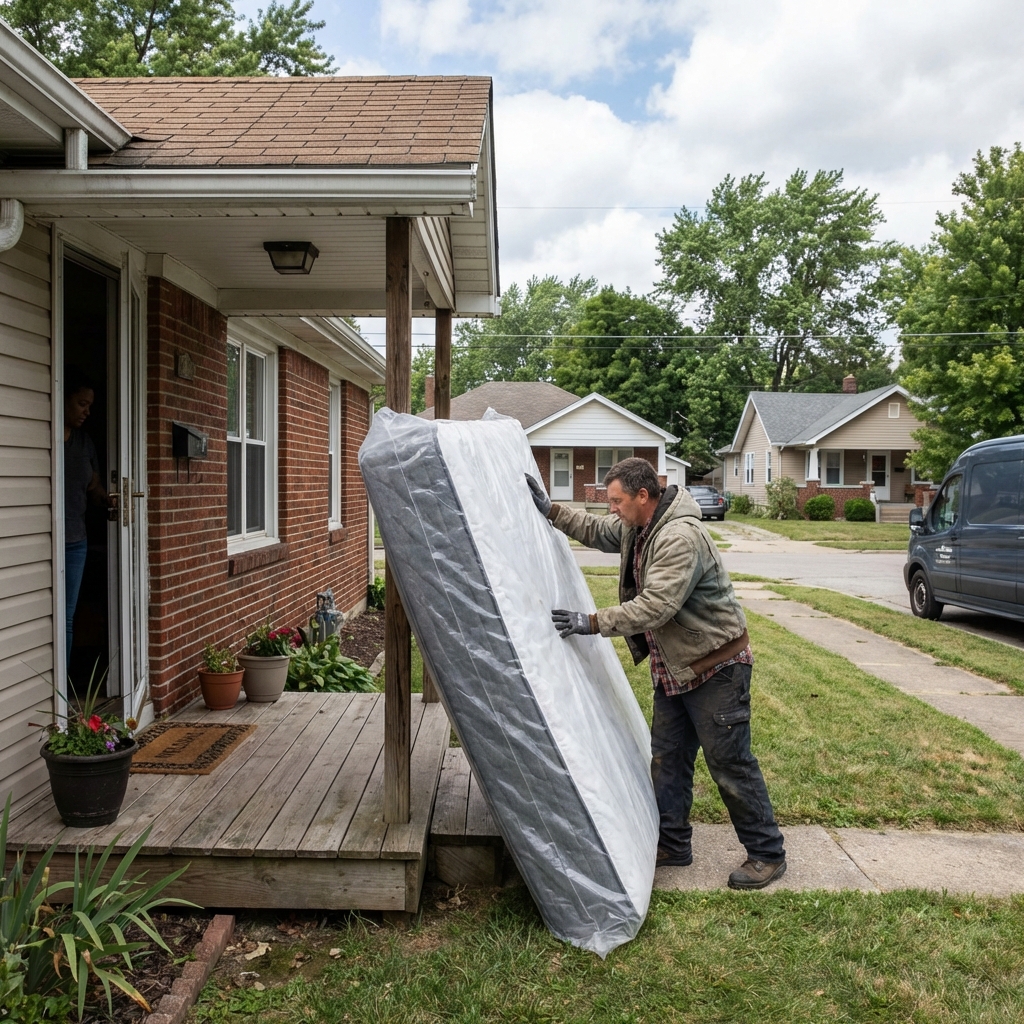
You ordered a bed-in-a-box online, slept on it for 90 nights, and decided it wasn't for you. So you called the company, they said "keep it or we'll arrange a pickup," and a few days later, the mattress was gone.
But where did it go?
If you've ever wondered what actually happens to returned mattresses, the answer is more complicated — and more wasteful — than you might expect. The mattress industry's generous return policies have created a massive logistical challenge, and the way most companies handle it has significant environmental consequences.
Let's pull back the curtain on the mattress return lifecycle — from the moment you request a return to where that mattress ultimately ends up.
The bed-in-a-box revolution changed how people buy mattresses. Brands like Casper, Purple, Nectar, Leesa, Tuft & Needle, and dozens of others built their businesses on a simple promise: try the mattress risk-free for 90 to 365 nights, and if you don't love it, return it for a full refund.
It's a brilliant sales strategy. Buying a mattress online is inherently risky — you can't lie down on it first, test the firmness, or see how it feels after a full night's sleep. Risk-free trials eliminate that hesitation and have driven billions of dollars in online mattress sales.
But those generous return windows come with a cost. Industry estimates suggest that 15-20% of online mattresses get returned — significantly higher than the 5-8% return rate for mattresses bought in stores. For a $1,000 mattress that weighs 80 pounds, that's a serious logistics problem.
Now multiply that by the scale of the industry. The U.S. mattress market generates roughly $20 billion in annual sales. If even 10% of those result in returns, that's $2 billion worth of mattresses that need to go somewhere every year.
When a customer initiates a return, the mattress brand has a few options. Here's what typically happens — and it's not what most consumers expect.
Many DTC mattress brands tell customers to simply "keep the mattress" or "donate it to a charity of your choice." The brand issues a full refund and avoids the cost of reverse logistics entirely.
This sounds generous, but here's the problem: the responsibility now falls entirely on the consumer. Most people don't have the means or motivation to actually donate a mattress. It requires a truck, coordination with a charity (many of which won't accept mattresses), and physical effort.
What really happens? A significant portion of these "keep it" mattresses end up curbside, in dumpsters, or dumped illegally. The brand gets to claim a clean return policy, but the environmental cost is simply externalized.
Some brands contract with liquidation companies that pick up returned mattresses in bulk. These companies might:
The economics are brutal. A mattress that retailed for $1,200 might sell for $50-$150 in a liquidation warehouse. The brand takes a total loss on the product, and the mattress often travels hundreds or thousands of miles in a truck — adding significant transportation emissions for a low-value transaction.
The hardest truth: a large number of returned mattresses end up in landfills. When reverse logistics costs exceed the resale value of the mattress — which happens frequently — the cheapest option is disposal.
Consider the math from the brand's perspective:
For many brands, the all-in cost of responsible handling exceeds what the mattress is worth. And so, into the landfill it goes — joining the estimated 20 million mattresses that end up there every year.
Each one takes up 40 cubic feet of space. They're notoriously difficult to compact (the springs resist crushing). And the foam and fabric take decades to decompose, sometimes releasing chemicals into the soil and groundwater.
There is a fourth option, and it's the one that's gaining the most momentum among forward-thinking mattress brands.
Sharetown has built a fundamentally different model for handling mattress returns. Instead of centralizing returns in warehouses, shipping mattresses cross-country, or dumping them in landfills, Sharetown deploys a network of local independent contractors — called "reps" — who handle the entire process within their community.
Here's how it works:
1. A customer requests a return from a partner brand (Sharetown works with major DTC mattress companies and retailers)
2. Sharetown's dispatch algorithm identifies the nearest available rep — a local contractor who lives in the area
3. The rep picks up the mattress from the customer's home, providing a white-glove experience
4. Professional refurbishment — The rep cleans, sanitizes, and inspects the mattress using professional-grade methods
5. Local resale — The refurbished mattress is sold to a new owner in the same community via platforms like Facebook Marketplace and OfferUp
6. Revenue sharing — The proceeds are split between the rep, Sharetown, and the original brand
What makes this model so powerful is the hyper-local element. The average distance from the first customer (return) to the second customer (purchase) is just 13 miles. Compare that to traditional reverse logistics where a returned mattress might travel 500+ miles to a centralized processing facility.
The environmental impact is dramatic: a 97% reduction in waste and emissions compared to conventional mattress disposal methods. And mattresses that truly can't be resold are donated — Sharetown is one of the largest donors to Habitat for Humanity in their chapter.
To summarize, every returned mattress follows one of three paths:
What happens: The mattress is picked up by a junk hauler or disposal service and taken directly to a landfill.
Environmental impact: Maximum negative impact. 40 cubic feet of landfill space consumed. Steel, foam, cotton, and wood all wasted. Potential chemical leaching over decades. Transportation emissions from hauling.
Why it still happens: It's the cheapest option for brands in the short term. When a mattress has been used for 90+ days, many companies write it off as unsellable and choose the lowest-cost disposal method.
What happens: The mattress is transported to a recycling facility where it's broken down into component materials — steel, foam, cotton, wood — each sent to separate recycling streams.
Environmental impact: Significantly better than landfill. Up to 90% of materials are recovered. However, the mattress still requires transportation to a facility, energy-intensive processing, and loses its value as a complete product.
Why it's not more common: Recycling infrastructure is limited (primarily in CA, CT, RI, OR). Transportation costs to facilities can be prohibitive. The economics only work at scale.
What happens: The mattress is picked up by a local rep, professionally cleaned and sanitized, and resold to a new owner within the same community.
Environmental impact: The best possible outcome. The mattress keeps serving its original purpose. Minimal transportation (13 miles average). No material processing or energy-intensive recycling required. 97% waste and emission reduction.
Why it's the future: Companies like Sharetown have proven this model works at scale. Brands benefit (partial cost recovery and sustainability credentials), reps benefit (income opportunity), consumers benefit (affordable mattresses), and the environment benefits (dramatically reduced waste).
The traditional mattress return system was designed around a linear model: make → sell → return → dispose. It treats returned mattresses as waste rather than assets.
Sharetown flips this model entirely. By treating every returned mattress as an opportunity — for resale, for local income, and for environmental impact — they've created a system where everyone wins.
For brands: Sharetown handles the entire reverse logistics chain. Partner brands don't need warehouses, trucks, or liquidation contracts. They get a sustainable return solution that strengthens their environmental story.
For consumers: Getting rid of a mattress becomes hassle-free. A local rep handles pickup at your door, and you know it's not going to a landfill.
For reps: Sharetown's network of independent contractors earn income by picking up, refurbishing, and reselling mattresses in their own community. It's a flexible opportunity that requires a truck and a willingness to hustle — no special training or equipment needed. Learn more about becoming a rep.
For the planet: The hyper-local model eliminates long-haul transportation, keeps products in use longer, and diverts the vast majority of handled items from landfills.
The next time you return a mattress — or need to get rid of one — you have more power than you think. Here's how to make sure your mattress doesn't end up in a landfill:
If you're returning a mattress to a brand:
If you're getting rid of an old mattress:
If you want to be part of the solution:
Unfortunately, many do. When the cost of reverse logistics exceeds the resale value, landfill disposal is often the default. However, a growing number of brands are partnering with companies like Sharetown that refurbish and resell returns locally, keeping them out of landfills.
Yes, and it's more common than you might think. Returned mattresses that have been professionally refurbished and sanitized are sold on platforms like Facebook Marketplace and OfferUp, typically at 50-80% off retail. When cleaned properly, they're safe and offer significant savings.
When professionally refurbished, yes. Companies like Sharetown have established sanitization and cleaning protocols that ensure returned mattresses meet quality standards. The key is buying from a reputable source rather than a random curbside find.
Approximately 20 million mattresses are discarded in U.S. landfills annually — that's roughly 55,000 per day. Each one takes up about 40 cubic feet of space and can take decades to decompose.
The economics are challenging. Transporting a mattress to a recycling facility, processing it, and selling the raw materials often costs more than the recovered materials are worth. That's why local refurbishment and resale models like Sharetown's are gaining traction — they're more economically and environmentally efficient than centralized recycling.
Sharetown is a reverse logistics company that partners with mattress brands to handle customer returns. Instead of sending returned mattresses to warehouses or landfills, Sharetown dispatches local independent reps who pick up, refurbish, and resell mattresses within their community. This hyper-local model reduces waste by 97% and creates income opportunities for reps.
The mattress industry is at a turning point. As consumers become more aware of where their returns end up, brands are being pushed to find better solutions. The good news? Those solutions already exist. Every returned mattress that gets refurbished and resold locally instead of landfilled is a step toward a more sustainable, circular economy.