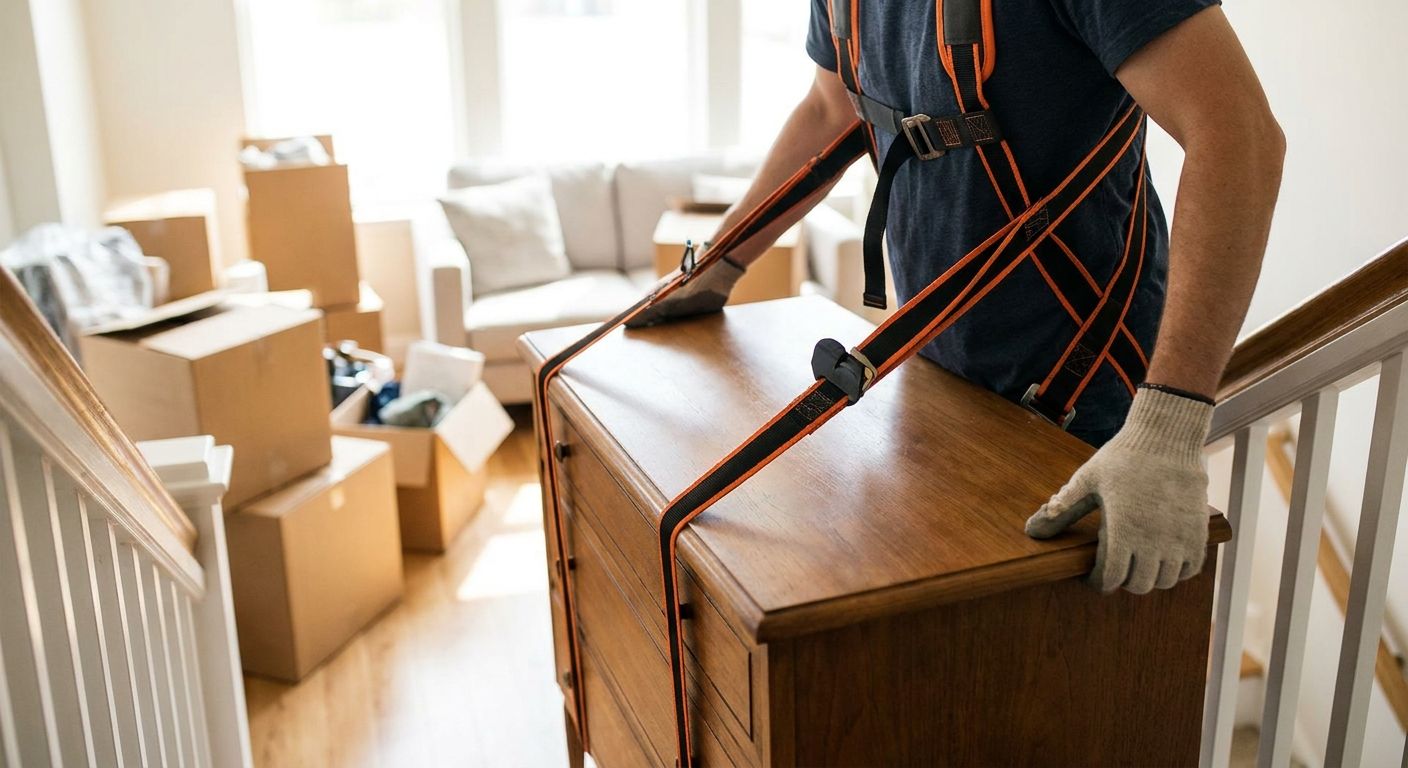
Hauling a dresser, loveseat, or mattress by yourself without wrecking your back comes down to one piece of gear: the right moving strap. This guide ranks the strap styles that actually work for solo furniture moves in 2026, not team-lift gear that assumes a second set of hands.
TL;DR
A strapped lift changes where the load sits on your body — off your lower back and onto your legs and shoulders. That's the difference between moving a dresser without incident and pulling a muscle you'll feel for a week.
If you're doing this once a year for a move, gear choice barely matters. If you're doing it weekly — picking up returned furniture, flipping dressers, or building a resale route — the wrong strap is a repeated injury risk and a slower job. Sharetown reps who pick up bulky retailer returns solo run into this exact problem daily: a couch or treadmill that needs to move from a truck to a garage with nobody else around.
Each pick below is ranked on load capacity for a single mover, strap design (shoulder/forearm harness vs. basic loop), and how well it holds up on repeated use rather than a one-time move. Weight figures reflect commonly published manufacturer ratings for each strap category, not one-off tests. Straps built for two people are noted where they still beat a solo-rated option on anything heavy.
This is the standard forearm forklift design scaled to one strap and one mover, looping under the item and across your forearm and shoulder. The two-person version of this same design is commonly rated up to 800 lbs in 2026, and the single-strap version is built to carry a proportional share of that load safely on one back.
What it does: redistributes the item's weight from your spine to your legs and shoulder, letting you walk a dresser or loveseat down a hallway without hunching over it.
Verdict: Buy. This is the default answer to best moving straps for furniture when you're working alone.
A padded shoulder harness with an adjustable strap loop, closer to a weightlifting belt than a webbing loop. It's built for repeated daily use, which matters if you're hauling furniture as part of a resale route rather than a single move.
What it does: locks the load against your hip and shoulder instead of your forearms, cutting arm fatigue on longer carries like from a truck to a second-floor apartment.
Verdict: Buy for daily use; Consider if you only move furniture a few times a year — the forearm strap above is cheaper and does the job.
No harness, no shoulder padding — just a webbing loop with a forearm cuff. Standard strap length across this category runs 9 to 14 feet, enough to wrap most dressers, loveseats, and mattresses.
What it does: gives you a grip point that isn't the furniture's edge, which helps on smooth surfaces like a dresser top or a boxed mattress.
Verdict: Consider for items under roughly 150 lbs like nightstands or dining chairs. Skip for anything sectional-sofa sized — a queen mattress alone runs 130-150 lbs, and this strap style has no shoulder support to carry that solo.
Standard tie-down ratchet straps, repurposed to cinch a furniture dolly and item together rather than lift the item directly. It's a workaround, not a purpose-built lifting strap.
What it does: keeps a heavy piece stable on a hand truck or dolly during transport, which matters more for stairs and ramps than flat-ground carries.
Verdict: Consider as a supplement to a real lifting strap, never as a replacement for one.
Technically not a solo product, but worth naming because it's the fallback the moment a piece is too heavy for one strap. A sectional sofa commonly weighs 250-400 lbs, well past what any single-strap harness is designed to carry safely.
What it does: splits the load across two movers using matched shoulder straps, cutting the per-person weight roughly in half.
Verdict: Buy if you can recruit a second person even occasionally — it's the only entry on this list rated for genuinely heavy furniture.
Forearm single-strap harness
Shoulder dolly solo strap
Basic padded forearm straps
Ratchet strap + dolly combo
Two-person shoulder dolly kit
Turn furniture hauling into income
Pick up, resell, and profit from retailer returns as a Sharetown rep.
Anyone building a route around picking up bulky returns solo runs into the same gear question fast — check side hustles for movers for how that route typically gets built, and best trailer setups for hauling furniture and mattresses for what carries the load once it's off your shoulders.
What are the best moving straps for furniture in 2026?
Forearm-style single-strap lifting harnesses are the best moving straps for furniture when you're working solo, since they shift weight onto your legs and shoulders instead of your back. Shoulder dolly straps are the better pick if you're hauling furniture daily rather than for one move.
Can one person move a couch with moving straps?
A loveseat or small couch is manageable with a forearm-style lifting strap, but a full sectional sofa at 250-400 lbs typically needs a second person even with straps. Weight, not the strap, is usually the limiting factor.
Are shoulder dolly straps better than forearm forklift straps?
Shoulder dolly straps add more padding and hip support, which matters for repeated daily hauling. Forearm forklift-style straps are lighter and cheaper, and work fine for occasional moves.
How much weight can a moving strap hold?
Two-person forearm-style straps are commonly rated up to 800 lbs total load in 2026, split across two movers. Single-strap solo versions carry a smaller share safely and aren't built for anything sectional-sofa sized.
Do moving straps work for mattresses?
Yes — a queen mattress weighs roughly 130-150 lbs, well within range for a basic padded forearm strap. King mattresses run heavier and benefit from a shoulder harness style strap instead.
What's the difference between moving straps and a furniture dolly?
Moving straps redistribute weight onto your body for a carry; a dolly rolls the item so you're pushing instead of lifting. Stairs favor straps, flat ground favors a dolly, and ramps often need both.
Can ratchet straps be used as moving straps?
Ratchet straps work to cinch furniture to a dolly or hand truck for stability, but they're not designed to be lifted with directly. Use them alongside a real lifting strap, not as a substitute.
How long should a moving strap be?
Standard moving straps run 9 to 14 feet, long enough to wrap a dresser, loveseat, or boxed mattress. Shorter straps under that range struggle to wrap bulkier items like sectional pieces.
The strap only solves half the problem — the other half is knowing what you're lifting before you commit to a solo carry. A sectional sofa at 250-400 lbs isn't a strap problem, it's a two-person problem, and no harness changes that math. Weigh the decision before you weigh the furniture.