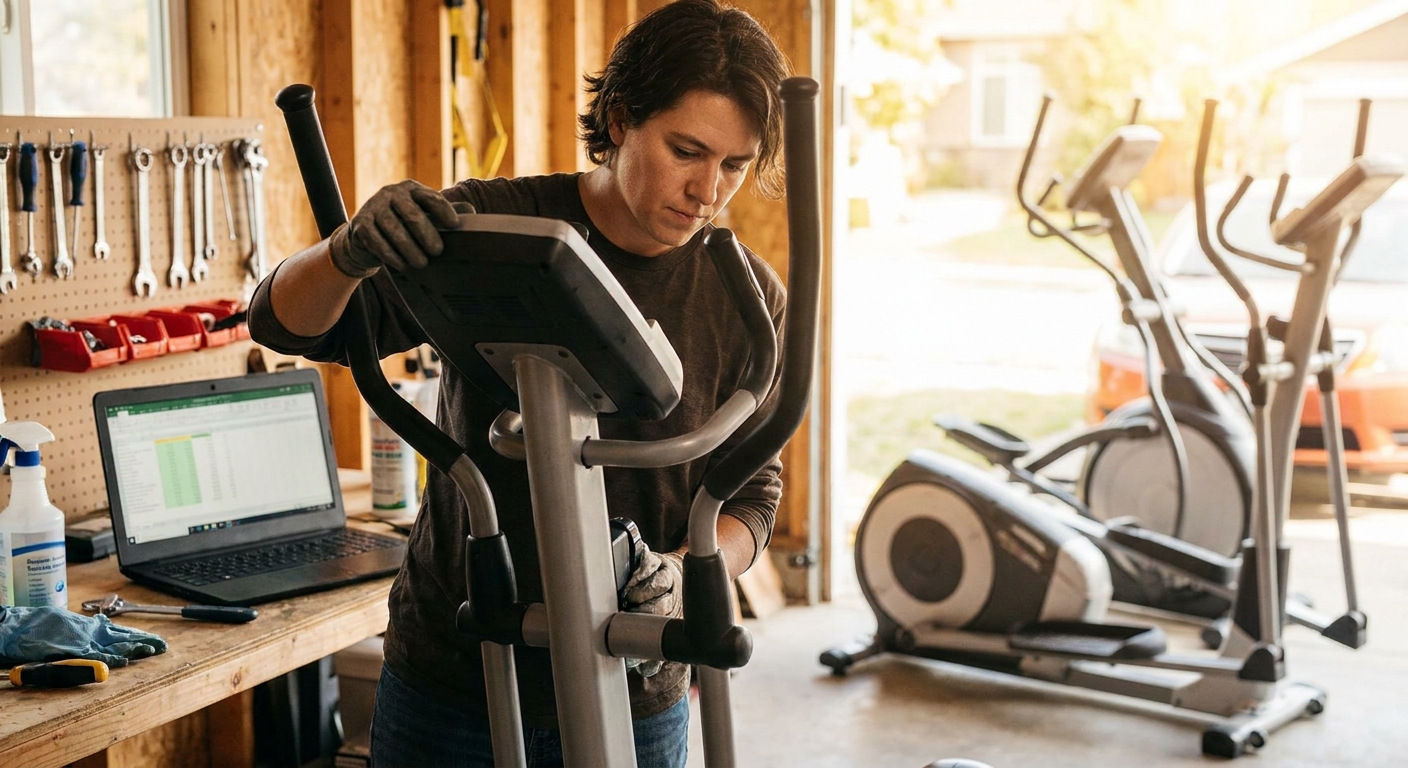
Retailers process thousands of elliptical returns every year — shipping damage, buyer's remorse, or a console that arrived with a scratch nobody wanted to keep. Those units land in liquidation pipelines at a fraction of retail, and reps who know what to grab (and what to skip) turn them into real weekly profit.
TL;DR
Home gym demand hasn't cooled off the way some retailers hoped after 2021 — treadmills, ellipticals, and rowers still get returned at a steady clip through 2026, and most of those returns are cosmetic, not mechanical. An elliptical that retailed at $1,200 might get liquidated for $150 to $250 because of a torn seat cover or a missing owner's manual. That gap is where the profit lives, and it's why fitness equipment shows up constantly in Sharetown rep pickup routes alongside mattresses and dressers.
The catch: ellipticals are heavier and bulkier than most flip categories, and a bad unit — cracked frame, seized flywheel — can sit in your garage for months. Knowing what separates a profitable elliptical flip from a storage liability is the whole game in 2026.
This guide is for reps and side-hustlers who already have a truck, van, or trailer and some square footage to stage a bulky item before resale — not someone flipping from an apartment. If you're already picking up returned mattresses or furniture, ellipticals are a natural add-on category because the buyer pool (home gym owners, small studios, garages) overlaps heavily with people already searching local marketplaces for fitness gear.
Magnetic resistance ellipticals have no contact brake pads to wear out, so a 2026-model magnetic unit with 20+ resistance levels holds resale value years longer than an older friction-brake machine. Test the resistance dial in person before you commit — a stuck resistance knob is a common defect on returns and it's an easy walk-away.
A compact or fold-up elliptical (under 6 feet by 2.5 feet footprint) moves faster because more buyers have small home gyms, garages, or apartments. Full-size commercial frames sell for more per unit but sit longer — factor that into how much storage time you can afford.
Units that retailed between $800 and $2,000 new hit the sweet spot for flipping ellipticals for profit: expensive enough that buyers expect quality, cheap enough that parts and consoles are still commodity-level to source if something's missing. Anything under $400 retail rarely clears repair costs once you factor your time.
The console is the single most expensive part to replace and the first thing to test on pickup — plug it in, cycle through programs, check the heart rate grips. A dead console on a $1,500 retail machine can turn a $200 buy into a total loss if you can't source a replacement part locally.
Spin the pedals by hand before loading anything. Grinding, clicking, or wobble in the pedal arms signals bearing wear that most casual buyers will notice on a test ride and use to negotiate your price down — or walk.
Check the stated weight capacity (commonly 300 to 400 lbs on mid-range models) and inspect welds at stress points. A bent or rusted frame is a hard skip regardless of how good the rest of the machine looks — you can't fix structural damage profitably.
Start picking up returns like this
Sharetown reps pick up fitness equipment returns from premium retailers and resell locally.
The safe pick — mid-range home ellipticals (Sole, Schwinn tier). Retail $900 to $1,500, magnetic resistance, 20+ programs, typically liquidated at 15-20% of retail when cosmetically damaged only. These move fastest in local listings because the brand names are recognizable to casual buyers. Verdict: Buy.
The wildcard — commercial-grade returns (NordicTrack Commercial, Precor). Retail $2,000 to $3,500, built for gyms and rated for daily heavy use, so resale buyers (small studios, serious home gym owners) will pay a premium — often 30-40% of original retail even used. The tradeoff is weight and footprint; these units can run 200+ lbs and need two people to move. Verdict: Consider if you have a helper and a dolly.
The fast flip — compact and under-desk ellipticals. Retail $300 to $600, small footprint, quick to move because apartment dwellers and small-space buyers search for these constantly. Margins are thinner in dollar terms but turnaround is often under two weeks. Pair this category with the pricing tactics in flipping exercise bikes for profit — the buyer psychology for compact cardio equipment is nearly identical. Verdict: Buy for volume, not margin.
The premium pick — Bowflex Max Trainer and hybrid step-ellipticals. Retail $1,000 to $1,800, strong brand recognition, and steady demand from buyers who specifically search the model name rather than "elliptical." That named-demand search behavior means you'll spend less time marketing the listing. Verdict: Buy when the console tests clean.
The risky pick — big-box budget ellipticals under $400 retail. These often use friction-brake resistance, plastic pedal arms, and console boards that aren't sold as replacement parts anywhere. Even a $50 buy-in can turn into a net loss once you count gas, storage, and listing time. Verdict: Skip unless it's essentially new.
Mid-range home (Sole/Schwinn)
Commercial-grade (NordicTrack/Precor)
Compact/under-desk
Bowflex Max Trainer/hybrid
Big-box budget
Is flipping ellipticals for profit actually worth it in 2026?
Yes, when you stick to units that originally retailed above $800 — the margin between liquidation price and local resale value covers your time and storage. Units under $400 retail rarely clear a profit once repair and hauling costs are counted.
What's the best elliptical brand to flip?
Mid-range magnetic-resistance brands like Sole and Schwinn move fastest because buyers recognize the names and the resistance systems rarely fail. Commercial brands like NordicTrack Commercial and Precor carry higher margins but need more space and muscle to move.
How much does a used elliptical sell for locally?
A cosmetically-flawed mid-range elliptical that retailed at $1,200 typically resells for $400 to $600 depending on condition and local demand in 2026. Commercial-grade units can resell for $700 to $1,200 even with visible wear.
Should I buy an elliptical with a broken console?
Only if you can confirm replacement parts are available and priced under what you'd gain from the flip. On most big-box budget models the console board isn't sold separately, which turns a broken console into a total loss.
How do I know if an elliptical's resistance system still works?
Cycle through every resistance level in person before you buy, listening for grinding or watching for a stuck dial. Magnetic systems fail less often than friction-brake systems, so a working magnetic resistance dial is a strong buy signal.
Where do returned ellipticals come from?
Premium retailers process returns from buyer's remorse, shipping damage, or cosmetic defects and route bulky items like ellipticals through liquidation or local pickup programs. Independent reps pick these units up directly from retailers before they hit landfill.
What weight capacity should a flip-worthy elliptical have?
Look for at least 300 lbs of stated weight capacity, which covers the broadest resale buyer pool. Higher-capacity commercial units, often rated to 400 lbs, appeal to studios and serious home gym buyers willing to pay more.
Is it better to flip ellipticals or exercise bikes?
Exercise bikes typically move faster because of smaller footprints and lower price points, while ellipticals carry higher per-unit margins but slower turnaround. Running both categories together spreads your risk across buyer types.
The fastest-selling ellipticals in 2026 aren't the cheapest ones — they're the mid-range magnetic units with a recognizable brand name, because buyers search the model directly instead of browsing generic listings. Skip the console-dead bargain bin units even at $50; the hours you'll spend trying to source parts cost more than the flip is worth.