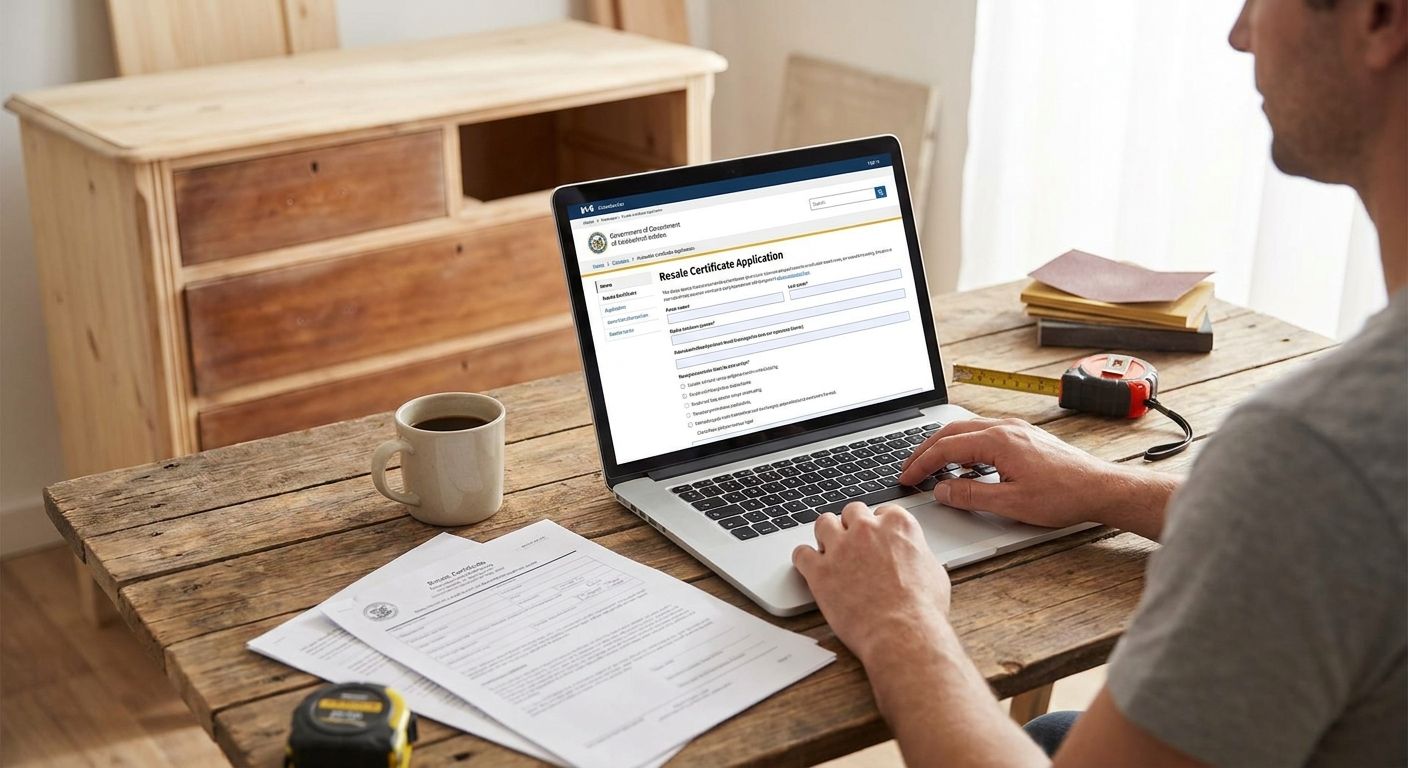
A resale certificate lets a furniture flipping business buy inventory tax-free from liquidators, wholesalers, and retailer return programs, then collect sales tax only when the piece actually resells. The process runs through your state's Department of Revenue, not the IRS, and most applications clear in 5 to 10 business days in 2026.
TL;DR
Without a resale certificate, every wholesaler, liquidation auction, and retailer return program charges you sales tax at purchase. Then you charge your buyer sales tax again at resale. That's double taxation on the same item, and it eats margin on every mattress, sectional, or dresser that moves through your business.
A resale certificate — sometimes called a seller's permit, sales tax exemption certificate, or reseller's license depending on the state — proves to suppliers that you're buying inventory to resell, not to keep. States still get their cut; they just collect it once, from the final buyer, instead of twice.
If you're still figuring out the basics of starting a resale business from your garage, the certificate is one of the first paperwork steps to knock out, right alongside picking a business structure.
States issue resale certificates to businesses, not individuals selling as a hobby. Filing a DBA or forming an LLC takes an afternoon in most states and usually costs under $100.
This step protects you two ways: it separates personal and business liability, and it gives the state a legal entity to attach the sales tax account to. Skipping it means your seller's permit application gets rejected or delayed while the state asks you to formalize the business first.
Common mistake: applying for the permit under a personal name and then trying to add a business name later. Fix the entity first.
An EIN is the business equivalent of a Social Security number, and most states require one before they'll open a sales tax account. Apply directly on IRS.gov — it's free and takes about 15 minutes, and you get the number immediately.
Skip any third-party site charging a fee for this. The IRS never charges for an EIN.
Expected outcome: a nine-digit EIN you can use for the state application, business banking, and tax filings.
This is the actual resale certificate application, filed through your state Department of Revenue (names vary: Comptroller, Board of Equalization, Tax Commission). Fees range from $0 to $100 depending on the state, and most approvals come back in 5 to 10 business days.
Oregon, Montana, Delaware, New Hampshire, and Alaska don't charge statewide sales tax, so there's no certificate to apply for if you only buy and sell inside those states. Every other state and Washington D.C. requires one.
Common mistake: assuming one state's certificate covers sales in another. If you're picking up returns or attending liquidation auctions across state lines, you may need a permit in each state where you register to buy, unless that state accepts the Streamlined Sales Tax certificate — 24 states currently do.
Once your seller's permit is approved, the state (or the multistate Streamlined Sales Tax form) gives you a resale certificate document. Fill in your business name, EIN, permit number, and a description of the goods you're buying to resell.
Be specific about categories: furniture, mattresses, fitness equipment. Vague descriptions like "general merchandise" get flagged more often during supplier reviews or audits.
Give a signed copy to each wholesaler, liquidator, or return program before you buy, not after. Most suppliers keep it on file and stop charging you sales tax on future purchases automatically.
Common mistake: forgetting to submit the certificate to a new supplier and eating sales tax on the first order because nobody flagged it before checkout.
Once you're buying tax-free, you're responsible for collecting and remitting sales tax when items resell — whether that's through a marketplace, a storefront, or cash sales. Most states want a return filed monthly, quarterly, or annually depending on your sales volume, even if you owe $0 that period.
Setting up a simple system now beats reconstructing records at filing time. If you haven't built one, tracking taxes for a furniture resale side hustle walks through what to log per sale.
Most states don't require annual renewal, but a handful do, and every state wants the certificate updated if your business name, address, or entity type changes. Most audits look back three to four years, so keep every version of the certificate on file that long, not just the current one.
Expected outcome: a certificate on file with every active supplier and a renewal date noted if your state requires one.
Turn returns into resale income
Sharetown reps pick up retailer returns and resell them locally.
A resale certificate is paperwork, not a business plan. Once it's filed, the real work is sourcing consistently and pricing to protect margin. If you're already flipping furniture and thinking bigger, scaling a furniture flipping side hustle into full-time income covers what changes once volume goes up.
How do I get a resale certificate for a furniture flipping business?
Register your business, get a free EIN from the IRS, then apply for a seller's permit through your state Department of Revenue. Most states issue the resale certificate within 5 to 10 business days in 2026 once the permit is approved.
How much does a resale certificate cost?
Fees range from $0 to $100 depending on the state. Some states, like California and Texas, charge nothing for the seller's permit that generates the certificate.
Do I need a resale certificate in every state I buy from?
Generally yes, unless that state is one of the 24 members accepting the Streamlined Sales Tax certificate, which covers multiple states with one form. Check each state's rules before buying across state lines.
Is a resale certificate the same as a seller's permit?
They're closely linked but not identical. The seller's permit is the state registration; the resale certificate is the document you present to suppliers proving you hold that permit.
Do private sellers need a resale certificate?
No. Resale certificates apply to purchases from registered businesses charging sales tax, not to garage sales, estate sales, or private individual purchases.
Which states don't require a resale certificate?
Oregon, Montana, Delaware, New Hampshire, and Alaska have no statewide sales tax, so there's no resale certificate to obtain if you're only buying and selling within those states.
What happens if I use a resale certificate but don't resell the item?
You owe use tax on that item, calculated as if you'd paid sales tax at purchase. States audit for this specifically, so keep certificates matched to actual resale activity.
Does a resale certificate expire?
Most states don't set an expiration date, but a few require periodic renewal. Update the certificate immediately if your business name, address, or entity type changes.
The certificate itself doesn't cost much and doesn't take long — the part flippers actually get wrong is treating every purchase as tax-exempt. Buy from a private seller at an estate sale with your resale certificate in hand, and it does nothing; that transaction was never taxed to begin with. Save the certificate for registered wholesalers, liquidation platforms, and retailer return programs, and the exemption works exactly as designed in 2026.