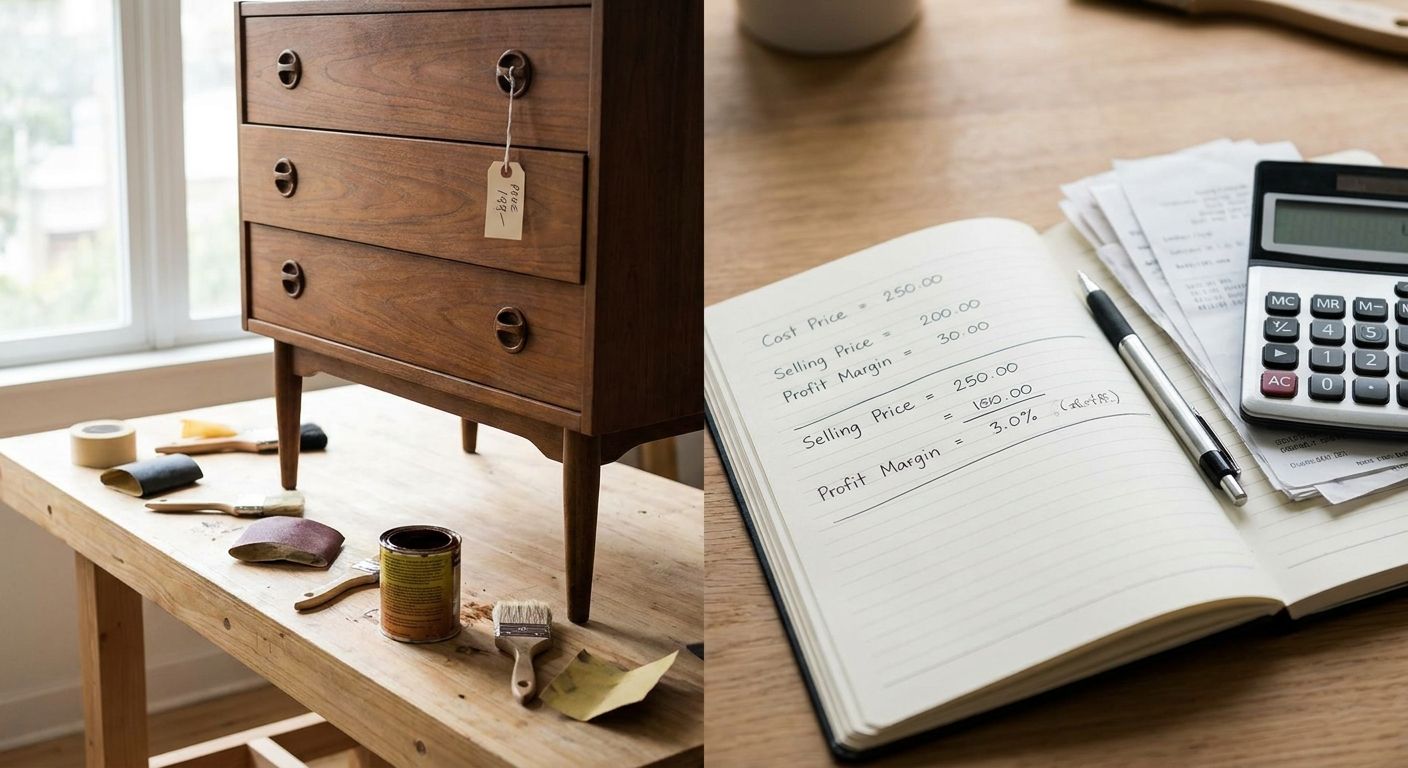
Profit margin is the number that tells you if a furniture flip actually made you money or just kept your garage full and your gas tank empty — the formula takes two minutes to run once you know what to count.
TL;DR
Profit dollars feel good. Profit margin tells you whether the business scales. A flip that clears $80 on a $200 sale (40% margin) is a better use of your time in 2026 than one that clears $80 on a $500 sale (16% margin), even though the dollar amount looks identical on paper.
Margin is also the number that exposes bad habits before they cost you real money — overpaying at pickup, underpricing out of impatience, or ignoring mileage until tax season. Reps working with Sharetown move enough volume that a 10-point margin gap across 20 flips a month is the difference between a decent side hustle and a real income stream.
This is what you actually paid to get the item into your hands — not the sticker price you negotiated down from, the number you settled on. If you bought a dresser for $45 after negotiating prices on secondhand items, $45 is your acquisition cost, full stop.
Common mistake: logging the asking price instead of the final negotiated price, which overstates your margin before you've even started.
Mileage, cleaning supplies, repair parts, and any tools bought specifically for this flip all belong in total cost. A 20-mile round-trip pickup burns real fuel in 2026, and that goes into the ledger, not into a mental close-enough bucket.
Expected outcome: your true cost on that $45 dresser lands closer to $65 once mileage and a bottle of wood cleaner are added in.
Price on what comparable pieces are actually selling for locally, not what you hope to get. A guide on pricing used furniture before you resell it covers comp research in depth — the short version is pull 5 to 8 sold listings, not active ones, since active listings are aspirational and sold listings are real.
Common mistake: anchoring to the highest comp you find instead of the median.
Subtract total cost from sale price. Sell that dresser for $160 against $65 in total cost and gross profit is $95.
Formula: Sale Price − Total Cost = Gross Profit.
This is the step most flippers skip, and it's the one that lets you compare flips against each other.
Formula: (Sale Price − Total Cost) ÷ Sale Price × 100 = Profit Margin.
Running the dresser numbers: 95 divided by 160, times 100, equals 59% margin. That 59% is the number to write down, not the $95.
Divide gross profit by hours spent — pickup, cleaning, listing, meeting the buyer — to get an implied hourly rate. If that $95 took 3 hours, you earned about $31 an hour, a useful reality check before committing a whole Saturday to a thin-margin piece.
Common mistake: judging a flip purely on margin percentage, which hides a great-margin item that ate six hours.
Set a personal threshold. Many flippers won't touch an item below 40% to 50% margin, because that cushion absorbs a slow sale, a price drop, or a surprise repair. Track the floor per category — dressers, sofas, mattresses — since margins vary by item type and local competition.
Expected outcome: within a few months you'll see which categories clear your floor and which ones you should stop buying in 2026.
A spreadsheet with columns for item, acquisition cost, hidden costs, sale price, gross profit, and margin turns guesswork into a pattern you can optimize. It's also the record you want when you track taxes for a furniture resale side hustle, since acquisition cost and expenses reduce taxable income.
Turn flips into steady income
Pick up returned furniture from premium retailers and resell it locally.
Margin looks strong but your bank account isn't moving. You're counting gross profit and skipping mileage, supplies, or platform fees. Rebuild the total cost line before trusting the percentage.
An item sits unsold and margin shrinks with every price drop. Recalculate at each new price point instead of anchoring to your original listing. A 60% margin item that drops 20% to move lands closer to 45%, which changes whether it was worth buying.
Mileage feels like guesswork. Log actual round-trip miles per pickup and delivery from your phone's maps app, then apply a per-mile cost so every flip carries a real number.
You're confusing markup with margin. Markup divides profit by cost; margin divides profit by sale price. A 100% markup on a $50 item sold for $100 is only a 50% margin — mixing them up inflates how healthy the business looks.
Cleaning and repair costs aren't logged per item. A shared bottle of upholstery cleaner doesn't need penny-level tracking, but a rough per-flip estimate keeps total cost honest.
All categories share one average. Sofas, dressers, and mattresses carry different margin profiles. One blended average hides which category is actually paying you.
Once margin tracking is a habit on single flips, the next question is volume — how many flips a month move this from side cash toward full-time income. Work that math before you scale up pickups in 2026.
How do you calculate profit margin on a furniture flip?
Subtract total cost from sale price, divide the result by sale price, then multiply by 100. Total cost must include acquisition price, mileage, cleaning supplies, repairs, and marketplace fees.
What is a good profit margin on a furniture flip in 2026?
Many flippers set 40% to 50% as their floor, since that cushion covers a slow sale or an unplanned repair. Fast-moving categories like dressers and coffee tables often clear more when acquisition cost stays low.
Is profit margin the same as markup?
No. Markup divides profit by cost, while margin divides profit by sale price, so the two numbers are never equal. A 100% markup on a $50 item sold for $100 is only a 50% profit margin.
Should mileage count toward the cost of a furniture flip?
Yes, mileage for pickup and delivery is a real cost and belongs in total cost. Skipping it is the most common reason a flip's real margin comes in lower than the flipper assumed.
How much do marketplace fees affect furniture flip margin?
Fees vary by platform and payment method, so check the current schedule before you list. Even a modest per-sale fee changes the calculation and should come off sale price before you finalize the number.
Does time spent affect profit margin?
Time does not change the margin percentage, but it changes your implied hourly rate. A 60% margin flip that eats six hours can be a worse use of a weekend than a 45% margin flip that takes ninety minutes.
How do you track profit margin across multiple flips?
Log acquisition cost, hidden costs, sale price, and margin percentage for every item in one spreadsheet. Reviewing that log monthly shows which furniture categories consistently hit your target margin.
Can a high sale price still mean a low profit margin?
Yes. A $500 sale with $420 in total cost nets 16% margin, while a $200 sale with $120 in total cost nets 40%. Margin percentage, not sale price, shows which flip was the better deal.
Flippers who scale past side income treat margin as a filter, not a scoreboard. They walk away at the pickup if the math doesn't clear their floor, instead of buying first and hoping the numbers work later. Set the percentage floor before you shop in 2026, not after the truck is already loaded.