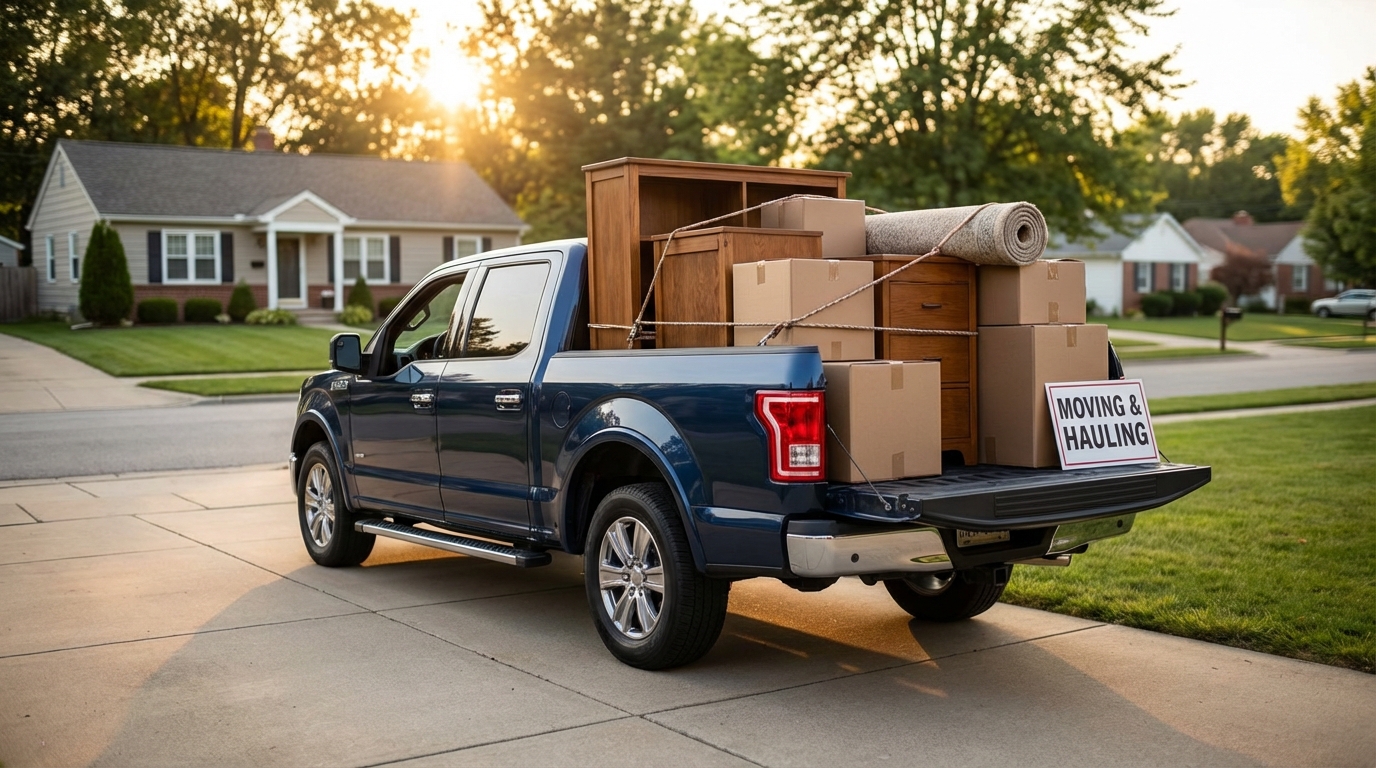
If you own a pickup truck, you're sitting on a business asset that most people only use for weekend hardware store runs. A reliable truck — whether it's an F-150, Ram 1500, Silverado, or Tacoma — is the foundation for dozens of legitimate business opportunities, many of which require little to no startup capital beyond the vehicle you already have.
The beauty of truck-based businesses is their accessibility. You don't need a degree, a storefront, or significant savings to get started. What you need is a truck, a willingness to hustle, and a plan.
This guide covers 20 pickup truck business ideas ranked by income potential, startup cost, and how realistic each one is as a full-time income replacement. Whether you're looking for a flexible side hustle or a full-blown business that can replace your 9-to-5, there's an option here for you.
Each idea is evaluated on four criteria:
Let's get into it.
Income potential: $3,000–$8,000+/month
Startup cost: $0
Barrier to entry: Low — just need a truck and a clean background check
Scalability: High — accept more pickups as you grow
This tops the list for a reason: it's the rare truck business with genuinely zero startup cost and built-in demand.
Sharetown partners with major DTC mattress, furniture, and fitness equipment brands to handle their product returns. As a Sharetown rep, you receive dispatch requests to pick up returned items from customers' homes. You transport, clean or refurbish the item, then resell it on platforms like Facebook Marketplace or OfferUp — keeping the resale profit.
What makes this different from starting your own hauling company or junk removal service:
If you already have a truck and want to start earning this week, becoming a Sharetown rep is the fastest path from "I own a truck" to "I'm making money with my truck."
Income potential: $50,000–$150,000/year
Startup cost: $2,000–$10,000 (insurance, licensing, marketing)
Barrier to entry: Moderate — need insurance, waste hauler permits
Scalability: Very high — 1-800-GOT-JUNK started as one truck
Junk removal is one of the most proven truck-based businesses. Homeowners, renters, and businesses constantly need stuff hauled away — and they'll pay a premium for the convenience.
The economics are straightforward: charge $150–$500 per job depending on the load size, spend $20–$60 on dump fees, and pocket the difference. A motivated solo operator can complete 3–5 jobs per day.
Getting started requires some setup: business registration, general liability insurance, commercial auto insurance, and local permits. But once you're operational, the demand is consistent year-round.
For a complete startup roadmap, check out our guide on how to start a junk removal business. And if you want to combine junk removal with resale income, read about the junk removal side hustle opportunity.
Income potential: $40,000–$100,000/year
Startup cost: $1,000–$5,000 (insurance, moving blankets, dollies)
Barrier to entry: Moderate — state regulations vary for movers
Scalability: High — add trucks and crew as demand grows
Small, local moves are a massively underserved market. Full-service moving companies charge thousands for full-house moves, but there's a huge market for affordable help with single-item moves, apartment relocations, and small loads.
Platforms like TaskRabbit, Dolly, and HireAHelper connect truck owners with people who need moving help. You can also market directly on social media and Craigslist.
Pro tip: Specialize in a niche. "College student move-in/move-out specialist" or "single-item large furniture moves" narrows your market but reduces competition and lets you charge premium rates.
Income potential: $40,000–$80,000/year
Startup cost: $500–$2,000 (bed liner, marketing)
Barrier to entry: Low
Scalability: Moderate
Homeowners renovating their yards need mulch, gravel, topsoil, river rock, and sand delivered — and many landscape supply companies charge $75–$150 for delivery. With your truck, you can offer the same service at competitive rates or partner with landscape suppliers who don't have their own delivery fleet.
Spring and summer are peak season, with demand dropping in winter. Many operators combine this with other seasonal services (snow removal, firewood delivery) to maintain year-round income.
Income potential: $20,000–$60,000/year (seasonal)
Startup cost: $500–$3,000 (chainsaw, splitter, PPE)
Barrier to entry: Low
Scalability: Moderate — limited by season and sourcing
Firewood is a surprisingly profitable commodity. A cord of seasoned firewood sells for $250–$450 depending on your region, and a single truckload can carry half a cord to a full cord. If you have access to timber (fallen trees, tree removal byproduct, logging contacts), your sourcing cost is primarily labor and fuel.
The business is seasonal (fall and winter), but those peak months can generate significant income. Many firewood businesses build a loyal annual customer base that reorders every season.
Income potential: $40,000–$90,000/year
Startup cost: $500–$2,000 (basic tools, insurance)
Barrier to entry: Low to moderate — basic installation knowledge helpful
Scalability: Moderate
Big-box retailers and appliance stores frequently outsource delivery to independent contractors. You can also offer private appliance delivery for people who buy used appliances on Marketplace or at scratch-and-dent stores.
Adding basic installation (hooking up washers, dryers, dishwashers) significantly increases your per-job earnings. A delivery-only job might pay $50–$80, but delivery plus installation can command $150–$250.
Income potential: $30,000–$80,000+/year
Startup cost: $200–$1,000 (tools, supplies)
Barrier to entry: Low — learning curve on restoration skills
Scalability: Moderate — limited by your workspace and time
Your truck gives you a massive advantage in the furniture flipping world. While other flippers are restricted to items they can fit in a sedan, you can pick up couches, dining tables, dressers, and other high-value pieces that most people can't transport.
The process: source undervalued furniture from estate sales, thrift stores, and curbside finds → restore/refinish → sell on Facebook Marketplace or OfferUp. A good flipper can complete 2–5 flips per week with average profits of $75–$300 per piece.
For sourcing ideas beyond traditional channels, learn about the best things to flip for profit and how platforms like Sharetown provide consistent inventory.
Income potential: $60,000–$150,000/year
Startup cost: $5,000–$20,000 (trailer, authority, insurance)
Barrier to entry: High — USDOT number, MC authority, commercial insurance
Scalability: High — add trucks and drivers
Hotshot trucking means hauling time-sensitive, less-than-truckload (LTL) freight using a heavy-duty pickup (typically 1-ton like a Ram 3500 or F-350) and a flatbed trailer. You're essentially running a small freight operation without the overhead of a semi-truck.
Loads are found through freight brokers and load boards (DAT, Truckstop.com). The startup costs are higher than most options on this list, but the income potential matches or exceeds a traditional full-time job.
Income potential: $40,000–$90,000/year
Startup cost: $1,000–$3,000 (insurance, permits)
Barrier to entry: Low to moderate
Scalability: High
Contractors need someone to haul away drywall scraps, old lumber, roofing materials, and construction debris. Most contractors hate dealing with cleanup — it's unproductive time they'd rather spend building. That's your opportunity.
Build relationships with local contractors, general contractors, and renovation companies. Offer reliable, same-day or next-day pickup. Once you're a contractor's go-to hauler, the recurring work is extremely consistent.
Income potential: $40,000–$80,000/year
Startup cost: $2,000–$5,000 (equipment, supplies, water tank)
Barrier to entry: Low
Scalability: Moderate to high
Your truck bed serves as a mobile workshop. A water tank, pressure washer, generator, and detailing supplies turn your pickup into a professional detailing rig. You drive to the customer, not the other way around.
Basic washes might bring $30–$50, but full interior/exterior details with ceramic coating can command $200–$500. Fleet accounts (dealerships, rental agencies) provide reliable recurring revenue.
Income potential: $20,000–$60,000/year (seasonal)
Startup cost: $3,000–$8,000 (plow attachment, salt spreader)
Barrier to entry: Moderate — equipment investment
Scalability: Moderate
In regions with regular snowfall, a truck-mounted plow is a money-making machine during winter months. Residential driveways pay $25–$75 per push, while commercial parking lots can bring $150–$500+ per storm.
The key is locking in seasonal contracts before winter hits. Property management companies, HOAs, and commercial properties will pay monthly retainers for guaranteed snow removal — giving you predictable income throughout the season.
Income potential: $30,000–$70,000/year
Startup cost: $500–$2,000
Barrier to entry: Low (in rural areas)
Scalability: Moderate
Rural areas offer unique opportunities: hauling hay bales, transporting livestock feed, moving equipment between properties, and handling agricultural supply runs. Farmers and ranchers often need extra trucking capacity during harvest season, planting season, and livestock sales.
If you're in a rural or semi-rural area, this can be highly profitable during peak agricultural seasons and combined with other services during off-seasons.
Income potential: $30,000–$60,000/year
Startup cost: $500–$1,000 (insurance, marketing)
Barrier to entry: Low
Scalability: Moderate
Many local businesses — nurseries, building supply stores, antique shops, small furniture stores — don't have their own delivery trucks. Offer yourself as their on-call delivery service. A consistent arrangement with 3–5 businesses can fill your weekly schedule and provide reliable income.
This works especially well when combined with an app like Roadie or GoShare, which connect truck owners with businesses and individuals who need same-day deliveries of large items.
Income potential: $25,000–$50,000/year
Startup cost: $500–$1,000
Barrier to entry: Low
Scalability: Low to moderate
When people win items at estate sales or auctions, they often can't transport them. Position yourself as the hauler on-call at local estate sales and auction houses. You show up, help load, deliver to the buyer's home, and charge by the item or load.
Building relationships with estate sale companies is the key — once they know and trust you, they'll recommend you to every buyer who asks, "How do I get this home?"
Income potential: $25,000–$50,000/year
Startup cost: $1,000–$3,000 (hitch setup, insurance)
Barrier to entry: Low to moderate
Scalability: Low to moderate
If your truck has adequate towing capacity, hauling boats, RVs, campers, and trailers for private sellers is a niche but profitable business. People buying used boats or campers from out-of-state sellers need someone to transport them. Rates of $1.50–$3.00 per mile are standard, and a single long-distance haul can pay $500–$2,000.
Platforms like uShip connect haulers with people who need vehicles and equipment transported.
Income potential: $40,000–$80,000/year
Startup cost: $3,000–$6,000 (pressure washer, water tank, surface cleaner)
Barrier to entry: Low
Scalability: Moderate to high
Driveways, patios, decks, fences, and building exteriors all need periodic cleaning. A truck-mounted pressure washing rig with a water tank lets you serve customers anywhere. Residential jobs pay $150–$400, and commercial contracts can bring $500–$2,000 per project.
Like mobile detailing, this business benefits from your truck serving as both transport and workspace.
Income potential: $20,000–$50,000/year
Startup cost: $200–$500 (magnet, basic tools)
Barrier to entry: Very low
Scalability: Low to moderate
Collecting scrap metal, appliances, and recyclable materials and selling them to scrap yards is one of the lowest-barrier truck businesses. Copper, aluminum, and steel all have commodity value. Old appliances (washers, dryers, HVAC units) are particularly valuable for their metal content.
Drive through neighborhoods on bulk trash day, respond to "free" listings on Marketplace, and offer free appliance removal. Your truck fills up, you drive to the scrap yard, and you get paid by weight.
Income potential: $30,000–$60,000/year
Startup cost: $300–$800 (equipment, marketing)
Barrier to entry: Very low
Scalability: Moderate
Yes, this is a real (and growing) business. Pet owners will gladly pay $15–$30 per week for someone to clean their yard. Build a route of 30–50 regular clients, and you've got a full-time income from a service nobody else wants to do — which is exactly why it's profitable.
Your truck gets you between jobs quickly and carries your equipment. It's not glamorous, but the recurring revenue model is strong.
Income potential: $40,000–$80,000/year
Startup cost: $3,000–$10,000 (tow equipment, licensing)
Barrier to entry: Moderate — state licensing, equipment
Scalability: Moderate
If your truck is heavy-duty enough, offering light-duty towing and roadside assistance (jump starts, tire changes, lockouts, fuel delivery) is a high-demand service. Partner with roadside assistance networks (AAA subcontracting, Agero, HONK) for a steady stream of calls.
Income potential: $10,000–$30,000/year (seasonal — November/December only)
Startup cost: $2,000–$5,000 (inventory, permits)
Barrier to entry: Low
Scalability: Low to moderate
A hyper-seasonal but very profitable side business. Source Christmas trees wholesale from farms ($15–$30 per tree), sell them roadside or via delivery for $60–$150+ each. Your truck handles both supply runs and customer deliveries. Six weeks of work can generate a significant income boost.
With 20 options to consider, here's how to narrow it down:
Assess your truck. A half-ton pickup (F-150, Ram 1500) handles most of these businesses. Hotshot trucking and heavy towing require a 1-ton (F-350, Ram 3500). Know your truck's payload and towing capacity before committing.
Calculate your startup budget. Some of these businesses need $0 to start (Sharetown, scrap collection). Others require $5,000–$20,000 in equipment and licensing. Be honest about what you can invest today.
Consider your market. Snow plowing doesn't work in Phoenix. Firewood delivery is limited in South Florida. Look at what your local market actually demands.
Match your skills and interests. Are you handy? Furniture flipping and pressure washing play to those strengths. Are you organized? Junk removal and moving services need logistics skills. Do you prefer working alone or with clients? That narrows the list significantly.
Think about income goals. If you need to replace a $60,000 salary, focus on the higher-income options: junk removal, hotshot trucking, Sharetown rep work, or moving services. If you're supplementing existing income, the seasonal and part-time options work well.
The most successful truck business owners follow a similar path:
If you're looking to earn $1,000 a week or more with your truck, the combination of a primary truck business (junk removal, Sharetown, moving) supplemented with seasonal add-ons (snow plowing, firewood, Christmas trees) creates a resilient, full-time income stream.
If you're still deciding which direction to go, here's our honest recommendation: start with Sharetown.
Not because it's the only option — but because it costs nothing to start, requires no business registration, and generates income from day one. It gives you real experience hauling, interacting with customers, and managing a flexible schedule — all skills that transfer directly to any other truck business on this list.
Many Sharetown reps start with mattress and furniture pickups and eventually expand into junk removal, moving, or other services on the side. The Sharetown income provides a financial foundation while you explore other opportunities.
Here's what you get as a Sharetown rep:
Apply to become a Sharetown rep today and start putting your truck to work.
The most profitable truck businesses depend on your market and effort level. Junk removal and hotshot trucking offer the highest earning potential ($100,000+/year at full scale), while Sharetown rep work and furniture flipping offer excellent income with minimal startup cost. The best choice balances your income goals with your available capital and skills.
Truck-based businesses can realistically generate $30,000 to $150,000+ annually depending on the business type, hours worked, and market. Part-time operators typically earn $1,000–$4,000/month, while full-time operators in high-demand services like junk removal or hauling can exceed $10,000/month.
For most businesses on this list, a standard driver's license is sufficient. Hotshot trucking with a trailer over 10,001 lbs GVWR requires a USDOT number and potentially a CDL depending on the configuration. Junk removal may require waste hauler permits in certain states. Check your state and local requirements before starting.
A half-ton pickup (F-150, Ram 1500, Silverado 1500, Tundra) handles the vast majority of truck-based businesses. For hotshot trucking, heavy towing, or commercial-scale hauling, a 3/4-ton or 1-ton truck (F-250/350, Ram 2500/3500) is recommended. Sharetown pickups, junk removal, furniture flipping, and most delivery services work perfectly with a half-ton.
Yes. Sharetown rep work requires zero startup cost — just your truck and a clean background check. Scrap metal collection needs minimal investment (a magnet and basic tools). Furniture flipping can start with free curbside finds. Even junk removal can launch with just insurance and a listing on Craigslist or TaskRabbit.
Furniture flipping, junk removal, Sharetown pickups, pressure washing, and detailing all work well on a weekend-only schedule. Many operators earn $500–$1,500 per weekend in these businesses. The key is focusing on services where customers expect weekend availability — which is most residential services.