There's no fixed timeline for becoming profitable as a new reseller. You cross into profit the moment your total sales cover what you spent on pickup, storage, and prep, and for most people that happens within their first several completed sales rather than on a set week or month. The catch is that storage time and unsold inventory quietly eat into that math long before you notice it, which is why two people picking up the exact same items can hit profitability at very different speeds.
TL;DR
New resellers often expect a clean finish line, like being profitable by a certain month, but reselling doesn't run on a calendar. Some sellers cover their pickup and prep costs on the very first item if it's priced right and moves fast. Others take longer because inventory sits in a garage, pricing is off, or the category they picked up moves slowly in their local market in 2026.
Looking at how long it typically takes to flip furniture for profit helps set realistic expectations instead of guessing at a number. The real goal isn't hitting profitability by a specific date. It's shortening the gap between picking an item up and getting paid for it, sale after sale.
Profit isn't the same thing as revenue. If you sell an item for a decent amount but spent just as much on gas, cleaning supplies, and weeks of garage space to hold it, you haven't actually made money, you've broken even at best. Tracking your running costs against your running sales total, even loosely, is the only honest way to know where you stand.
This is especially true heading into 2026, as more categories of returned furniture, mattresses, and fitness equipment move through local resale channels and competition on marketplaces grows. Sellers who track cost per pickup against sale price catch a slow, unprofitable pattern early instead of finding out months in.
Profitability comes down to a simple breakeven point: once your total resale income covers what you spent picking up, storing, and prepping your inventory, everything after that is profit. The reseller who lists fast and prices to move reaches that point sooner than the one who holds out for a higher offer, even if the slower seller eventually gets a better price per item.
Here's how the two approaches typically compare:
Listing timeline
Pricing approach
Storage use
Cash flow
The fast-turnover approach isn't about rushing or underpricing. It's about treating storage time as a real cost, because every week an item sits unsold is a week it isn't generating income.
If you're picking up returned furniture, mattresses, or fitness equipment as a Sharetown Rep, this same math applies directly. You earn after an item resells, so your personal timeline to profit mirrors how quickly you move from pickup to completed sale, not how many items you've collected along the way.
A handful of factors decide whether you clear your costs in your first few sales or several months in:
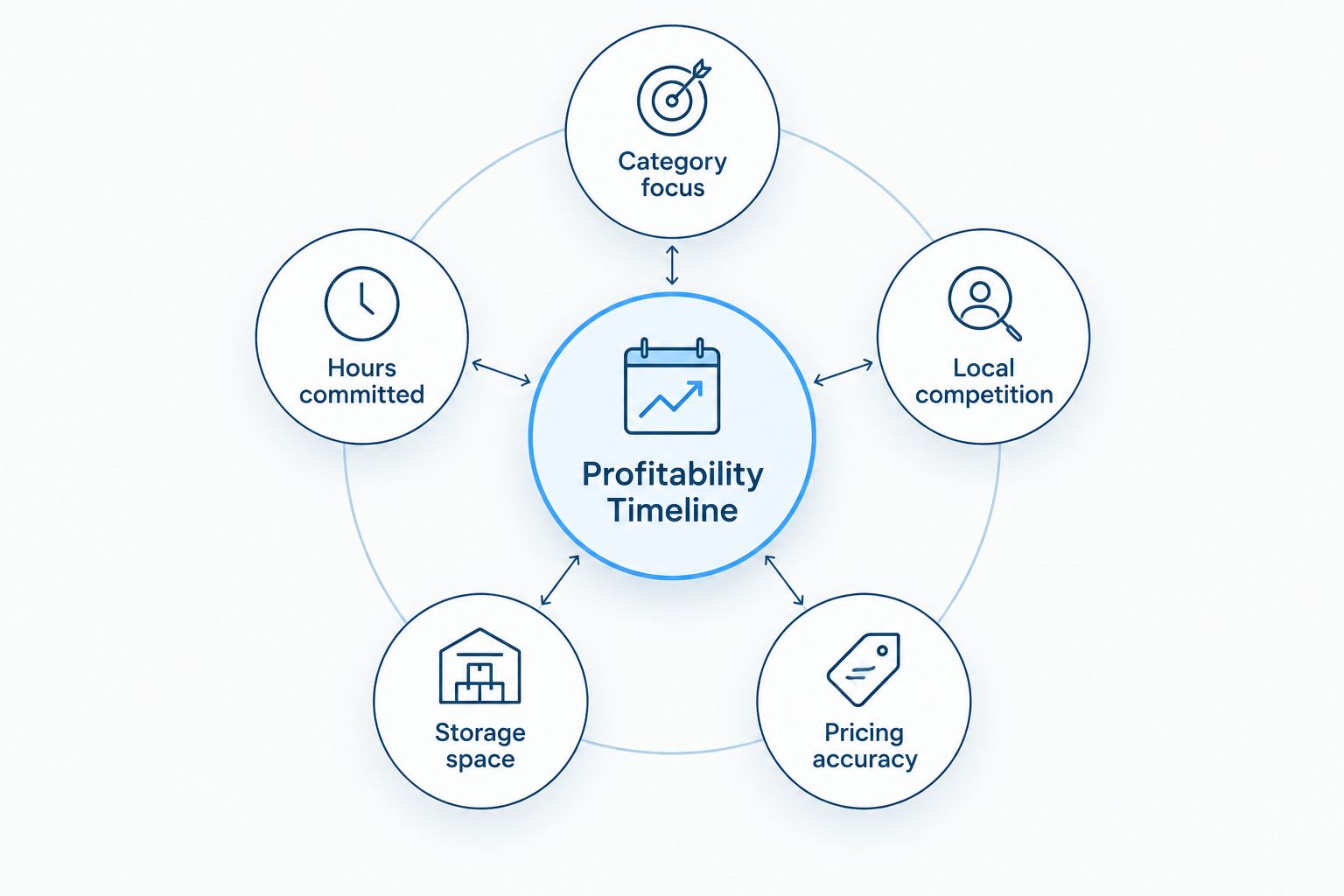
Category choice and pricing accuracy tend to move the timeline more than any single tactic.
None of these factors act alone. A seller with plenty of storage but poor pricing will still stall out, and a sharp pricer with no storage space at all will feel pressure to sell before they've built any real routine. Profitability speeds up when several of these line up at once, not when you fix just one.
Some upfront cost is usually involved, whether that's gas for pickups, basic cleaning supplies, or space to store items before they sell. The exact amount depends heavily on what you're picking up and how you're picking it up, which is covered in more detail in how much money you need to start flipping furniture.
Being busy with pickups and listings doesn't automatically mean you're making money. Track your profit margin per item, not just your total number of sales, since a full schedule of low-margin flips can leave you working hard for very little actual profit. The math behind that gets broken down in how to calculate profit margin on a furniture flip.
Yes. Items with steady, everyday demand, like mattresses, dressers, and sectionals, generally move faster locally in 2026 than niche or bulky specialty pieces, which shortens the time between pickup and payout.
That depends on your local market and how quickly you list, not a set number of days. Sellers who photograph and post an item within a day or two of pickup, priced close to what similar local listings are actually selling for, tend to see interest much sooner than those who let items sit unlisted while they decide on a price.
Once you understand the breakeven math, the fastest way to test it is to actually pick up and resell something.
Start earning as a Sharetown Rep
Pick up, store, list, and resell returned furniture near you.
How long does it take to become profitable as a new reseller?
There's no fixed timeline: you become profitable once your sales cover what you spent on pickup, storage, and prep, which for most sellers happens within their first several completed sales rather than a set number of weeks. Turnover speed matters more than the price you eventually get for any single item.
How many items do I need to sell before I break even?
It depends entirely on what those items cost you to pick up, store, and prep, not a fixed count. Tracking your running costs against your running sales total is the only reliable way to know when you've crossed into profit.
Does storage space affect how fast I become profitable?
Yes. Limited storage forces faster listing and selling decisions, while a garage full of unsold inventory quietly ties up cash and space without generating income.
Is furniture resale profitable faster than reselling clothing?
Furniture and mattresses typically involve higher per-item value than clothing, so fewer sales are needed to cover the same amount of pickup and storage costs. That doesn't guarantee faster profitability, since furniture also takes longer to sell than smaller items.
How much money do I need to start reselling furniture in 2026?
Some upfront cost is normal, covering things like gas for pickups, cleaning supplies, or short-term storage, and the exact amount depends on what you pick up. A closer breakdown is available in Sharetown's guide on how much money you need to start flipping furniture.
Do Sharetown Reps get paid before an item resells?
No. Sharetown Reps earn after the item they picked up actually resells, so a Rep's personal profitability timeline follows how quickly their inventory sells locally.
What's the fastest way to speed up my time to profitability?
List items within days of pickup instead of letting them sit, and price close to what comparable local listings are actually selling for rather than guessing at retail value.
Does specializing in one furniture category help you profit faster?
Usually yes, since sticking to a category you understand well speeds up pricing decisions and helps you spot which items in your area sell quickly versus which ones sit.
The fastest way to shorten your time to profit usually isn't better pricing or better photos. It's turning down items you already suspect will be hard to move locally, since a piece that sits in your garage for months costs you storage space and time even if it eventually sells in 2026. Being selective about what you pick up in the first place often does more for your profitability timeline than any pricing trick ever will.