You need enough clean, dry, accessible space to store your furniture inventory and still inspect, photograph, and move each item without blocking exits. There is no universal square-footage requirement: item dimensions, doorways, and your working layout determine what fits. For your resale plan, measure usable space rather than treating an empty room’s total floor area as inventory capacity.
TL;DR
You have enough storage when you can retrieve any item safely without turning the rest of your inventory into an obstacle. A room that holds furniture tightly packed together is not necessarily a workable resale space.
Start by measuring the furniture you expect to handle, then check the route from your vehicle to its storage position. Include doors, corners, stairs, and anything that narrows the path. Our guide to how to store furniture and mattresses before a resale pickup covers the next part of that process.
Use this sequence before committing to inventory:
Keep your measurements in consistent units. Multiplying length by width gives a rectangular footprint, but that footprint does not include handling clearance or account for awkward shapes.
Furniture resale involves more than holding products until a buyer responds. You need to document condition, create listings, answer questions, and make sold items accessible.
In your setup, treat storage as part of that selling process. If reaching a dresser requires shifting the rest of the room, every inspection and pickup becomes another moving job.
Protect working space before adding inventory. Extra pieces are not useful if they prevent you from photographing or retrieving the products already waiting to sell.
A garage, spare room, and rented storage unit each offer different advantages. None is automatically suitable simply because it has an empty floor.
Garage
Spare room
Storage unit
A garage is useful when furniture can travel directly between the loading area and its storage position. Mark the floor area that remains available after accounting for everything your household needs to keep there.
Do not plan around temporary space. If you must empty the garage each time someone parks, that layout does not provide dependable inventory storage.
A spare room deserves consideration when the moving route accommodates your intended furniture. Walk that route before accepting a bulky item.
An upstairs room with ample floor space still requires moving inventory up and down stairs. Consider the handling work as well as the room itself, and keep household exits clear.
Before renting a unit, ask the facility about inventory storage, photography, buyer visits, and other activities you intend to carry out. Confirm the rules rather than assuming a unit functions as a showroom or workshop.
Check the loading route in person. A suitable unit needs more than enough interior space; you also need practical access when collecting inventory and preparing sold items to leave.
For a practical layout, give each activity a place. You can reuse the same clear area for different tasks, but keep stored furniture out of the route you need for moving it.
Keep item records tied to their storage positions. A simple inventory list should identify the piece, its condition, listing status, and where its hardware is stored.
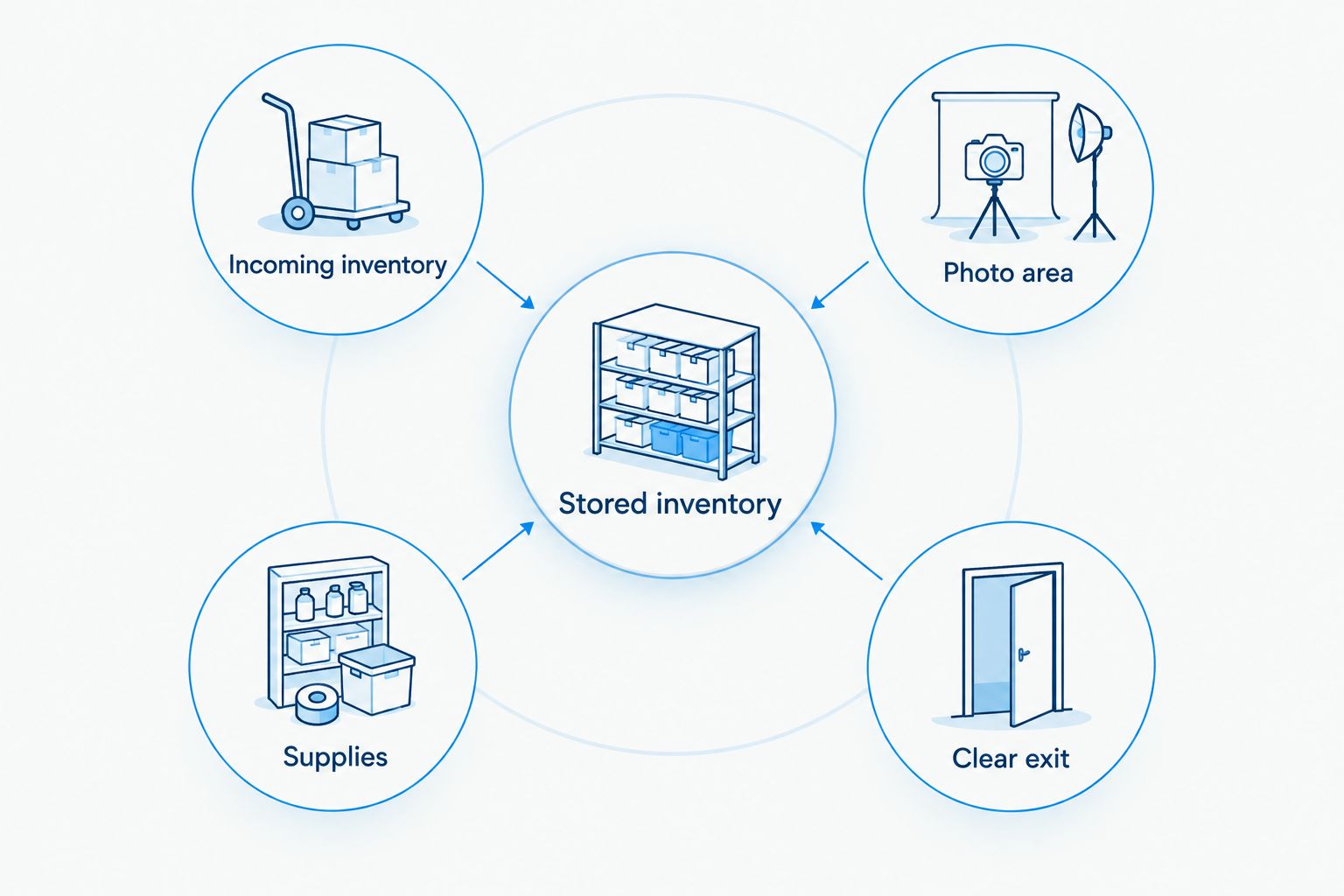
Furniture storage needs room for the work around each item, not just the item itself.
Avoid using furniture as shelving for unrelated inventory. Keep pieces stable, protect surfaces, and follow any available handling or storage instructions for the item.
Your space requirement depends on what you store and how you work. Use these factors when deciding whether your current setup is sufficient:
Review your layout whenever the mix changes. A setup that works for smaller furniture does not automatically work for oversized inventory.
Sharetown’s ideal prospective rep has storage space for at least 5 pieces of inventory, such as in a garage, spare room, or storage unit. That is an item-capacity planning guideline, not a published square-footage specification or a guarantee that any particular room qualifies.
Sharetown is a furniture resale opportunity for people who can store, move, list, and sell oversized inventory. Independent reps receive assigned like-new returned products, pick them up, store and prepare them, and list them for local resale. Reps earn a portion of the profit when an item sells, not simply when they collect it.
Storage is only part of the fit. The ideal prospective rep also has an appropriate vehicle, a helper for moving large products, and the ability to lift 50+ lbs. Those capabilities do not make every item safe to lift manually; assess each move and use appropriate help and equipment.
For your planning, consider the full workflow before pursuing the Sharetown furniture resale opportunity. Assigned inventory addresses sourcing, but you still need to manage storage, listings, buyer communication, and completed sales.
You can start without a garage if another permitted space accommodates your inventory and handling needs. A spare room or storage unit is an option, but check access and working conditions before collecting furniture.
Choose the space around the items you can realistically manage. Do not accept oversized inventory on the assumption that you will find somewhere to put it afterward.
Expand when your existing layout no longer supports safe retrieval and routine selling tasks, not merely because more inventory is available. First check whether unlisted items, poor organization, or unnecessary supplies are occupying useful space.
Use your actual inventory records to make the decision. Additional storage does not guarantee additional sales.
How much storage space do you need to resell furniture?
You need enough usable space for your inventory, preparation, photography, and safe retrieval. Measure the actual furniture and moving route rather than relying on total room area.
How many pieces should a prospective Sharetown rep have room for?
Sharetown’s ideal prospective rep has space for at least 5 pieces of inventory. This describes item capacity, not a universal square-footage requirement or confirmation that a specific space qualifies.
Is a garage better than a storage unit for furniture resale?
A garage is convenient when you have dependable space and suitable access at home; a storage unit separates inventory from your household. Check conditions, access, and permitted activities before choosing either.
Can I store resale furniture in a spare bedroom?
A spare bedroom is an option if the furniture fits through the moving route and you can store it without blocking household access. Check doors, corners, and stairs before accepting an item.
Can I stack furniture to fit more inventory?
Do not assume furniture can be safely stacked. Keep pieces stable and accessible, protect their surfaces, and follow any available item-specific storage instructions.
Do Sharetown reps earn money just for picking up inventory?
Sharetown reps earn a portion of the profit when inventory sells, not simply for picking it up. Pickup, storage, preparation, listing, and local resale are parts of the process.
Before adding inventory in, test the exit route with the largest item you already own. Check whether you can turn, reach the door, and load it without dismantling your storage layout.
The practical limit is the furniture you can safely retrieve, not the furniture you can squeeze inside.