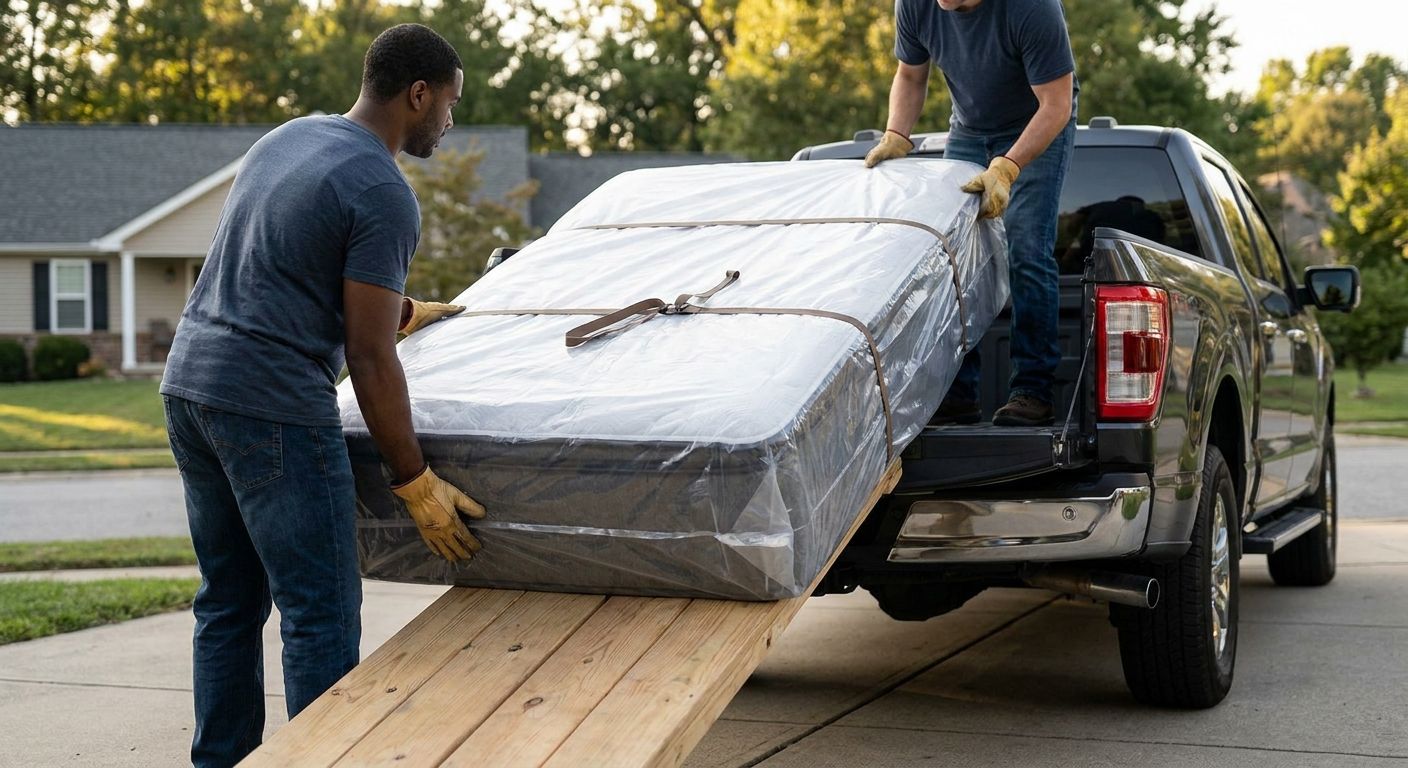
Loading a mattress into a pickup truck bed wrong means a cracked windshield, a lost mattress on the highway, or a trip to the ER for a herniated disc — none of which are worth skipping five extra minutes of prep.
TL;DR
A mattress that shifts at 60 mph doesn't just look sketchy in your rearview mirror — it's a road hazard that can get you a ticket in most states for unsecured cargo. Independent resale reps who move dozens of mattresses a month can't afford a torn cover, a soaked mattress from an open tailgate in the rain, or a strap failure that scraps a $150 flip before it starts. Sharetown reps handle this exact job daily, picking up retailer-returned mattresses and getting them home undamaged and resale-ready — the technique below is what keeps a mattress in sellable condition from pickup to driveway. Get the load right once and you'll do it the same way every time in 2026, without guessing at knots or hoping a tarp holds.
If you're sourcing mattresses to resell, inspecting the mattress before you buy it matters more than the loading technique — a stained or structurally shot mattress isn't worth the truck trip.
Protecting the mattress before it touches the truck bed accomplishes two things: it keeps road grime and moisture off a surface you're about to resell, and it reduces friction so the mattress slides instead of drags. Slide a plastic mattress bag over the entire unit, taping the open end shut, or wrap it tightly in a tarp secured with tape at the seams. Skipping this step is the single most common mistake new resellers make — a mattress with road dust ground into the fabric loses resale value instantly.
Common mistake: Using a thin painter's tarp that tears at the first ratchet strap tension point. Go with 4-6 mil plastic or a dedicated mattress bag.
Lay the mattress at a diagonal or flat against the truck bed with the top edge leaning against the cab. Leaning it against the cab, rather than standing it fully upright, cuts wind resistance dramatically and keeps the mattress's center of gravity low. For a queen or king that overhangs the tailgate, angle it so the overhang is minimized — a mattress hanging more than a foot past the tailgate needs a red flag per most state transport laws.
Expected outcome: the mattress sits stable at roughly 30-45 degrees against the cab with minimal wind catch.
This is where most DIY loads fail. A strap draped over the top of the mattress with no anchor point on the far side will slide right off under vibration. Run each strap through the truck bed's built-in tie-down loops, over the mattress, and back down to a second anchor point — creating an X pattern across the mattress face gives you the most resistance to lateral shift.
Why it matters: highway vibration works exactly like a slow-motion earthquake on unsecured cargo. A strap that isn't anchored on both ends will walk itself loose within 20-30 miles.
Ratchet each strap to about 50% tension first, check that the mattress is still square and hasn't bunched to one side, then finish tightening to full tension. Cranking one strap to maximum before checking the others often pulls the mattress crooked, which puts uneven pressure on the seams and can tear the cover fabric near the corners.
Common mistake: over-tightening a single strap so hard it creases the mattress foam — this can leave a permanent dent that tanks resale value on a memory foam unit.
Grab the mattress at the top corner and push firmly in four directions — forward, backward, left, right. It should move less than two inches in any direction. If it shifts more, you need another strap point or tighter tension before pulling onto the road.
Expected outcome: a mattress that doesn't move when you shake the truck bed by hand won't move at highway speed either.
Even a well-secured mattress changes how your truck handles — it adds wind drag and shifts your effective center of gravity higher and further back. Take turns wider than usual, brake 20-30% earlier than you would empty, and avoid highway speeds over 55 mph if the mattress has any visible bow in the wind.
If the mattress bows more than a few inches at highway speed, pull over and re-tie it before continuing — that's the rule reps who move mattresses professionally follow every time.
Slide a furniture dolly under the leading edge before you pull the mattress off the tailgate — this converts a dead lift into a controlled slide and saves your lower back on the tenth mattress of the week, not just the first. A furniture dolly built for one-person resale work pays for itself after two or three loads.
The mattress keeps sliding toward the tailgate. Your straps aren't anchored far enough forward. Move the front strap anchor point closer to the cab and re-run the X pattern.
The straps are cutting into the mattress cover. Add a folded moving blanket or towel under each strap contact point before tightening — this spreads the pressure and stops fabric tears.
The mattress won't stay flat against the cab. Wind is catching it like a sail. Lower the angle closer to 30 degrees and add a third strap across the middle third of the mattress.
You're loading solo and can't lift the far end. Stop. A queen or king mattress solo lift is exactly how back injuries happen — use a dolly and a ramp, or wait for a second set of hands.
Rain is forecast for the drive. A tarp alone won't keep a mattress dry at highway speed. Use a taped plastic mattress bag, not just a draped tarp — water finds every gap in loose plastic.
The load passed the shake test but shifted anyway on the highway. Ratchet straps loosen slightly over the first 10-15 miles as materials settle. Pull over once early in the drive and re-tighten — this is standard practice, not a sign you did something wrong.
Turn mattress pickups into income
Sharetown connects independent reps with retailer mattress returns nationwide.
Once the mattress is home safely, the next step in the resale process is getting it sanitized and photo-ready. Cleaning a used mattress before reselling it covers the exact steps for stains, odor, and disinfecting before you list it — skipping this step is the second most common reason resale mattresses sit unsold for weeks in 2026.
How do you load a mattress into a truck by yourself?
Use a furniture dolly to slide the mattress up a ramp or tailgate rather than lifting it, then angle it against the cab and secure it with at least two ratchet straps. Solo loading works fine for twin and full mattresses; queen and king sizes are safer with a second person.
Is it safe to drive with a mattress in a truck bed?
Yes, as long as the mattress is secured with straps run through the truck bed's tie-down anchors, not just draped over the top. An unsecured mattress can shift or fly off at highway speeds and most states ticket unsecured cargo.
Do I need to cover a mattress when transporting it in a truck?
Yes. A plastic mattress bag or taped tarp keeps road dust, moisture, and debris off the surface, which matters most if you plan to resell the mattress afterward.
How many straps do you need to secure a mattress in a truck bed?
Two straps in an X pattern work for twin and full mattresses; queen and king mattresses need three to four anchor points to resist highway vibration and wind.
Can a queen mattress fit in a short truck bed?
A queen mattress usually overhangs a 5.5-foot short bed by a foot or more, which requires a tailgate-down setup with a red flag on the overhang. A 6.5 or 8-foot bed fits a queen mattress flat with little to no overhang.
What's the best way to keep a mattress from sliding in a truck bed?
Angle the mattress against the truck cab at roughly 30-45 degrees and run ratchet straps through the bed's anchor loops in an X pattern across the mattress face. A flat mattress with no anchor against the cab will slide toward the tailgate on any incline or hard brake.
Can bungee cords secure a mattress in a truck bed?
No. Bungee cords stretch and lose tension over highway distances and aren't rated for the weight of a mattress at speed. Ratchet straps rated for at least 500 lbs are the only reliable option.
The mattress isn't the fragile part of this job — the straps are. A worn ratchet strap with frayed webbing can snap under tension exactly when you need it most, usually mid-highway with a queen mattress bowing in the wind. Check strap webbing for fraying or UV damage before every load, not just the first one of the season, and retire any strap showing wear before it costs you a mattress and a resale sale.