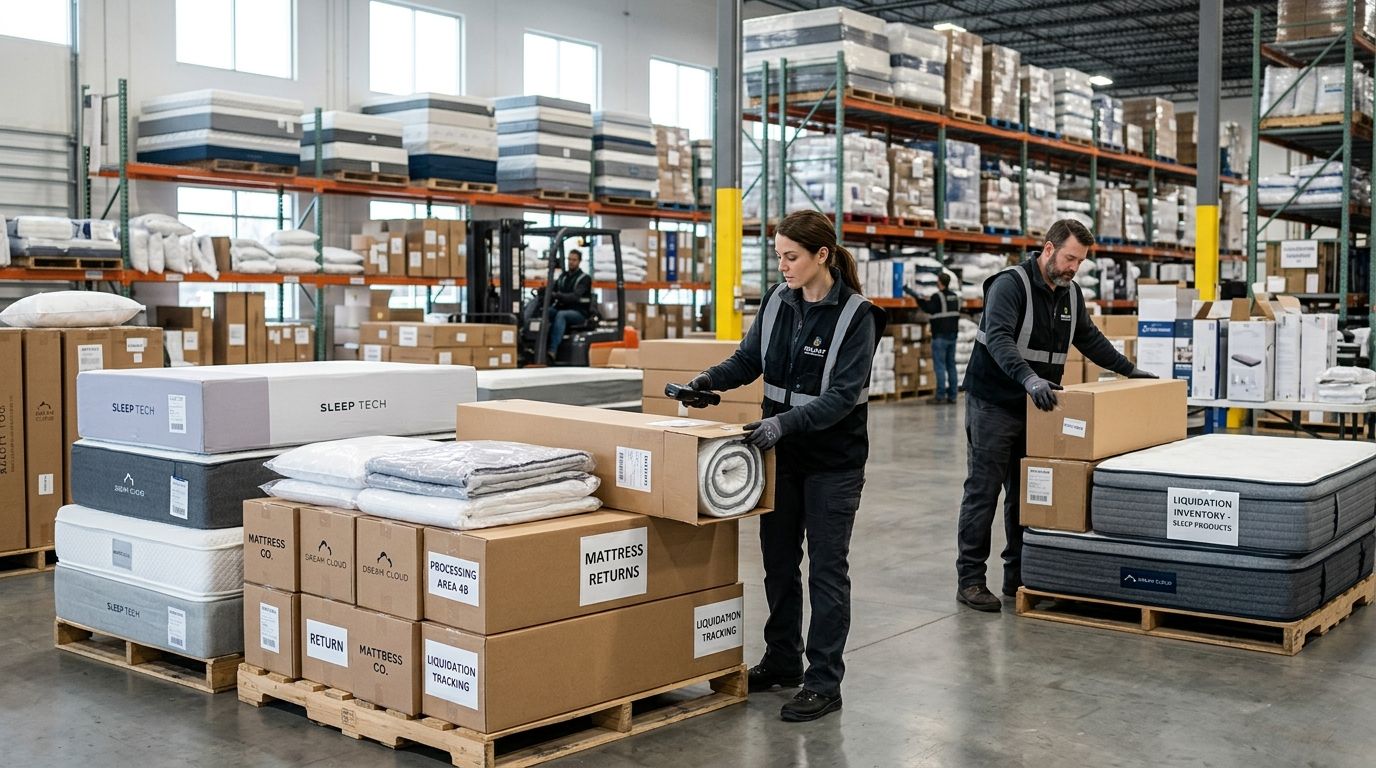
Returns liquidation for sleep brands means turning returned mattresses, foundations, and bedding accessories into recovered cash through resale, wholesale, or recycling channels instead of letting them sit as dead warehouse stock. Sleep brands run a different returns clock than furniture or fitness retailers do — bed-in-a-box compression, mattress law tags, and 90-to-365-night trial windows all shrink a return's resale value the longer it waits on a dock.
TL;DR
- Returns liquidation for sleep brands means grading, sanitizing, and reselling returned mattresses before comfort-return value drops to zero.
- Foam and hybrid units lose shape the longer they sit — dispatch graded returns fast or write off the value.
- State bedding laws require a sanitation certificate and a replaced law tag before a used mattress resells legally.
- Sharetown's local rep network picks up graded returns and handles resale without a brand listing units itself.
Why returns liquidation matters for sleep brands
A mattress return isn't like a returned couch or treadmill. Foam and hybrid coils compress and degrade in storage, a comfort-return unit can't legally resell as "new," and most states require a sanitation certificate plus a replaced law tag before a used mattress moves again. Every extra week a return sits in a warehouse is a week closer to a landfill fee instead of a resale.
Sleep brands running direct-to-consumer trial programs see some of the highest return volume in the home category — trial windows running 90 to 365 nights mean a mattress can travel back to the warehouse months after it shipped, already compressed and packaged for one-way delivery, not resale. Sharetown picks up returned mattresses from partner retailers and brands and moves them into local resale, but the fastest channel only pays off once a brand has already sorted returns by grade before pickup.
How to run returns liquidation as a sleep brand
Audit your return volume and reasons
Start by pulling return data before you touch a liquidation channel. You can't price a channel decision without knowing what's actually coming back.
- Pull return reason codes for the last 90 days: comfort return, damage-in-transit, defect, wrong size
- Split returns by material line — memory foam, hybrid, latex — since resale demand and grading time differ by material
- Flag units returned inside the first 30 days versus units that sat past day 60
- Note which channel generated the return; wholesale returns often arrive in better shape than DTC trial returns
- Set a weekly volume threshold that triggers automatic liquidation instead of case-by-case review
Sort returns by resale grade
Grading is the single decision that determines every dollar you recover later.
- Grade A: unopened box, factory seal intact, no visible wear
- Grade B: comfort return, opened and slept on, no stains or damage, needs sanitizing
- Grade C: cosmetic damage or minor stains, resells at a discount after cleaning
- Grade D: structural damage, torn cover, broken coils — recycle, don't resell
- Use the same inspection checklist buyers use before purchasing a used mattress for resale to keep grading consistent across staff
Sanitize and re-tag before resale
This step is legal compliance, not a nice-to-have.
- Steam-clean or professionally sanitize any mattress that left the factory seal
- Replace or reissue the law tag per your state's bedding law before resale — most states require it removed, sanitized, or replaced with a new one
- Document the sanitation date and method on a certificate that travels with the unit
- Re-bag and re-compress hybrid and foam units the same way they shipped, if equipment allows
Choose your liquidation channel per grade
Start with the manual, no-cost channels, then bring in a network partner once volume outpaces staff hours.
- List Grade A and B units on local marketplaces for full local reach at no listing cost
- Sell Grade B and C units in bulk to regional liquidators or pallet buyers when volume outpaces staff time
- Route Grade B and C units through Sharetown's local rep network for pickup, resale, and remittance without listing them yourself
- Send Grade D units to a textile or foam recycler instead of paying storage on unsellable stock
- Reserve a small batch of Grade A returns for an outlet or clearance section if the brand runs its own retail floor
Price by grade and season
- Price Grade A returns below original retail — local buyers expect a discount even on unopened trial returns
- Price Grade B comfort returns lower once sanitizing cost is factored in; buyers pay for a clean, tested mattress, not a "like new" label
- Adjust pricing weekly against local listings for the same size and material
- Bundle foundations, frames, or pillows with mattress returns to move slower SKUs faster
- Cut price or move the unit to bulk liquidation if a Grade B or C listing hasn't sold in two weeks
Set a pickup and dispatch cadence
- Set a maximum warehouse dwell time per grade — for example, a week for Grade A and B, two weeks for Grade C, immediate dispatch for Grade D
- Schedule recurring pickup windows with your liquidation partner instead of calling per unit
- Track dock-to-dispatch time as a KPI, not just total units processed
- Coordinate pickup routes by ZIP code density to cut per-unit handling cost
- Build a backup channel for volume spikes after major sales weekends
Track recovery rate and time-to-sale
- Calculate recovery rate: total resale revenue divided by original retail value of returned units
- Track average time-to-sale by grade — Grade A should move fastest, Grade D should never enter a resale queue
- Compare recovery rate month over month after switching liquidation channels
- Watch warehouse carrying cost per unit against recovery rate to know when to drop a channel
- Report chargeback and warranty-return trends back to product teams to cut future return volume
Comparison: liquidation options for sleep brands
In-house liquidation team
- Best for: Brands with steady, predictable return volume
- How it works: Staff grade, clean, and list returns internally
- Key limitation: Ties up payroll hours that scale with return volume
Regional liquidator or pallet buyer
- Best for: High-volume, mixed-grade returns moved in bulk
- How it works: Sell truckloads or pallets at a flat bulk rate
- Key limitation: Recovery per unit is lower than individual resale
Local resale marketplaces
Sharetown rep network
- Best for: Brands wanting hands-off pickup and local resale
- How it works: Local reps pick up graded returns, resell them, and remit proceeds
- Key limitation: Coverage depends on rep density in the brand's market
Recycling-only channel
- Best for: Grade D and non-resalable units
- How it works: Foam and textile recyclers process unsellable stock
- Key limitation: No resale recovery, only landfill-diversion value
Sharetown wins on speed for brands that don't want to build an in-house resale team; a regional pallet buyer wins on volume when a brand needs a warehouse cleared fast, not maximized per-unit recovery.
Mattress retailers running physical showrooms face a slightly different mix of return types and floor-space pressure — see the returns liquidation for mattress retailers guide for the storefront-specific playbook.
Move sleep brand returns faster
Sharetown reps pick up graded returns and handle local resale for you.
See how it works
Common mistakes sleep brands make with returns liquidation
- Reselling without a replaced law tag. Most states require a sanitation certificate and a new or reissued law tag before a used mattress can legally change hands again — skipping this creates real regulatory exposure.
- Letting comfort returns sit past the trial window. Foam and hybrid units compress and lose shape in storage; a return dispatched late loses more resale value than one moved within a week.
- Grading every return the same way. Treating an unopened trial return like a torn Grade D unit either underprices good inventory or resells stock that should have been recycled.
- Skipping sanitation documentation. A clean mattress without a paper trail still creates liability if a resale buyer disputes condition later.
- Ignoring recycling entirely. Foam that can't resell still costs storage and disposal fees — routing it to a recycler early avoids paying twice.
FAQ
What is returns liquidation for sleep brands?
Returns liquidation for sleep brands is the process of grading, sanitizing, and moving returned mattresses and bedding into resale, wholesale, or recycling channels instead of storing them as dead stock. The goal is recovering cash and warehouse space before comfort-return value drops to zero.
How long can a returned mattress sit before it loses resale value?
Foam and hybrid mattresses start losing shape and resale appeal within weeks of storage, not months. Dispatching Grade A and B returns within about a week keeps them competitive with new inventory.
Do sleep brands need to sanitize returns before reselling?
Yes — most state bedding laws require a sanitation certificate and a replaced or reissued law tag before a used mattress can legally resell. Skipping this step creates regulatory risk, not just a hygiene issue.
What's the difference between mattress retailer returns and sleep brand returns?
Mattress retailer returns often come from a physical showroom floor, while sleep brand returns typically come from direct-to-consumer trial programs running 90 to 365 nights. Trial returns arrive more compressed and further from the original ship date.
Can a sleep brand resell a mattress after a comfort trial?
Yes, once it's sanitized, re-tagged per state law, and graded for condition. Comfort-return units can't legally sell as new but resell fine as used, graded inventory.
How does Sharetown handle sleep brand returns?
Local Sharetown reps pick up graded returns from partner brands and retailers, then resell them in their own market and remit proceeds. This replaces the need for a brand to list and ship units itself.
What happens to mattresses that can't be resold?
Grade D units with structural damage or torn covers route to textile or foam recyclers instead of resale. Recycling avoids paying storage and disposal fees twice.
How much can a sleep brand recover on returned mattresses?
Recovery rate depends on grade, dwell time, and channel — calculate it as resale revenue divided by original retail value per unit rather than assuming a fixed percentage across all returns.
One last thing
The channel matters less than the clock. A Grade A trial return dispatched within a week competes with new inventory on a resale listing; the same unit dispatched two months later competes with a disposal invoice. Fix dwell time before you shop for a new liquidation partner — most recovery-rate problems trace back to how long a return sat before anyone touched it, not which channel eventually sold it.
Related guides