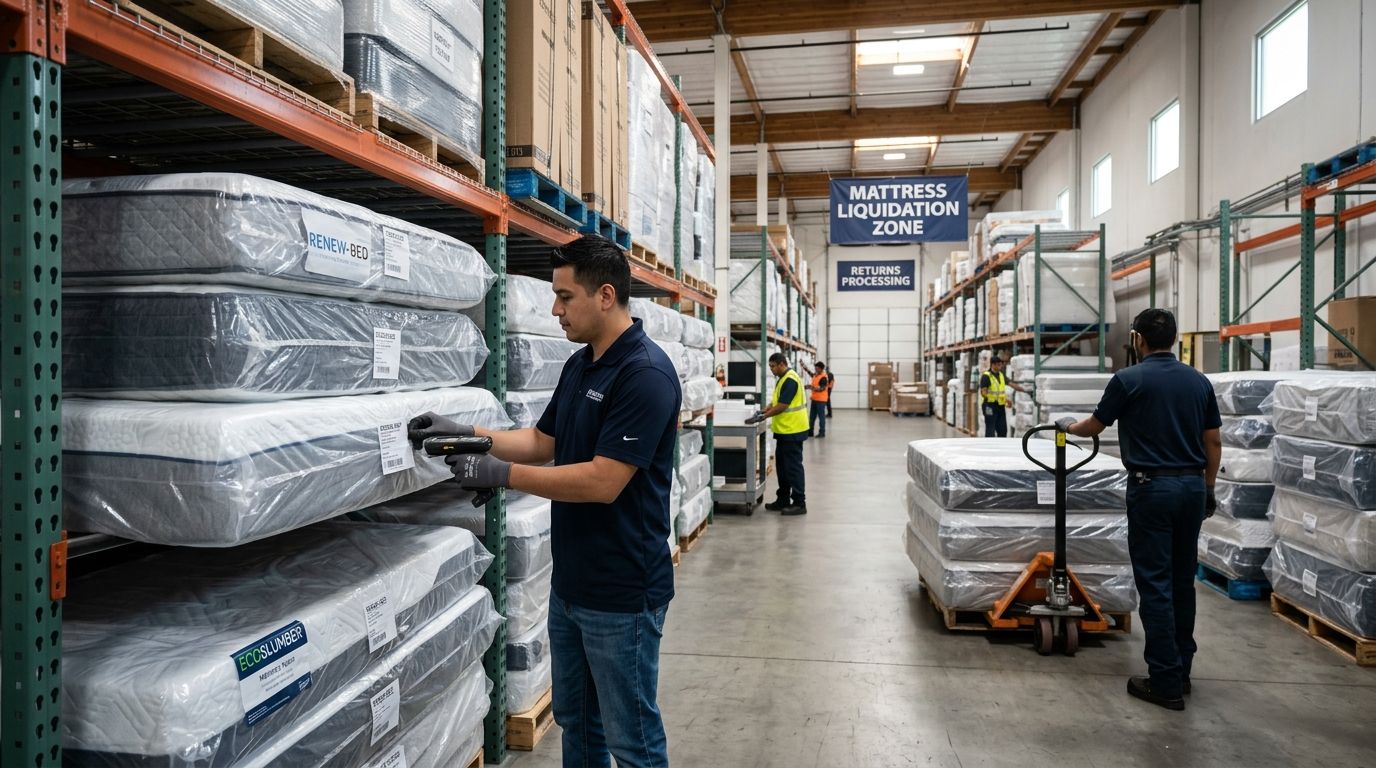
Returns liquidation for mattress retailers means turning returned, floor-model, and overstock mattresses into recovered revenue instead of dead warehouse inventory. Mattress retailers face a version of this problem no other category deals with at the same scale: the units are bulky, hard to store, and legally restricted from resale in most states until they're cleaned and re-tagged.
TL;DR
A returned couch takes up a corner of a warehouse. A returned mattress takes up a whole rack slot and can't be stacked more than a few high without damaging the foam or coils. Mattress retailers running comfort-guarantee return policies see a steady stream of these units coming back, and every day one sits undecided costs storage space and staff hours.
The category also carries legal weight the average furniture return doesn't. Most states require a law tag disclosing that a mattress has been used and, in many cases, a documented sanitizing step before it can be resold, donated, or transferred. Skip that step and a retailer isn't just leaving money on the table, they're carrying liability. Returns liquidation for mattress retailers has to solve compliance and logistics before it solves price.
Before picking a channel, know what's actually coming back and in what shape. A retailer moving high volumes of new-in-box exchanges has different options than one dealing mostly with soiled or damaged returns.
Once units are sorted, match each disposition category to a channel built for it. This is where most mattress retailers either overpay for logistics or underprice their inventory.
This step can't be skipped or outsourced without a plan. Get it wrong and a single complaint can trigger a state inquiry into how a retailer handles used bedding.
Liquidation only works if returns actually leave the building on a schedule. Retailers that let returns pile up until there's a full truckload end up paying for storage they didn't need to.
Move mattress returns off your floor
Sharetown reps pick up, sanitize, and resell returned mattresses locally.
This is the fork in the road most retailers hit around month three of running their own liquidation process.
A liquidator that clears your warehouse fast isn't automatically the right channel if it's paying pennies per unit. Track the number that actually matters.
National auction/pallet liquidator
DIY marketplace listing
Nonprofit donation
Recycling processor
Independent resale network (Sharetown)
Verdict: for mattress retailers moving steady volume of resalable returns, an outsourced local resale network recovers more per unit than bulk auction liquidation while removing the storage burden entirely — for damaged or non-resalable stock, recycling or bulk liquidation is still the right call in 2026.
What is returns liquidation for mattress retailers?
Returns liquidation for mattress retailers is the process of recovering value from returned, floor-model, or overstock mattresses through resale, donation, or recycling instead of scrapping them. It includes sorting by condition, meeting state sanitation and law tag requirements, and choosing a resale or recycling channel.
How much can retailers recover from liquidating returned mattresses?
Recovery depends heavily on condition and channel: bulk auction liquidators pay the least per unit, while local resale channels that clean and re-tag units for individual resale recover more. There is no fixed rate across the industry, so tracking recovery rate by channel is the only reliable way to compare.
Is it legal to resell a used mattress?
Yes, in most states, as long as the mattress carries a proper law tag disclosing it is used and has gone through a documented sanitizing process. Requirements vary by state, so retailers should confirm local rules before reselling.
What is the difference between mattress liquidation and mattress recycling?
Liquidation means reselling a mattress to recover part of its value, while recycling means breaking down the springs and foam for material recovery when a unit cannot be resold. Damaged, soiled, or contaminated units typically go to recycling instead of resale.
Can retailers donate returned mattresses instead of reselling them?
Some nonprofits accept clean, resalable mattress returns, but many decline them entirely due to bedbug and liability concerns. Retailers should confirm a nonprofit's mattress policy before counting on donation as a disposition channel.
How does Sharetown handle mattress returns for retailers?
Sharetown sends independent reps to pick up returned mattresses directly from a retailer's store or distribution center, then clean, sanitize, and resell them locally. This removes the storage and staffing burden retailers otherwise carry in-house.
Should retailers use pallet liquidators or local resale networks?
Pallet liquidators make sense for high volumes of damaged or non-resalable stock where speed matters more than per-unit recovery. Local resale networks recover more per unit on resalable returns but require coordinating pickup schedules.
How do retailers stay compliant with mattress resale laws in 2026?
Retailers stay compliant by verifying law tags, documenting a sanitizing step for every unit, and keeping chain-of-custody records before any mattress leaves for resale, donation, or recycling. State requirements vary, so retailers operating across multiple states need a process that meets the strictest local rule.
The mattress retailers who get the most out of returns liquidation in 2026 aren't the ones chasing the highest bulk buyout offer, they're the ones who sort condition at the loading dock before a mattress ever reaches a warehouse shelf. That single step cuts storage cost, speeds up disposition decisions, and makes every downstream channel — auction, recycling, or local resale — perform better because the inventory arrives already categorized.