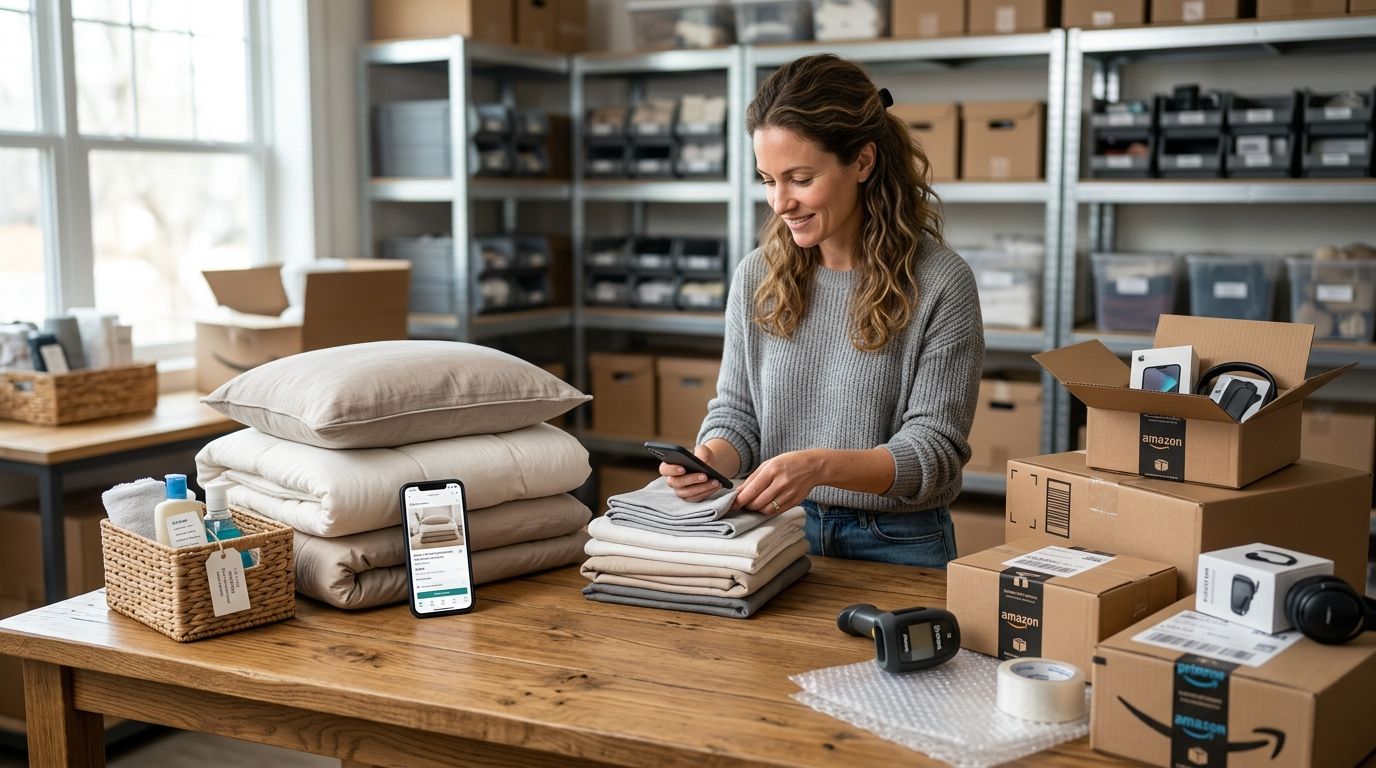
Sharetown wins if you want oversized items (mattresses, sofas, treadmills) sourced for you through retailer returns and resold locally without shipping headaches. Amazon wins if you want to build your own storefront, source your own inventory, and sell to buyers nationwide through an existing marketplace. The real axis here isn't "which platform pays more" — it's who sources the inventory and where you sell it.
TL;DR
Most reselling comparisons assume you're already holding inventory and just picking a place to list it. That's not the real decision in 2026. The real decision is whether you spend hours sourcing product yourself — thrifting, garage sales, liquidation pallets — or whether retailer-return inventory gets routed to you.
Sharetown runs on the second model: independent reps pick up returned mattresses, furniture, and fitness equipment from premium retailers, then resell them locally for profit. Amazon runs on the first: you decide what to sell, you source it, and you list it on a marketplace that already has buyer traffic.
Neither is universally better. They solve different sourcing and logistics problems, and the item category you want to flip usually decides the winner for you.
Best for
Sourcing model
Item types
Shipping and logistics
Pricing model
Startup cost
Geographic reach
Standout feature
This is the single biggest structural difference between the two. On Amazon, sourcing is entirely on you — retail arbitrage, liquidation lots, estate sales — before you list a single item. Sharetown flips that: reps get assigned pickups of items retailers return, which removes the most time-consuming part of reselling.
That matters most in bulky categories. A queen mattress or a sectional sofa doesn't show up cheap at a garage sale very often, and hunting for one usually means driving around all weekend with no guaranteed payoff.
Sharetown turns sourcing into a scheduled pickup instead of a scavenger hunt.
Amazon is built for small-to-mid shippable goods — electronics, books, home items that fit in a box and move through standard carriers or FBA. Sharetown is built for oversized items that are expensive or impractical to ship: mattresses, furniture, treadmills, weight benches.
Forcing a mattress through a parcel fulfillment network gets complicated fast. Selling a phone case through a bulky-item pickup model makes no sense either.
Neither platform loses this round — the categories barely overlap.
Amazon reselling beyond small parcels means boxing, palletizing, freight quotes, or prep fees eating margin before a single sale closes. Furniture and fitness equipment are exactly the categories where shipping cost can erase the profit.
Sharetown sidesteps that because the resale is local. No carrier, no freight class, no damage-in-transit risk on a king mattress. You pick it up, clean and prep it, sell it near where you live.
The practical benefit in 2026 is a shorter chain between pickup and payment.
If you want to choose exactly what you sell — a specific niche, brand, or price band — Amazon gives you full control. You pick the SKU, write the listing, set the category.
Sharetown reps work within what retailers actually return, so the exact inventory mix varies week to week. Some weeks lean mattresses, others lean fitness equipment.
That's the trade: total catalog control on Amazon versus a sourced pipeline with Sharetown.
Amazon connects a listing to a national — often international — buyer pool the moment it goes live. Sharetown resale is local, which caps your addressable market to your city or route, but produces faster in-person transactions with no shipping wait.
If a niche item needs a large buyer pool to clear at a fair price, Amazon's reach is a real advantage. If speed and simplicity matter more than reach, it isn't.
Amazon reselling typically means buying inventory before you've earned a dollar — pallets, arbitrage stock, or wholesale lots — plus a seller account and packaging supplies. That's spend-before-earn money.
Sharetown's model doesn't require an inventory purchase to start; the retailer returns are the inventory. Your main upfront cost is transport — a truck or van that can haul furniture and mattresses.
If you're comparing entry costs across models, reselling side hustles ranked by startup cost breaks down what each one actually takes to launch in 2026.
Neither platform runs on a single flat fee, and real costs shift with category, volume, and fulfillment choice. The structural difference is what you control.
Both reward the same discipline — knowing an item's real resale value before you invest time in it. Calculating profit margin on a furniture flip walks through the math either way. Check current terms with each platform directly before assuming a number.
See if Sharetown fits your route
Retailer-sourced pickups, local resale, no inventory purchase required upfront.
Choose Sharetown if you own a truck or van, want bulky-item inventory sourced for you through retailer returns, and prefer local sales without shipping logistics cutting into margin. A delivery or warehouse worker already comfortable moving heavy items fits this model cleanly — the physical skill transfers on day one.
Choose Amazon if you want full control over your product catalog, you're comfortable sourcing your own inventory, and you want a national buyer base for smaller shippable goods. A seller building a niche electronics or home-goods storefront fits Amazon better than a bulky-item pickup route.
Sourcing model
Item types
Shipping and logistics
Startup cost
Catalog control
Geographic reach
Pricing model
Is Sharetown better than Amazon for reselling in 2026?
Sharetown is better for bulky items like mattresses and furniture sourced through retailer returns and sold locally. Amazon is better for small-to-mid shippable goods sold to a national buyer base.
Do I need to buy inventory to start with Sharetown?
No. Sharetown routes retailer-return pickups to independent reps, so no inventory purchase is required upfront. Amazon reselling usually means buying stock before you list anything.
Can I sell furniture and mattresses on Amazon?
You can, but shipping and fulfillment costs on oversized items cut deeply into margin. A local resale model avoids carrier costs and transit damage risk entirely.
What items work best for Sharetown reselling?
Returned mattresses, furniture, and fitness equipment from premium retailers are the core categories. Small shippable goods suit Amazon's model better.
Which has lower startup costs, Sharetown or Amazon?
Sharetown is generally lower because inventory comes from routed pickups instead of a purchase. Your main cost is a vehicle capable of hauling bulky items.
Which is faster to a first sale?
Sharetown typically moves faster because pickups are pre-sourced. Amazon requires a seller account and self-sourced inventory before a listing goes live.
Can you do both Sharetown and Amazon reselling at once?
Yes. Many resellers run Sharetown for bulky locally-sold items and Amazon for small shippable inventory, since the two rarely compete for the same products.
Do you need a truck for Sharetown?
You need a vehicle that can transport mattresses and furniture, which usually means a pickup truck, cargo van, or trailer setup. That is the main equipment requirement.
The biggest detail most comparisons miss: these two barely compete. A mattress rarely makes sense on Amazon, and a phone case never makes sense through a bulky-item pickup route. Pick the platform that matches the item, not the one that sounds bigger.