Yes, specializing in one furniture category can be worth it, but only after your sales records show that the category sells consistently and fits your pickup, storage, and delivery setup. Until then, staying broad gives you more chances to accept profitable inventory in 2026. Treat specialization as a proven operating decision, not a starting identity.
TL;DR
A narrow niche can simplify pricing, listings, cleaning, storage, and buyer communication. It can also leave you waiting when that category is unavailable or local interest slows. The right decision comes from your own completed sales, not a general claim that dressers, sectionals, or another category always wins.
Start with item-level records. Track pickup details, preparation work, listing activity, completed sales, and related expenses using a consistent furniture flip profit calculation. Those records show whether a category actually deserves more space and attention.
This distinction matters for Sharetown reps because the available inventory can include returned mattresses, furniture, fitness equipment, and other bulky products from premium retailers. Refusing everything outside one furniture niche reduces the number of pickups that fit your rules. That tradeoff is justified only when the chosen niche performs better for your operation.
You should specialize after one category repeatedly produces a better operating fit than the alternatives. That means you understand its condition issues, know how to prepare and describe it, can store it safely, and have a practical way to reach likely buyers.
You should stay broad while you are still learning which items work in your local market. A mixed approach provides more observations across categories and prevents an early assumption from becoming an inventory restriction.
One-category specialization
Mixed furniture categories
Furniture plus other bulky goods
Sharetown is best for independent reps who want to pick up and resell bulky retailer returns across several categories rather than source only one furniture type. Its flexible inventory model makes strict specialization less natural than a preferred-category strategy.
A preferred-category strategy means prioritizing the furniture you understand without automatically refusing everything else. You can favor dressers, dining tables, or sectional sofas while still considering a suitable mattress or fitness item. This keeps the benefits of growing category knowledge without turning that knowledge into a rigid limit.
Specialization makes sense when it removes recurring friction. If the same item type fits your vehicle, storage area, preparation process, and local selling channels, repeated handling becomes simpler. You know what to inspect, which measurements buyers need, what photographs to take, and which condition details belong in every listing.
Repeat buyers strengthen the case. A reseller who regularly hears from people seeking the same furniture category has a clearer reason to source more of it. The niche is then supported by actual conversations and completed transactions rather than social media enthusiasm.
Use these signs before narrowing your inventory:
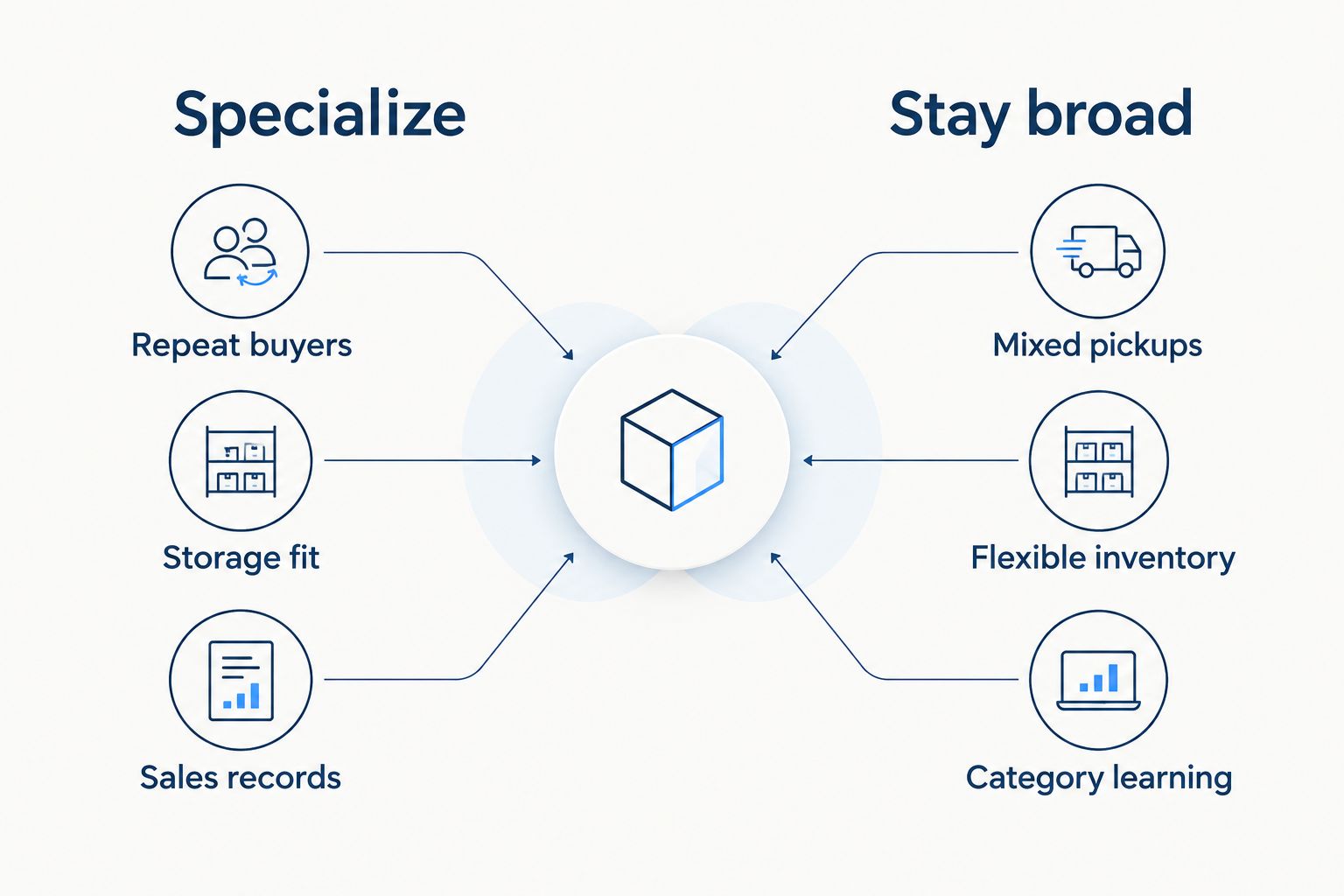
Specialize when your records and operating setup support the niche; stay broad while you are still learning.
Specialization is not simply knowing more about one category. It is building an operation where that knowledge improves the work from pickup through resale. If your expertise grows but available inventory becomes too limited, the niche is not helping the whole business.
Stay broad when your inventory comes from opportunities you do not fully control. Retailer returns vary, and the Sharetown furniture reselling opportunity includes more than one furniture type. A rule that accepts only dining tables or recliners can exclude other bulky returns that fit your vehicle, storage, and selling process.
A broad strategy also makes sense when your records are still thin. One fast sale does not establish a category pattern, and one slow listing does not prove that a category fails. You need repeated observations under your own market conditions before rewriting your pickup criteria.
Staying broad does not mean accepting every item. You can still screen for condition, handling requirements, storage fit, buyer questions, and the work needed before listing. The difference is that your screen evaluates each opportunity rather than rejecting it because of its category name.
Broad inventory has real costs. You must learn different inspection points, write different listing details, and organize varied shapes and sizes. Those costs are manageable when you use a standard intake process and save category-specific notes for future listings.
Verdict: stay broad in 2026 until a category proves that specialization will improve your complete resale process, not just your familiarity with the product.
Use the same decision process for every category you are considering. It keeps preference from being confused with performance.
Start with completed transactions rather than active listings. An active listing shows that you have inventory; it does not show that the category works. Compare how much preparation each item required, how long it occupied useful space, which buyer questions repeated, and what expenses were tied to the sale.
Do not judge a niche only by the largest single result. Look for repeatability. A category deserves more attention when the full workflow remains practical across several items, including examples that needed more cleaning, more buyer communication, or more complicated transport.
Walk through the physical process before accepting more inventory. Can you inspect the item from every side? Can you clean it without moving several other pieces? Can you photograph it clearly? Can you load and secure it with your current setup?
Storage is often the deciding constraint. A category that looks attractive on a sales report can still disrupt the operation if every unit blocks access to other inventory. The strongest niche uses your limited space predictably.
Separate buyer activity from buyer intent. Messages, saves, and questions can help improve listings, but completed transactions provide the clearest category signal. Record common requests, objections, delivery questions, and condition concerns so you can see whether the same issues keep appearing.
Repeat inquiries also help define a narrower niche. You may discover that buyers respond to a specific size, material, style, or use case within a broad furniture category. Let that evidence refine your focus instead of choosing a niche solely from the category label.
Even after specializing, define when an outside-category item deserves consideration. The item might fit unused storage, match a known buyer request, or require a process you already understand. An exception rule prevents specialization from becoming automatic rejection.
Review that rule throughout 2026. If outside-category items regularly fit your operation, your niche may be too narrow. If they repeatedly create storage or handling problems, the specialization is doing useful work.
Explore flexible resale work
Pick up returned bulky products from retailers, then resell them locally as an independent rep.
No single furniture category is automatically right for every reseller. The decision changes with the inventory you can access and the physical operation you already have.
These factors explain why the answer can change as your resale operation develops. Staying broad can be correct when you begin in 2026, while a focused category can become practical after your records identify a repeatable pattern.
No. A beginner benefits from comparing several categories before making a permanent inventory rule. Staying broad creates the information needed to identify which furniture fits your storage, transport, preparation skills, and local buyer activity.
Start with clear acceptance standards instead of a niche. Evaluate condition, handling, available space, preparation work, and how you expect to present the item. Specialize only when completed sales show a repeatable advantage.
Yes. A preferred-category model lets you build expertise while keeping useful exceptions. Prioritize your strongest category, then accept outside-category items when they fit your equipment, storage, and buyer contacts.
This model is especially practical for Sharetown resale work because reps can encounter mattresses, furniture, fitness equipment, and other bulky products. A preference guides decisions without unnecessarily shrinking the available inventory.
Choose the category that best fits your documented sales process, not the category receiving the most online attention in 2026. Your strongest option is the one you can inspect, store, prepare, photograph, describe, transport, and sell without creating recurring bottlenecks.
Dressers, dining tables, bookshelves, sectionals, and other furniture types each impose different space and handling demands. Compare your own completed sales before giving any category priority.
Should you specialize in one furniture category when reselling?
Yes, but only after completed sales show that the category fits your sourcing, storage, transport, preparation, and buyer activity. Beginners should usually stay broad while collecting that evidence.
Is furniture specialization better than mixed inventory?
Furniture specialization is better when repeat buyers and an efficient workflow offset the inventory you reject. Mixed inventory is better when available pickups vary or your strongest category is not yet clear.
What is the best furniture category to resell in 2026?
The best category is the one supported by your own completed sales and operating setup. No single furniture type is automatically best for every reseller or local market.
Can a Sharetown rep focus on furniture?
Sharetown reps can build experience with furniture while evaluating returned mattresses, fitness equipment, and other bulky products. A preferred category preserves flexibility better than a strict one-category rule.
How do you know when to choose a furniture niche?
Choose a furniture niche when one category repeatedly fits your storage, vehicle, preparation process, and buyer contacts. Confirm the pattern with completed transactions rather than listing activity alone.
What are the risks of specializing in furniture reselling?
The main risks are rejecting workable inventory, depending on one category, and dedicating storage to items that do not sell as expected. A clear exception rule reduces those risks.
Can you change your furniture resale niche later?
Yes. Review your completed sales, storage use, buyer questions, and handling requirements, then adjust the categories you prioritize. Specialization should follow current evidence rather than become permanent.
Test a niche in your records before enforcing it at pickup. Tag the category, compare its complete workflow with other inventory, and note the problems it creates as carefully as the sales it completes.
That approach keeps the decision reversible. In 2026, the smartest furniture specialty is not the category you like most; it is the category that repeatedly fits how you source, store, prepare, transport, and sell.