Every year, Americans discard roughly 20 million mattresses. Stacked end to end, that's enough discarded beds to stretch from New York to Los Angeles and back — twice. The vast majority of these mattresses end up in landfills, where they occupy enormous amounts of space (a single mattress takes up to 40 cubic feet), resist compaction, and sit for decades without decomposing.
But here's what most people don't realize: up to 90% of a mattress is recyclable. The steel springs, foam, cotton, wood, and fabric that make up a mattress can all be recovered and repurposed — if the mattress enters the right recycling stream.
The mattress recycling process is a fascinating, multi-step operation that turns what most people consider bulky waste into valuable raw materials. In this guide, we'll walk you through exactly what happens when a mattress gets a second life — from collection to disassembly to material recovery — and explain how companies like Sharetown are building a more sustainable alternative to traditional disposal.
Before diving into the process itself, it's worth understanding why mattress recycling is such a critical environmental issue.
The scale of the problem is staggering. According to the International Sleep Products Association, over 50,000 mattresses are discarded every single day in the United States. That translates to roughly 20 million mattresses per year entering the waste stream — the vast majority headed straight for landfills.
Mattresses are a landfill nightmare. Unlike food waste or paper products, mattresses don't break down. Their steel springs, synthetic foams, and treated fabrics can persist in landfill conditions for decades. Their bulky shape makes them difficult to compact, meaning they consume disproportionate landfill space relative to their weight.
Illegal dumping creates additional problems. Because mattress disposal is often expensive or inconvenient, illegal dumping is common. Abandoned mattresses become breeding grounds for pests, create fire hazards, and blight communities — particularly in underserved neighborhoods that lack adequate waste management resources.
But there's a growing solution. Mattress recycling has evolved significantly over the past decade. Specialized facilities now exist that can disassemble a mattress in under 10 minutes and recover 80–90% of its materials for reuse. Extended producer responsibility (EPR) laws in states like California, Connecticut, and Rhode Island are creating funding mechanisms that make recycling economically viable at scale.
The recycling process begins with getting mattresses from homes and businesses to processing facilities. This happens through several channels:
Municipal curbside collection. Many cities include mattresses in bulk waste pickup schedules. These mattresses are transported to transfer stations, where some are sorted for recycling and others are landfilled.
Retailer take-back programs. When you buy a new mattress, many retailers offer to haul away your old one. Mattress Firm, for example, has pledged to recycle millions of mattresses through these programs. The old mattress rides the delivery truck back to a distribution center and is then routed to a recycling facility.
Return management services. This is where the process gets interesting. Companies like Sharetown specialize in handling mattress returns from DTC (direct-to-consumer) brands — the bed-in-a-box companies that offer 100-night or longer sleep trials. When a customer decides to return a mattress, Sharetown dispatches a local rep to pick it up.
But here's the key difference: Sharetown's model prioritizes resale and reuse over recycling. If a returned mattress is in good condition — and most trial returns are, since they've been used for only weeks or months — it's cleaned, refurbished, and resold locally. This is actually the most environmentally beneficial outcome, because it extends the product's life without the energy-intensive process of breaking it down and rebuilding something new.
Dedicated recycling drop-offs. Some municipalities and private companies operate mattress recycling drop-off points where consumers can bring mattresses directly. This is most common in states with EPR laws that fund the recycling infrastructure.
For a comprehensive guide to disposal options in your area, check out our post on mattress recycling near me.
Once mattresses arrive at a recycling facility, they undergo inspection and sorting. Not every mattress follows the same path:
Condition assessment. Workers evaluate each mattress for overall condition, contamination, and type. Mattresses that are structurally sound and relatively clean may be candidates for refurbishment and resale rather than disassembly. This is the highest-value outcome — a mattress that gets a second life as a mattress.
Contamination screening. Mattresses with significant mold, pest infestation, bodily fluid contamination, or chemical exposure are flagged for immediate recycling (disassembly) rather than resale. Health and safety standards determine which mattresses can be refurbished and which must be broken down.
Type identification. Different mattress types require different disassembly approaches. An innerspring mattress has steel coils that need to be separated from foam and fabric. A memory foam mattress has no metal but larger volumes of foam. A hybrid combines both. Workers sort mattresses by type to optimize the disassembly process.
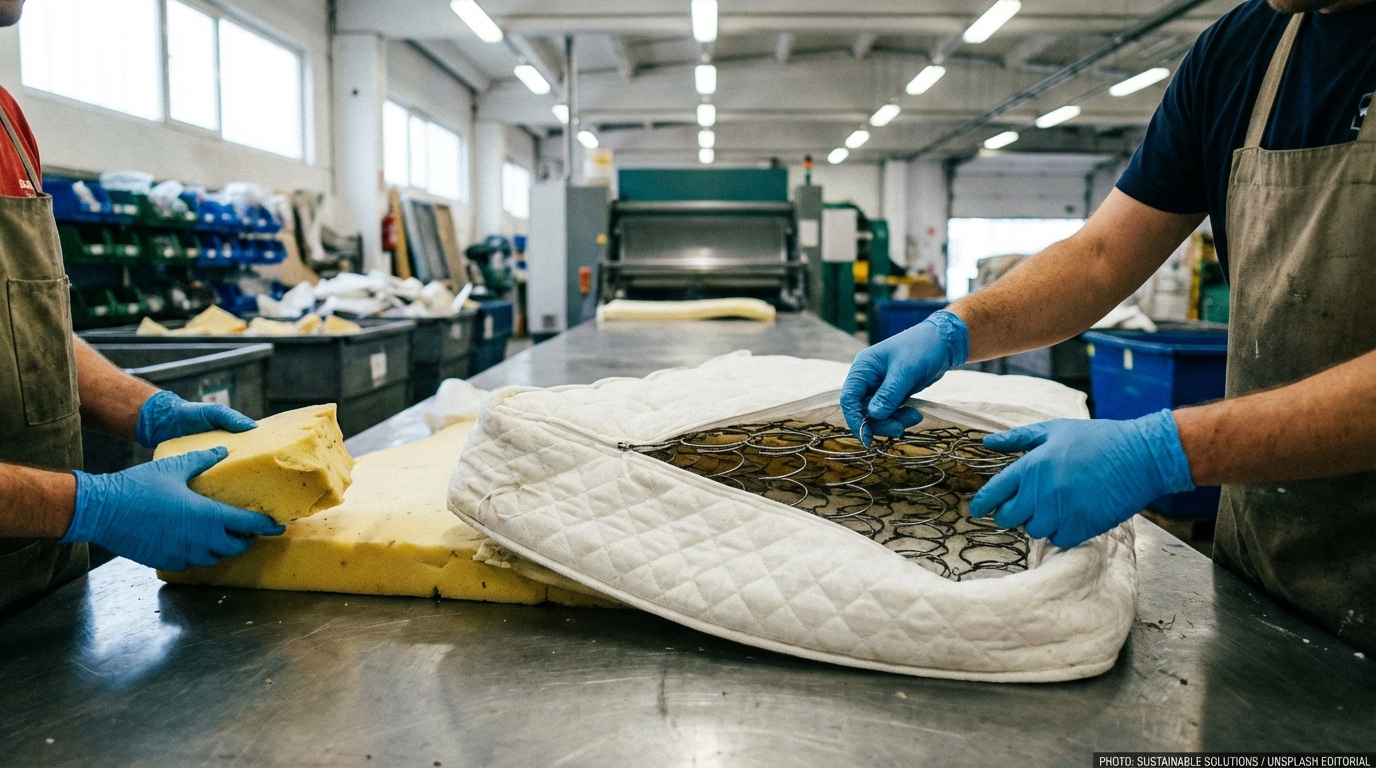
This is the core of the mattress recycling process — and it's more hands-on than most people expect.
Outer fabric removal. Workers use specialized cutting tools to remove the outer fabric layer (the ticking). This is typically a blend of polyester, cotton, and sometimes wool. The fabric is carefully separated and set aside for textile recycling.
Foam extraction. The comfort layers — memory foam, polyurethane foam, latex, or combinations — are removed and separated by type. Foam is one of the most valuable recovered materials, and different foam types have different recycling pathways.
Spring separation. For innerspring and hybrid mattresses, the steel coil system is removed as a unit. Workers separate the coils from any remaining foam or fabric attached to them. The steel is then compressed or baled for transport to scrap metal processors.
Wood frame dismantling. Box springs and some foundations contain wooden frames. The wood is separated and sorted — clean wood can be chipped for mulch, biomass fuel, or animal bedding. Treated or painted wood follows a different disposal path.
Component layering. Many modern mattresses are built in layers held together with adhesive. Workers must separate these bonded layers, which can be the most time-consuming part of disassembly. Some facilities use specialized machinery to speed this process, while others rely on manual separation.
Speed and efficiency. An experienced team at a well-equipped facility can fully disassemble a mattress in 6–10 minutes. High-volume operations process hundreds of mattresses per day.
Once a mattress is broken down into its component parts, each material enters its own recycling stream:
Steel springs → Scrap metal. Steel is the easiest and most economically viable material to recycle from a mattress. The coils are compressed into bales and sold to scrap metal processors, who melt them down for use in new steel products — everything from car parts to rebar to new springs. A single mattress can yield 25–30 pounds of recyclable steel.
Polyurethane foam → Carpet padding and insulation. Shredded polyurethane foam is compressed and rebonded into carpet padding — the cushioned layer you feel under carpeting. This is the most common second life for mattress foam. It's also used in acoustic insulation, packaging materials, and sports flooring underlayment.
Memory foam → Specialty applications. Memory foam (viscoelastic polyurethane) can be shredded and used in pet beds, pillow fill, bean bag chairs, and packaging. Some companies are developing chemical recycling processes that break memory foam back into its base polyols for use in manufacturing new foam products.
Latex foam → Mulch and playground surfaces. Natural latex foam can be shredded and used as mulch or in rubberized playground surfaces. Synthetic latex follows similar pathways to polyurethane foam.
Cotton and natural fibers → Industrial rags and insulation. Cotton batting and other natural fibers are cleaned and processed into industrial wiping rags, insulation material, or automotive sound deadening. Some textile recyclers also process mattress cotton into recycled fiber for new textile products.
Wood → Mulch, biomass, and animal bedding. Clean wood from box springs is chipped and used as landscape mulch, biomass fuel for industrial boilers, or animal bedding material. The wood fraction is typically 10–15% of a box spring's total weight.
Fabric → Textile recycling. Outer ticking fabric is processed through textile recyclers. Depending on the fiber content, it may be shredded for insulation, processed into industrial rags, or in some cases, downcycled into lower-grade textile products.
Recycling facilities must meet strict environmental and health standards:
Waste tracking. Reputable recyclers track the weight and disposition of every mattress — documenting what percentage was recycled, reused, or landfilled. This data is reported to state regulators in EPR states and to brand partners who want proof of responsible disposal.
Contamination management. Materials that can't be recycled (heavily contaminated foam, treated fabrics, non-recyclable composites) are properly disposed of. The goal is to minimize the landfill fraction, but complete zero-waste processing isn't always achievable.
Certifications. Look for facilities certified by the Mattress Recycling Council (MRC) in EPR states, or those adhering to R2 (Responsible Recycling) standards. Certification ensures consistent processes and environmental compliance.
Here's something the recycling conversation often misses: the most sustainable thing you can do with a mattress is keep it as a mattress.
Recycling recovers materials, but the process itself requires energy, transportation, and processing. A mattress that's resold and reused for another 5–10 years avoids all of that — the embedded energy, raw materials, and manufacturing emissions that went into making it in the first place are preserved.
This is exactly the principle behind Sharetown's approach to returned mattresses. Rather than routing every return to a recycling facility, Sharetown's model prioritizes the waste hierarchy in order:
The result: Sharetown diverts 97% of returned items from landfills. That's not just a recycling statistic — it's a reuse-first model where most items find a second home without being broken down at all.
For a deeper look at what happens to beds once customers request a return, check out our article on refurbished mattresses and the safety, quality, and savings they offer.
Understanding the economics helps explain why mattress recycling hasn't scaled faster — and what's changing:
The cost challenge. Processing a single mattress costs a recycling facility an estimated $15–$35, not including collection and transportation. Without EPR funding or brand subsidies, the revenue from recovered materials (primarily steel) often doesn't cover the processing cost. This is why many recyclers have historically struggled to operate profitably.
EPR changes the math. Extended producer responsibility laws — currently active in California (through the Mattress Recycling Council), Connecticut, and Rhode Island — add a small fee ($10.50 in California) to every new mattress sold. This fee funds collection infrastructure and subsidizes recycling operations, making them economically viable.
The resale model is more sustainable — economically and environmentally. Sharetown's approach bypasses the recycling cost problem entirely for mattresses that are still usable. Instead of spending $15–$35 to disassemble a mattress and sell its parts for scrap, the mattress is resold for $150–$500 as a complete product. The economics are better for everyone: the brand recovers value from returns, the rep earns income, the consumer gets an affordable mattress, and the environment benefits from one less mattress manufactured.
Corporate sustainability drives demand. Major mattress brands increasingly track their environmental impact and want proof that returned products aren't going to landfill. This creates demand for services like Sharetown that can demonstrate high diversion rates and sustainability metrics.
If you have a mattress to get rid of, here's how to ensure it enters the most responsible stream:
Check your state's recycling program. If you live in California, Connecticut, or Rhode Island, you have access to funded mattress recycling infrastructure. Visit ByeByeMattress.com to find drop-off locations near you.
Ask about retailer take-back. When purchasing a new mattress, ask whether the retailer offers old mattress removal. Many do, and some ensure the old mattress enters a recycling stream rather than going to a landfill.
Look for local recyclers. Even outside EPR states, independent mattress recyclers operate in many metro areas. A quick search for "mattress recycling near me" can reveal options you didn't know existed.
Consider donation first. If your mattress is still in good condition (no major stains, structural damage, or pest issues), donation keeps it as a mattress. Habitat for Humanity ReStores, Salvation Army, and local shelters may accept mattress donations depending on condition.
Avoid illegal dumping. Leaving a mattress on the curb without scheduling pickup, dumping in alleys, or abandoning in vacant lots creates environmental and community problems. Most municipalities offer bulk pickup scheduling — use it.
The traditional mattress lifecycle is linear: manufacture → sell → use → discard. Even with recycling, the end-of-life phase typically means breaking the product down and starting over.
Sharetown's model introduces a circular element. When a DTC brand's customer returns a mattress during a sleep trial, Sharetown's dispatch algorithm routes a local rep — often within just 13 miles of the customer's home — to pick it up. The rep cleans and photographs the mattress, then resells it locally to a buyer who gets a premium mattress at a significant discount.
The mattress doesn't travel hundreds of miles to a warehouse or processing facility. It moves a few miles from one home to another. The environmental savings — in fuel, emissions, warehouse energy, and avoided manufacturing of a replacement product — are substantial.
This is what makes the reuse model fundamentally different from recycling. Both are vastly better than landfilling. But reuse preserves the product's full value, not just its material components.
If you're interested in being part of this model — either as someone who picks up and resells mattresses, or as a brand looking for a sustainable returns solution — visit Sharetown to learn more.
Want to earn income while keeping mattresses out of landfills? Learn about becoming a Sharetown rep.
Up to 80–90% of a mattress can be recycled. Steel springs, foam, cotton, wood, and fabric can all be recovered and repurposed. The exact percentage depends on the mattress type and the capabilities of the recycling facility. Innerspring mattresses tend to have higher recycling rates due to the high value of recoverable steel.
A skilled team at a specialized facility can disassemble a mattress in 6–10 minutes. The full recycling cycle — from collection to material processing — varies by facility but typically takes a few days from drop-off to completed material separation.
It depends on your location. In EPR states (California, Connecticut, Rhode Island), mattress recycling is funded through fees on new mattress sales, making collection and recycling free or low-cost for consumers. Outside these states, recycling may cost $20–$50 per mattress at private facilities. Municipal bulk pickup may be free but doesn't guarantee recycling.
Steel springs are the most commonly recycled mattress component. They're separated during disassembly, compressed into bales, and sold to scrap metal processors. The steel is melted down and reused in manufacturing new steel products. A single mattress can contain 25–30 pounds of recyclable steel.
Yes, though the process differs from innerspring mattresses. Memory foam (viscoelastic polyurethane) is shredded and used in carpet padding, pet beds, packaging, and insulation. Chemical recycling methods that break memory foam back into base chemicals are being developed but aren't yet widely available. Resale and reuse remain the most environmentally beneficial options for foam mattresses in good condition.
The most sustainable option is reuse — selling or donating a mattress that's still in good condition to someone who needs it. This preserves the full value of the product and avoids both landfill waste and recycling energy costs. Companies like Sharetown facilitate this by connecting returned mattresses with local buyers. If a mattress is too damaged for reuse, recycling through a certified facility is the next best option.
Sharetown prioritizes reuse over recycling. Instead of breaking mattresses down into raw materials, Sharetown's local reps pick up returned mattresses, refurbish them, and resell them in their communities. This keeps mattresses as functional products rather than converting them to lower-value materials. The result is 97% diversion from landfills, lower carbon emissions (13-mile average pickup distance), and a circular model that benefits brands, reps, and consumers.