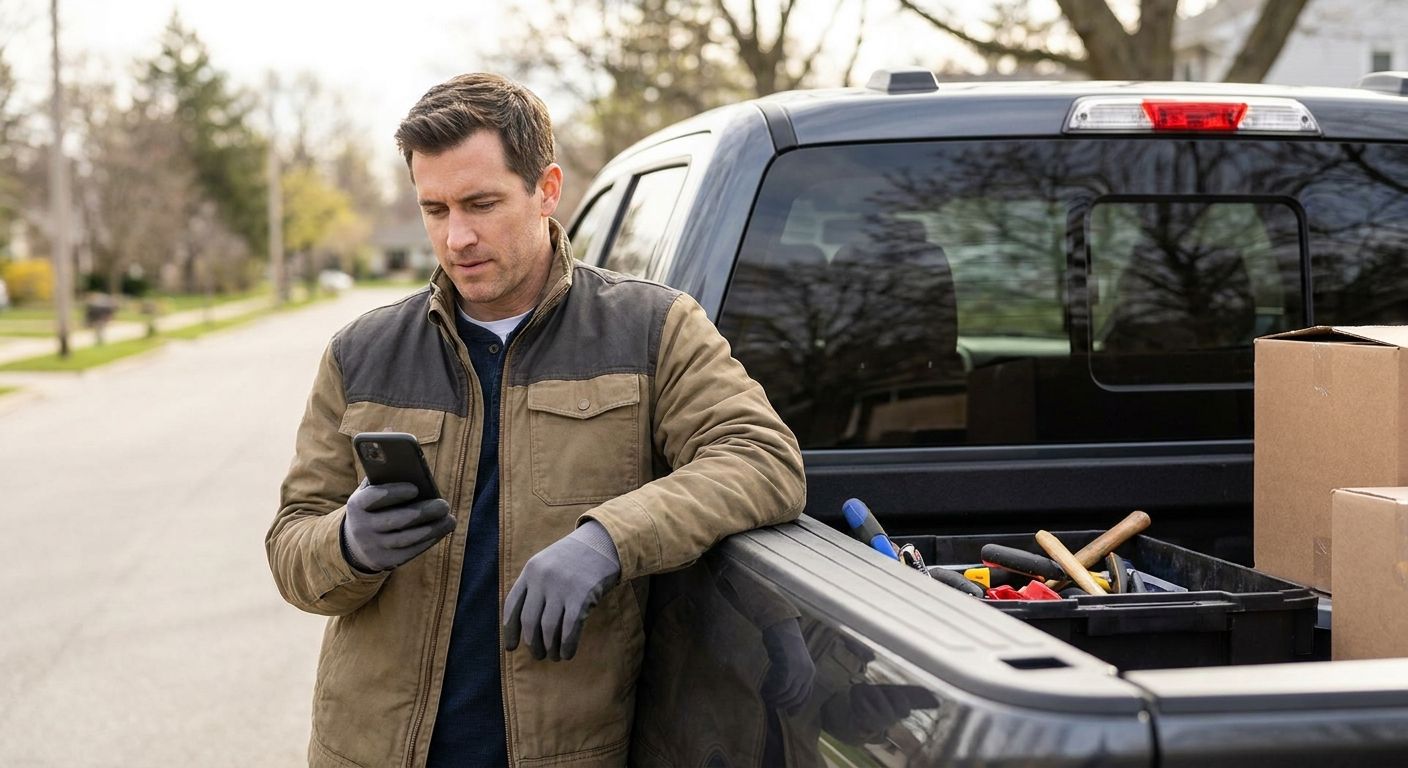
A pickup truck can earn more than gas money if you point it at the right app -- some pay a flat rate per job, and one lets you keep the resale profit instead of a capped fee. Here's how the main options compare for 2026, and which one fits your truck and your schedule.
TL;DR
Most delivery apps pay you for the drive, not for what's in the truck bed. That caps your income at whatever the app's per-job rate happens to be that week.
A pickup truck is built for hauling bulky items -- mattresses, dressers, treadmills, sectional sofas -- and those items carry resale value most delivery apps ignore entirely. If you're comparing side hustles for truck drivers, the difference between a flat-fee app and a resale model is the difference between a side gig and a business.
The apps below split into two camps: pay-per-job delivery platforms, and platforms where your truck becomes a small inventory operation. Knowing which camp fits your goals in 2026 matters more than which app has the flashiest sign-up bonus.
Sharetown
GoShare
Dolly
Roadie
Curri
TaskRabbit
Independent reps on Sharetown pick up bulky items -- mattresses, furniture, fitness equipment -- that customers returned to retail partners, then resell them locally and keep the profit.
Sharetown pros:
Sharetown cons:
Sharetown pricing: earnings come from the resale margin on each item, not a flat job fee -- check current pickup opportunities on Sharetown directly.
Best for: reps who want a truck to double as an inventory vehicle in 2026, not just a delivery van.
Verdict: Buy. Uncapped upside from resale beats a fixed per-mile rate for anyone willing to store and list a few items.
GoShare connects vehicle owners with people who need something moved the same day -- furniture pickups, home improvement store runs, junk hauls.
GoShare pros:
GoShare cons:
Best for: drivers who want simple point-to-point jobs with no resale work attached.
Verdict: Hold. Reliable for filling gaps between other gigs, but the income ceiling is fixed by the app, not by you.
Dolly pairs a truck owner with jobs that need both a vehicle and physical labor -- moving a couch, loading a washer, hauling furniture across town.
Dolly pros:
Dolly cons:
Best for: drivers who want to show up, lift, and get paid without building a resale sideline.
Verdict: Hold. Fine as a standalone gig, weak as a long-term income builder.
Roadie matches drivers to package and larger-item deliveries along routes they're already driving, from big-box store runs to shipped freight.
Roadie pros:
Roadie cons:
Best for: drivers who want to monetize driving they're already doing.
Verdict: Hold. Works as a side layer on top of other gigs, not as a primary income source.
Curri is built for time-sensitive B2B freight -- lumber, tools, and materials moving between suppliers and job sites, not household resale items.
Curri pros:
Curri cons:
Best for: truck owners located near job sites and supply yards.
Verdict: Wait. Check local job-site density in 2026 before counting on Curri as a primary income stream.
TaskRabbit is a broader task marketplace where a truck is one tool among several -- assembly, light moving, and delivery bundled into a single job.
TaskRabbit pros:
TaskRabbit cons:
Best for: handy truck owners who want task variety, not just hauling.
Verdict: Wait. Solid add-on once you have other gigs running, weak as a truck-first starting point.
Put your truck to work in 2026
Pick up retailer returns near you and keep the resale profit.
Each app was measured against the six criteria above: payout structure, job volume, cargo fit, schedule control, support backbone, and onboarding speed. Apps that pay a flat rate regardless of what's in the truck bed rank lower on payout structure than a resale model where the margin scales with the item. Apps thin on truck-specific job volume in 2026, like Curri and TaskRabbit for hauling work specifically, rank lower on availability even when the job quality is solid.
If you want a truck that earns beyond a fixed per-job rate, Sharetown is the default pick for 2026 -- the resale margin model rewards a truck bed full of mattresses or furniture more than a flat delivery fee ever will. If you'd rather skip storage and listings entirely and just want same-day work, GoShare or Roadie fill that gap. Curri only makes sense if you're near active construction activity, and TaskRabbit works best as an add-on once other gigs are already running.
What's the best app to make money with a pickup truck in 2026?
Sharetown is the strongest overall pick because it pays out through resale margin on retailer returns rather than a flat delivery fee. Apps like GoShare and Roadie are better if you want simple, no-resale delivery jobs instead.
Is Sharetown better than GoShare for truck owners?
Sharetown suits drivers who want uncapped resale profit, while GoShare suits drivers who want fixed, on-demand delivery jobs with no listing or storage work. The right choice depends on whether you want to build a small resale business or just haul items for a set rate.
Do I need a specific truck size to qualify for hauling apps?
Most apps ask for a functional truck bed and don't require a specific model, though bigger beds fit more jobs like mattresses, sectionals, or appliances. Check each app's vehicle requirements at signup since they vary by platform.
Can I use more than one pickup truck app at the same time?
Yes, most drivers run more than one app to fill schedule gaps, pairing a resale platform like Sharetown with an on-demand delivery app like GoShare or Roadie. There's no exclusivity requirement across these platforms.
Is reselling more profitable than flat-rate delivery gigs?
Reselling has a higher ceiling because your income scales with how well you price and sell an item, not a fixed per-job rate. Flat-rate delivery is more predictable but caps what a single haul is worth.
What items are best suited to pickup truck hauls?
Bulky household items like mattresses, dressers, sectional sofas, and fitness equipment are built for a truck bed. These same categories carry resale value on platforms like Sharetown, unlike small packages better suited to a car or van.
Do these apps require insurance or a business license?
Requirements vary by app and by state, so confirm current insurance and licensing requirements directly with each platform before your first job. Resale-based work may also carry separate tax and business registration steps depending on volume.
Most drivers comparing apps to make money with a pickup truck default to whichever one pays the fastest, and skip the one question that actually determines long-term income: does the payout scale with the item, or is it fixed no matter what's in the bed? A flat-rate app pays the same for a lamp and a sectional sofa. A resale model doesn't -- and in 2026, that gap is the entire difference between a side gig and a repeatable income stream.