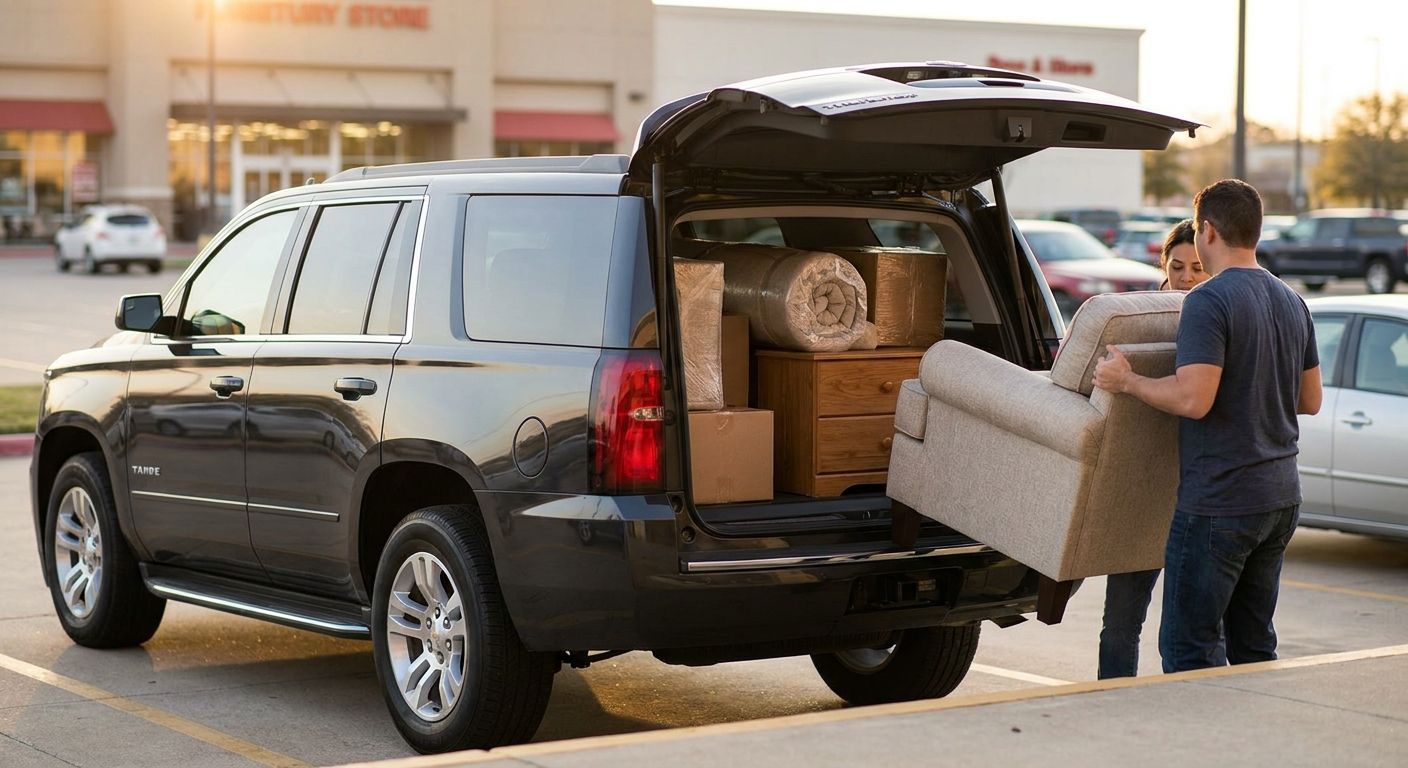
Best overall: Chevrolet Suburban. Best midsize pick: Honda Pilot. Best budget compact: Toyota RAV4. Best 3-row family hauler: Kia Telluride. Best rugged hauler: Toyota 4Runner. Best AWD wagon: Subaru Outback. If you're picking up furniture, mattresses, or gym equipment for resale in 2026 and don't own a truck, one of these six SUVs gets the job done without a trailer.
TL;DR
Furniture resale side hustles run on one constraint: getting the item from the retailer's dock or a customer's living room into your vehicle. Retailers process an ongoing stream of oversized returns in 2026 — mattresses, treadmills, sectionals, dressers — and most of that inventory needs a pickup within days or it heads to a landfill. Sharetown reps run furniture resale pickups exactly like this, and a good share of them never touch a truck bed.
A pickup truck is still the default answer, but it's not the only one. The right SUV moves a queen mattress, a loveseat, or a folded treadmill frame in a single trip, parks like a normal car, and doesn't need a tarp when it rains. Pick the wrong SUV and you're strapping a dresser to the roof rack in a downpour, which nobody wants to do twice.
Six things separate an SUV that handles furniture pickups from one that just looks big in the driveway:
None of this replaces a truck bed for a full living room set moved in one trip. It does replace one for single-item pickups, which is most of what a furniture resale route actually looks like in 2026.
Chevrolet Suburban
Honda Pilot
Toyota RAV4
Kia Telluride
Toyota 4Runner
Subaru Outback
Row order matches the sections below.
The Suburban is a full-size, body-on-frame SUV with up to 144.7 cubic feet of cargo room behind the front seats — more usable volume than most 6-foot pickup beds once you count vertical stacking under a closed roof. It's the one vehicle on this list built to swallow a sectional sofa and a coffee table in the same trip, without worrying about rain.
Chevrolet Suburban pros:
Chevrolet Suburban cons:
Best for: reps hauling multiple pieces or full households in one run.
Verdict: Buy if your pickups regularly involve more than one large item per stop.
The Pilot carries up to 87 cubic feet of cargo with the second and third rows folded flat, enough for a queen mattress laid flat or a loveseat tipped on its side. It's sized small enough to still fit in a standard driveway and a normal parking spot, which the Suburban isn't.
Honda Pilot pros:
Honda Pilot cons:
Best for: reps running a part-time furniture resale route who need one vehicle for pickups and everyday driving.
Verdict: Buy for anyone who wants a single vehicle that handles both jobs well.
The RAV4 holds roughly 69.8 cubic feet with the rear seats folded — enough for dressers, bar stools, coffee tables, and boxed lamps, but not enough for a mattress laid flat or a full sectional. It's the smallest and least expensive SUV to run on this list, which matters when fuel and maintenance eat into resale margins.
Toyota RAV4 pros:
Toyota RAV4 cons:
Best for: reps just starting out with Sharetown who want to keep vehicle costs low while testing a furniture resale route.
Verdict: Buy if your typical pickup is a single mid-size piece, not a mattress or sectional.
The Telluride offers about 87 cubic feet of max cargo space and a wider load floor than the Pilot or 4Runner, useful when a mattress needs to sit diagonally instead of flat against the seatbacks. Reps who pick up on evenings or weekends with kids in the car get a genuine third-row seating option without switching vehicles for the day.
Kia Telluride pros:
Kia Telluride cons:
Best for: reps who need one SUV for both furniture pickups and family duty.
Verdict: Buy if a dedicated hauling vehicle isn't in the budget and the SUV needs to earn its keep twice.
The 4Runner's body-on-frame construction and roughly 89.7 cubic feet of cargo space with the rear seats folded make it the pick for estate sales and rural pickups down gravel or dirt driveways where a lower crossover would scrape its bumper. Ground clearance and available part-time 4WD matter more here than raw cargo volume.
Toyota 4Runner pros:
Toyota 4Runner cons:
Best for: reps whose pickups regularly include rural addresses, estate sales, or unpaved driveways.
Verdict: Hold unless rough-terrain pickups are a regular part of the route — a crossover does the job for less otherwise.
The Outback carries about 75.7 cubic feet with the rear seats down — less than the midsize SUVs above, but standard all-wheel drive and a lower loading height make it the easiest vehicle on this list to load in bad weather. It behaves more like a tall wagon than a true SUV, which also helps fuel economy.
Subaru Outback pros:
Subaru Outback cons:
Best for: reps working snow-belt or rainy climates who prioritize traction over raw cargo volume.
Verdict: Buy for cold-climate routes where dependable AWD matters more than maximum cargo space.
Each SUV was scored against the six criteria above: max cargo volume with seats folded, load floor flatness, liftover height, roof rack capacity, and ground clearance or AWD for tougher routes. No two vehicles on this list compete for the same use case — the Suburban owns full-room hauls, the RAV4 owns budget single-item pickups, the Outback owns bad-weather routes. It reads as a decision tree based on what you actually haul, not a single leaderboard where one SUV wins everything.
If you're not sure where to start, the Honda Pilot is the safest default for 2026 — enough cargo room for most single-item pickups, a manageable size for daily driving, and available AWD for bad weather. Step up to the Chevrolet Suburban the moment your pickups regularly involve more than one large piece per stop. Stay with the Toyota RAV4 if fuel and vehicle costs matter more than maximum cargo volume right now, and lean on the Subaru Outback if your routes run through snow more months than not.
None of these six replace a pickup truck or a cargo van for a full-time hauling operation. They replace one for Sharetown reps doing single-item retail returns and resale runs, which covers most of what a furniture resale side hustle actually requires in 2026.
Start hauling returns for profit
Sharetown connects reps with retailer pickups you can run from an SUV.
What is the best SUV for hauling furniture without a truck?
The Chevrolet Suburban is the best SUV for hauling furniture in 2026 thanks to its 144.7 cubic feet of max cargo space. For smaller budgets or daily driving, the Honda Pilot or Toyota RAV4 handle single-item pickups just as well.
Can an SUV replace a pickup truck for furniture pickups?
An SUV replaces a pickup truck for single-item pickups like a mattress, dresser, or loveseat, especially in bad weather since the cargo area stays dry. It doesn't replace a truck bed for hauling multiple bulky pieces or items too long to fit with the tailgate closed.
Will a queen mattress fit in an SUV?
A queen mattress fits flat in SUVs with roughly 85 cubic feet or more of max cargo space, like the Honda Pilot or Kia Telluride. Smaller SUVs like the Toyota RAV4 usually require folding the mattress or angling it diagonally.
Is a minivan better than an SUV for hauling furniture?
A minivan often has a lower, wider cargo opening than an SUV, which can make loading heavy furniture easier on your back. SUVs typically win on ground clearance and available AWD, which matter more for rural or winter pickups.
How much cargo space do I need to haul furniture in an SUV?
Most single-item furniture pickups need at least 70 cubic feet of max cargo space with the rear seats folded. Full room hauls or sectional sofas call for 85 cubic feet or more, which is where the Chevrolet Suburban and similar full-size SUVs come in.
Does an SUV need AWD to haul furniture?
AWD isn't required for hauling furniture, but it helps on wet, snowy, or gravel routes where traction matters more than raw cargo space. The Subaru Outback and Kia Telluride both offer AWD as an option for exactly that reason.
What size SUV works best for a furniture resale side hustle?
A midsize SUV like the Honda Pilot balances cargo space, fuel costs, and everyday drivability for most furniture resale side hustles. Full-size SUVs like the Chevrolet Suburban make more sense once pickups regularly involve more than one large item.
How much weight can an SUV cargo area hold?
Cargo weight limits vary by model and are listed on the driver's door jamb sticker, not the cargo volume spec. Check that rating before loading heavy furniture like a solid wood dresser or a weight bench to avoid overloading the rear suspension.
On several full-size SUVs, including the Suburban, the second-row seats fold to a stepped floor rather than a perfectly flat one — check the spec sheet before assuming a mattress will lie level all the way to the tailgate. A cheap cargo mat or a folded moving blanket closes that gap in under a minute and saves the mattress cover from a rub mark on the drive home.