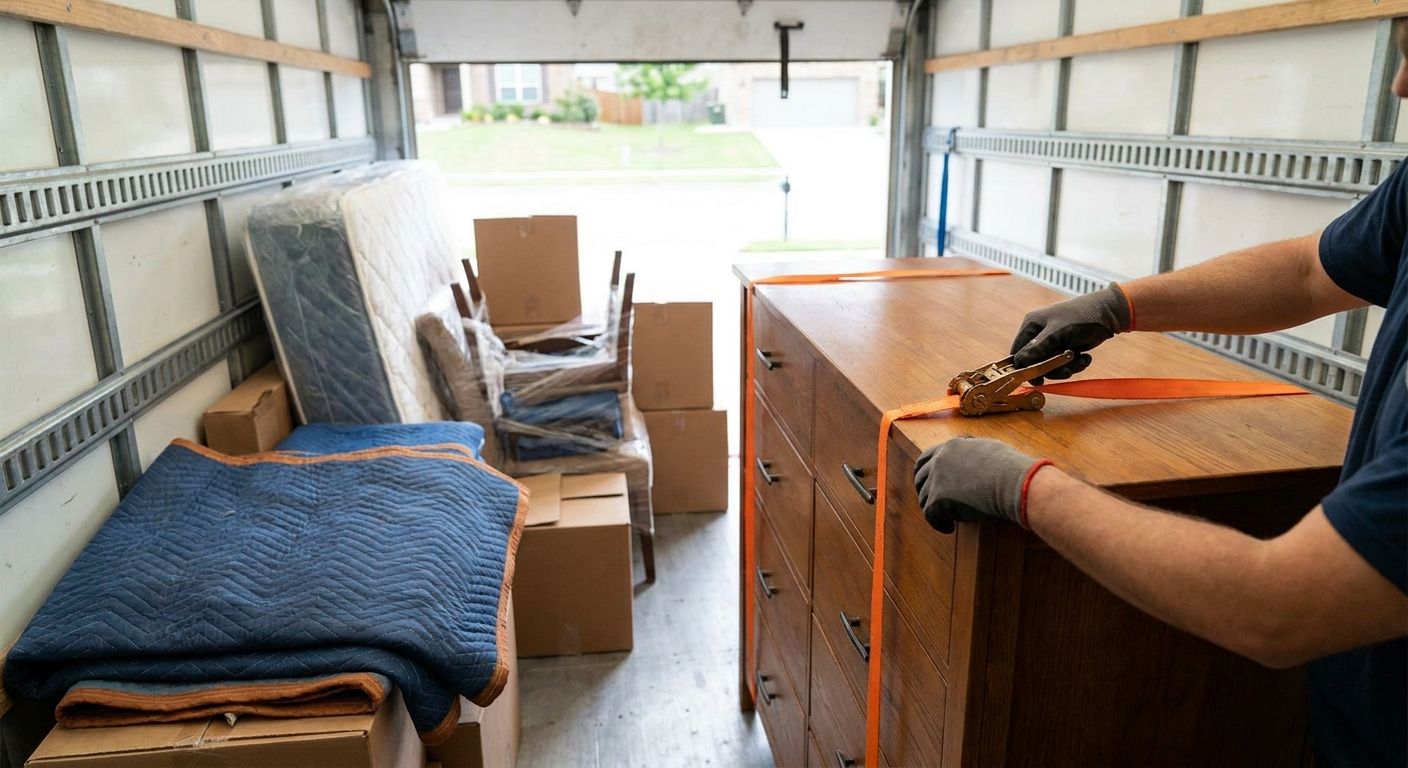
Straps that look tight in the driveway can be dangerously loose by mile 20 — vibration, heat, and cornering all work against you. Knowing how to strap down furniture for transport correctly is the difference between a clean pickup and a cracked headboard, a scratched truck bed, or worse, a piece flying loose on the highway.
TL;DR
A loose strap doesn't just risk the furniture — it risks a ticket, a lawsuit, or a piece of someone else's property on a windshield behind you. Most states treat unsecured cargo as a moving violation, and insurance claims for road debris caused by furniture falling from a truck bed are not rare in 2026.
For anyone picking up and reselling bulky items — mattresses, dressers, recliners, dining sets — a bad strap job also means damaged inventory before it ever reaches a buyer. A dented dresser corner or a torn recliner arm cuts straight into resale margin. Getting the tie-down right the first time protects both the load and the payout.
Ratchet straps beat cam buckle straps for anything heavier than a dining chair. Cam straps hold tension fine on light loads, but they creep under vibration once you're carrying a dresser or a loaded bookshelf. If you're building a hauling kit from scratch, the best moving straps for hauling furniture solo breaks down which strap types hold up over repeated pickups versus the ones that fray after a few uses.
Position the furniture flush against the truck bed's front wall, the trailer nose, or the van's bulkhead before you touch a strap. This gives the load a fixed point that absorbs forward momentum during braking, instead of relying on straps alone to stop 150+ lbs of dresser.
Common mistake: loading the heaviest piece last and wedging it in the middle, with nothing solid in front of it.
Wrap moving blankets around corners, drawer fronts, and any spot where the piece touches metal — the truck bed rail, another item, or the strap itself. Furniture edges without padding chip against ratchet buckles within the first few miles on rough pavement.
Expected outcome: no metal-on-wood or wood-on-wood contact anywhere on the load.
This is the step most people get wrong. Loop straps through solid frame points — table legs, bed rails, dresser bases — never just around upholstery or cushions. A strap cinched around fabric alone will slide right off the frame the first time the truck hits a pothole.
For mattresses specifically, the strap needs to anchor to the frame or headboard support, not just wrap the mattress itself. The how to load a mattress into a pickup truck safely guide covers the mattress-specific anchor points in more detail, since a mattress has no rigid frame to loop around.
Run at least two straps in an X pattern over and around the piece, anchoring to opposite sides of the truck bed or trailer. A single strap pulled straight down lets the load rock side to side on turns — crisscrossing kills that lateral movement.
Tighten each strap until there's less than 1 inch of play when you push on the piece. Over-tightening on soft furniture can crush cushions or crack veneer, so stop at firm, not white-knuckle tight.
Before you pull out of the driveway, grab the furniture with both hands and shake it hard in every direction — forward, back, side to side. Anything that shifts more than an inch needs another strap or a tighter cinch. This 30-second check catches loose points that are invisible just by looking at the straps.
Slide foam sleeves or extra padding over any strap section that rubs against a finished surface. Ratchet buckles left bare against a wood tabletop will scuff or gouge it over a 45-minute drive.
Straps loosen fast in the first 15-20 minutes as padding compresses and the load settles. Pull over after the first few miles and re-tighten every strap, then check again roughly every 50 miles on longer hauls. Heat from the road and constant vibration both work the ratchet mechanism loose over time.
Turn hauling skills into income
Pick up, strap down, and resell retailer returns in your area.
The furniture shifts on turns even with straps tight. You likely have straps running vertically instead of crisscrossed — add a diagonal strap to kill lateral movement, not just downward pressure.
A ratchet strap keeps slipping loose mid-drive. The webbing may be worn or the ratchet mechanism damaged — replace the strap rather than doubling up tension, since a compromised ratchet can fail without warning.
Fabric or upholstery gets cut where the strap sits. The strap edge is too sharp against soft material — add a folded moving blanket or foam sleeve between the strap and the upholstery.
A mattress balloons or shifts in wind at highway speed. Mattresses catch wind like a sail when strapped flat in an open bed — strap it on its side against the cab or trailer wall instead of laying it flat.
Drawers slide open during transport. Tape drawer fronts shut or remove drawers entirely before loading, since even a tight overall strap won't stop an unsecured drawer from sliding on braking.
Straps loosen noticeably after 30-40 minutes. This is normal as padding compresses — build a tension recheck into your route instead of treating the first cinch as final.
Strapping is one piece of a bigger hauling process — the load quality, the vehicle setup, and how you lift matter just as much as the tie-down. If your back is taking a beating on pickup day, the how to protect your back when lifting heavy furniture guide covers lifting form that prevents the injuries that end hauling side hustles early.
What's the best way to strap down furniture for transport?
Ratchet straps run through the furniture's frame in a crisscross pattern, anchored to opposite sides of the truck bed, is the most reliable method in 2026. Cam buckle straps work for lighter items but creep loose under vibration on anything heavier than a chair.
How many straps do I need for one piece of furniture?
Use a minimum of two straps in a crisscross pattern for small to medium furniture, and four straps for large pieces like dressers or sectionals. More anchor points reduce the chance of any single strap failing.
Is it safe to strap furniture directly to fabric or cushions?
No — straps need to loop through a solid frame point, not fabric or upholstery. Fabric alone will let the strap slide off the piece once the truck hits a bump or turn.
How tight should furniture straps be?
Tight enough that the piece moves less than 1 inch when pushed by hand, but not so tight that cushions compress or veneer cracks. The shake test before driving is the fastest way to confirm tension.
Do I need to re-tighten straps during a long drive?
Yes — recheck tension after the first few miles and roughly every 50 miles after that. Padding compresses and ratchet mechanisms loosen from road vibration and heat.
Can I strap a mattress flat in an open truck bed?
Flat mattresses catch wind like a sail at highway speed and can shift or lift. Standing the mattress on its side against the cab or trailer wall and strapping it there is safer for transport.
What straps should I avoid for heavy furniture?
Avoid cam buckle straps and anything rated under 500 lbs working load for pieces over 75-100 lbs. Bungee cords are not a substitute for rated cargo straps on furniture transport.
How much does it cost to properly strap down furniture for a haul?
A basic kit of four ratchet straps and a set of moving blankets runs under $60 in 2026, and the gear is reusable across dozens of pickups.
The shake test catches more failed tie-downs than any visual check — a strap can look perfectly taut and still let a dresser rock 2 inches side to side if it's anchored to the wrong point. Thirty seconds of shaking the load before you drive away costs nothing and prevents the damage that turns a resale item into a write-off.