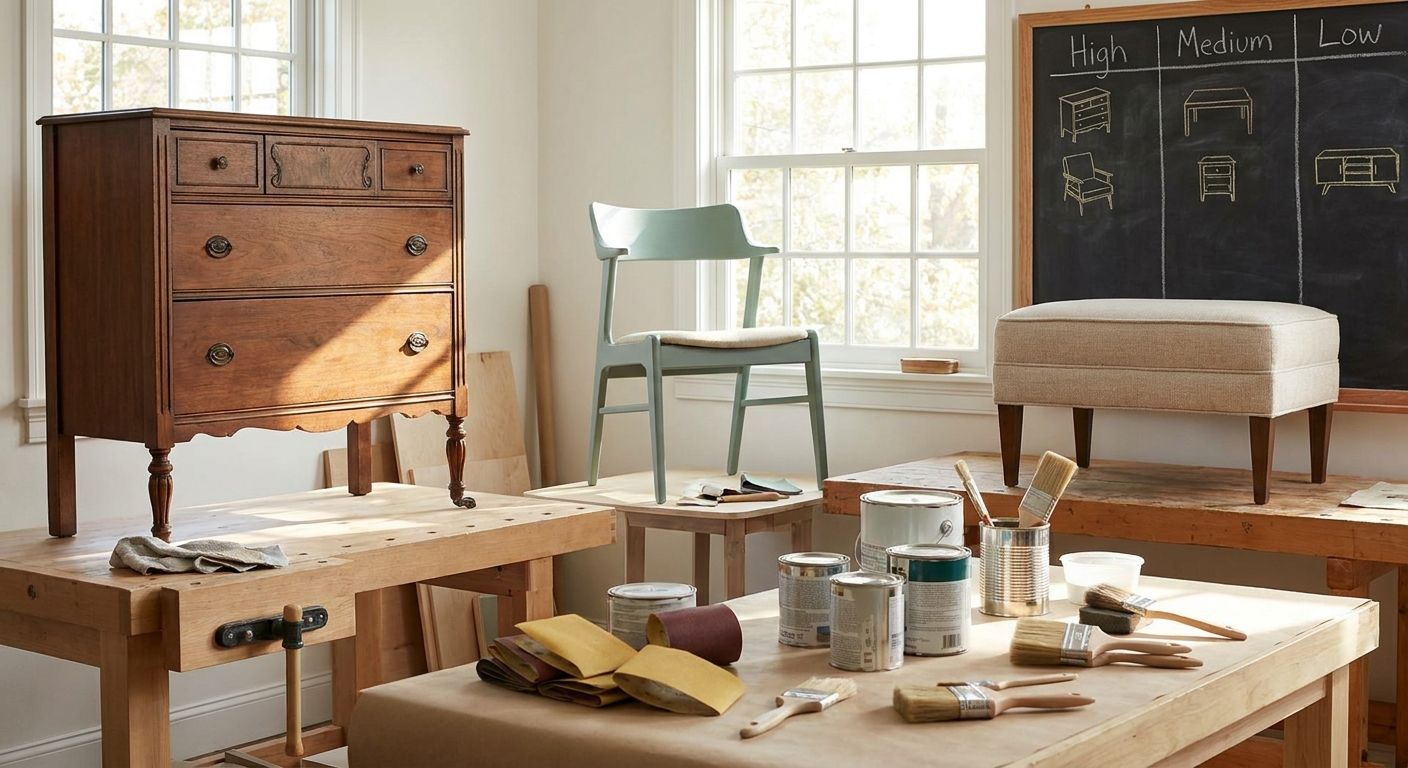
Furniture flipping side hustles aren't all the same trade dressed up differently — margin swings hard depending on what you pick up, refinish, and resell. This guide ranks seven furniture flipping side hustles by profit margin so you know which category rewards your time in 2026, not just which one looks good on Instagram.
TL;DR
Most lists of "best furniture to flip" rank by how easy an item is to find, not by what it actually pays after acquisition cost, cleanup time, and resale friction. That's backwards if you're doing this as a side hustle in 2026 and your hours are limited.
Margin is the number that tells you whether a flip was worth the truck trip. If you haven't run the math on a recent flip, how to calculate profit margin on a furniture flip walks through the formula before you read the rankings below — it changes how you read every item on this list.
The categories below aren't hypothetical. They're pulled from real flipping patterns: retailer returns, estate sales, curb finds, and liquidation lots that independent resellers work through every week.
A furniture flipping side hustle earns a spot near the top of this ranking when it scores well on:
Antique furniture
China cabinets
Recliners
Sectional sofas
Dressers & nightstands
Bar stools
Bookshelves
Antique furniture tops this ranking because the ceiling on resale value is set by rarity and craftsmanship, not by what a retailer paid for it new. A solid-wood dresser from the 1940s with dovetail joints resells for far more than a comparable piece of particleboard furniture from this decade, and the acquisition cost is often close to zero at estate sales.
Antique furniture pros:
Antique furniture cons:
Getting this category right starts with flipping antique furniture for profit, which covers how to tell real age from a reproduction before you commit a truck trip to it.
Verdict: Buy — highest margin on this list, but only if you're willing to learn the authentication side.
China cabinets sit near the top because they're consistently underpriced by sellers who just want them gone, and resale demand from buyers furnishing dining rooms stays steady year-round.
China cabinet pros:
China cabinet cons:
Verdict: Buy — strong margin, but only if you have a garage or storage unit to hold inventory.
Recliners rank third because retailer return channels supply a steady stream of them, and most defects are cosmetic rather than structural.
Recliner pros:
Recliner cons:
Verdict: Buy — reliable margin if your sourcing pipeline includes retailer returns rather than random curb finds.
Sectional sofas pay well per flip because the resale price reflects a full living room set, not a single chair — but you need the hauling capacity to make it work.
Sectional sofa pros:
Sectional sofa cons:
Verdict: Buy — strong margin per flip, but only with the transport capacity to move it in one piece.
Dressers and nightstands rank as the best entry point because the refinishing skill floor is low — sanding, priming, and a fresh coat of paint turns a dated piece into a sellable one in a weekend.
Dresser & nightstand pros:
Dresser & nightstand cons:
Start here if you're new: how to flip dressers and nightstands for profit covers the refinishing steps that make the biggest difference in resale price.
Verdict: Buy — lower ceiling than antiques or cabinets, but the easiest category to start profitable in 2026.
Bar stools rank lower on margin because per-unit profit is thin, but they're the only category on this list you can flip without ever renting or borrowing a truck.
Bar stool pros:
Bar stool cons:
Verdict: Hold — fine as a side category, weak as your main flip if margin is the goal.
Bookshelves round out the ranking with the fastest turnover and the thinnest margin — buyers negotiate hard because bookshelves are treated as a commodity.
Bookshelf pros:
Bookshelf cons:
Verdict: Skip unless you're already running volume through a route and need filler inventory.
Start earning as a Sharetown Rep
Pick up retailer returns near you and resell them for profit.
Each category above was scored against the six criteria listed earlier — acquisition cost, refinishing effort, demand consistency, transport difficulty, turnover speed, and damage risk. Antique furniture and china cabinets scored highest because acquisition cost stays low while resale ceiling stays high. Bar stools and bookshelves scored lowest on margin despite scoring well on turnover speed, which is exactly why volume-only categories don't automatically win a profit-margin ranking.
The same logic holds outside furniture. Resellers who branch into adjacent categories — collectibles, electronics, even flipping refurbished retro consoles — apply the identical acquisition-cost-versus-resale-ceiling math that puts antique furniture at the top of this list.
If you want the highest margin per flip in 2026 and don't mind a learning curve, antique furniture wins. If you're storage-limited but want strong margin without the authentication work, china cabinets are the safer pick. If you're brand new to reselling and want fast wins to build confidence, dressers and nightstands are the default recommendation — low skill floor, steady demand, and enough margin to reinvest into bigger categories once you've got a system running.
What is the best furniture flipping side hustle for profit margin in 2026?
Antique furniture posts the highest profit margin among furniture flipping side hustles in 2026 because acquisition cost stays low relative to resale value for authenticated pieces. China cabinets rank second for reps with storage space to hold inventory.
Is flipping dressers better than flipping sectional sofas?
Dressers earn less per unit than sectional sofas but require less transport capacity and refinishing skill, making them the better starting category for beginners. Sectional sofas pay more per flip but need a truck or trailer and usually two people.
How much does it cost to start a furniture flipping side hustle?
Startup cost varies by category and sourcing method rather than a fixed number, since acquisition cost depends on whether you're buying from estate sales, retailer returns, or curb finds. The lower the acquisition cost relative to resale value, the higher the margin.
Do I need a truck to flip furniture for profit?
No — bar stools, dressers, and nightstands can be flipped using a sedan or hatchback, but bulkier categories like sectional sofas and china cabinets require a truck or trailer. Transport capacity directly limits which categories on this ranking are realistic for you.
What furniture sells fastest when flipping for profit?
Bookshelves and bar stools turn over the fastest because demand is broad and buyers don't need to coordinate delivery logistics for a large piece. Fast turnover doesn't always mean the best margin, though — those two categories rank lowest on profit per unit.
Are retailer returns a good source for furniture flipping?
Yes — retailer returns supply a consistent pipeline of recliners, dressers, and sectionals with mostly cosmetic rather than structural damage. This channel reduces the sourcing time that eats into margin when you're hunting curb finds or estate sales instead.
Can furniture flipping become a full-time income in 2026?
Furniture flipping scales when a reseller moves from single-item flips to a repeatable route with consistent sourcing, storage, and resale channels. The transition depends on volume and systems more than which single furniture category you start with.
The categories at the bottom of this ranking — bar stools, bookshelves — aren't bad side hustles. They're bad primary hustles if margin is your goal. Run them as filler inventory alongside a higher-margin category like antique furniture or china cabinets, and you get both the fast cash flow of quick-turning items and the real profit of the slower, higher-ceiling pieces.